The Royal Theatre, Holborn
The Picture of Dorian GrayThe Royal Theatre, Holborn, a shabby and disreputable venue in the East End of London, serves as the unlikely stage for the novel's most intense romantic drama and its most devastating emotional collapse. It is here that Dorian Gray, newly awakened by Lord Henry Wotton's doctrines of sensation and beauty, first encounters the actress Sibyl Vane, and here that he destroys her—and, in doing so, seals the supernatural bargain that will govern the rest of his life. The theatre is not merely a setting but an active agent in the plot: its tawdriness throws into relief the transcendent art it briefly houses, and its squalid reality becomes the measure of Dorian's moral descent.
Appearance and Atmosphere
The Royal Theatre is described as a "little third-rate theatre" with "great flaring gas-jets and gaudy play-bills." Its manager is a "hideous Jew" with greasy ringlets and an enormous diamond blazing in the centre of a soiled shirt, who greets patrons with "gorgeous servility." Inside, the house is a "tawdry affair, all Cupids and cornucopias, like a third-rate wedding-cake." The gallery and pit are fairly full, but the two rows of dingy stalls are empty, and the dress-circle is nearly deserted. Women sell oranges and ginger-beer, and the audience consumes nuts with terrible industry. The orchestra is dreadful, presided over by a young Jew at a cracked piano. The scenery looks as if it had come out of a pantomime of fifty years earlier. This is the world in which Dorian Gray, guided by Lord Henry's philosophy of the search for beauty as "the poisonous secret of life," chooses to seek his adventure.
Dorian's First Encounter with Sibyl Vane
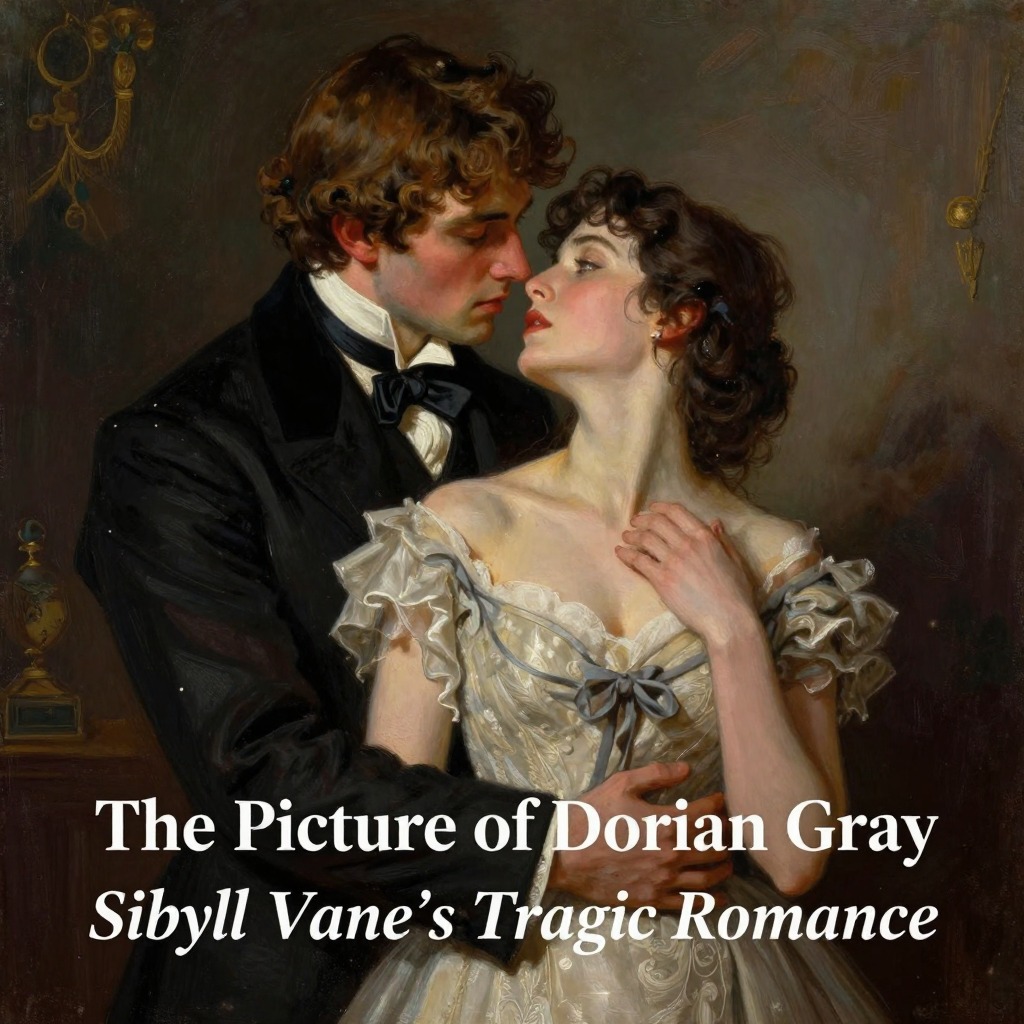
On the evening of his first visit, Dorian pays a whole guinea for a stage-box, a decision he later cannot explain but which he recognizes as fateful. The play is Romeo and Juliet. Romeo is played by a stout elderly gentleman with corked eyebrows and a figure like a beer-barrel; Mercutio, by a low-comedian who introduces his own gags. But Juliet—Sibyl Vane—is a revelation. Dorian sees a girl of hardly seventeen, with a little flower-like face, a small Greek head with plaited coils of dark-brown hair, eyes that are "violet wells of passion," and lips like the petals of a rose. Her voice, low at first with deep mellow notes, rises to the wild passion of violins. Dorian is so moved that he can hardly see her through his tears. After the performance, the manager offers to bring him behind the scenes, but Dorian refuses, telling him that Juliet has been dead for hundreds of years. He returns night after night, watching her transform into Rosalind, Imogen, and all the great heroines of Shakespeare. On the third night, he finally consents to go behind the scenes, and there meets Sibyl, who is shy, gentle, and childlike. She tells him simply, "You look more like a prince." Their romance begins.
The Fatal Performance
The crucial event at the Royal Theatre occurs on the night Dorian brings Basil Hallward and Lord Henry to see Sibyl perform Juliet. The house is crowded, and the fat Jew manager is beaming. But Sibyl's acting is a catastrophe. She speaks her lines in a "thoroughly artificial manner," her voice exquisite but absolutely false in tone. The balcony scene is declaimed with the painful precision of a schoolgirl taught by a second-rate professor of elocution. Even the common audience grows restless, begins to talk loudly and whistle. The manager stamps and swears. Only Sibyl herself seems unmoved. Lord Henry declares she cannot act and proposes they leave. Basil suggests she may be ill. Dorian, pale and bitter, insists on staying through the play, which drags on to almost empty benches. The performance is a complete fiasco.
The Rejection and Its Aftermath
After the play, Dorian rushes behind the scenes to the greenroom. Sibyl is standing alone, transfigured with joy. She tells him that before she knew him, acting was the one reality of her life; she believed in the shadows. But he freed her soul from prison and taught her what love really is. "I am sick of shadows," she says. "You are more to me than all art can ever be." Dorian, however, is cold and brutal. "You have killed my love," he tells her. He accuses her of being shallow and stupid, of having spoiled the romance of his life. He leaves her weeping on the floor. The next morning, Lord Henry brings Dorian the news that Sibyl Vane is dead. She swallowed something by mistake—prussic acid, Lord Henry believes—and died instantaneously in her dressing-room. An inquest is held at the Bell Tavern on Hoxton Road, and a verdict of death by misadventure is returned. The Royal Theatre, Holborn, thus becomes the site not only of love's birth and death but of the first direct consequence of Dorian's wish: the portrait has already changed, showing a touch of cruelty around the mouth, before Dorian even learns of Sibyl's suicide.