Alvin’s artificial leg
The Plot Against AmericaAlvin’s artificial leg makes the consequences of Alvin Roth’s wartime injury tangible: it offers a way to walk, but a poor fit turns that promise into pain and repeated risk. Its story is not simply one of replacement or recovery. The prosthesis must be learned, maintained, and adapted to Alvin’s body and clothes, while Philip Roth’s growing attention to those practical needs becomes a form of care.
Injury, fitting, and failure
Alvin returns to Newark after volunteering to fight the Germans with his left leg amputated below the knee. His family initially understands that he has been fitted with an artificial leg, but when he comes home to convalesce, the device is not carrying him. Asked why he has been discharged without walking on it, he explains that the stump has broken down. The blunt phrase describes a physical failure, not a lack of will: the stump opens, cracks, and becomes infected, with boils, sores, and swelling. It cannot bear the prosthesis, so Alvin has to go without it and rely on crutches until the tissue heals.
The trouble lies in the fit. Alvin rejects the suggestion that he has somehow lost a fit he once possessed; he says the legmaker never measured him correctly in the first place. A device intended to restore mobility instead presses on a stump that cannot tolerate it. For a time, the artificial leg stays at the back of a clothes closet, partly hidden behind shoes and hanging trousers. Its absence from use is also a presence in the room: Philip knows it is there but does not yet understand what it is made of or how Alvin will manage with it.
What the prosthesis is made to do
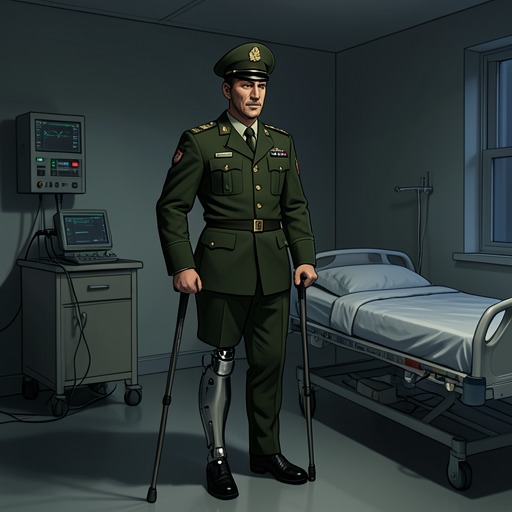
When Alvin finally takes the leg out, its construction proves more intricate than Philip had imagined. A dark leather harness laces up the front and extends from below the buttock to the top of the kneecap. Hinged steel joints on either side of the knee connect the harness to the prosthesis. Alvin’s stump, covered in a long white woolen sock, fits into a cushioned socket carved into the top of the hollowed wooden leg, whose air holes puncture the wood. At the bottom, an artificial foot flexes only a few degrees and rests on a sponge sole; it screws into the leg without visible hardware.
The foot looks more like a wooden shoetree than a living foot with separate toes. Yet once Alvin puts on socks and shoes, the assembled pair can pass for his own. The contrast is central to the object: it has a conspicuously constructed interior and a carefully concealed exterior. The leg does not simply reproduce a lost limb. It is a fitted mechanism, joined to Alvin’s body through a socket, harness, and hinges, and its usefulness depends on the soundness of that fit.
Learning to walk again
Alvin’s return to the prosthesis begins within strict limits. On the first day he walks back and forth in the alley, from the garage to the hedge around the tiny front yard, stopping short of the street where passersby might see him. The next day he exercises alone in the morning, then takes Philip outside for another session after school. He concentrates on walking while trying not to dwell on the condition of the stump, the fit of the leg, or the long future of living on one artificial limb.
The practice expands gradually. The following week Alvin wears the leg around the house all day; the week after, he asks Philip to get a football. They have none, so Philip steals a worn leather Wilson football from a driveway on Keer Avenue. The two spend close to an hour practicing passes in the alley. Alvin throws left-handed spirals and puts nearly all his weight on the artificial limb; afterward, he and Philip examine the stump and find no sign that it is breaking down. The episode gives the leg a test beyond cautious walking, though it does not erase the uncertainty of whether the stump can continue to withstand pressure.
As the stump heals, Philip takes over its nightly bandaging, first practicing on himself and then becoming skilled enough to avoid wraps that are too loose or too tight. Even after Alvin resumes walking regularly on the prosthesis, Philip continues bandaging the stump to prevent the swelling from returning. The object’s use therefore depends on work done around it as well as on the device itself: healing, monitoring, and restraint are part of mobility.
Adapting ordinary life
Over the following weeks Alvin’s use of the leg becomes less confined. He moves around the neighborhood without the crutches or cane he finds humiliating in public, shops for Philip’s mother at the butcher’s, bakery, and vegetable store, buys a hot dog, and takes buses to the dentist and to Market Street. His wheelchair is eventually put away in a storage bin. The change is substantial, but daily dressing remains difficult: getting trousers over the prosthesis can make Alvin curse in frustration.
Philip notices the problem and suggests a practical alteration. Bess Roth takes a pair of Alvin’s army trousers to a neighborhood seamstress, who opens the left side seam and inserts a zipper extending about six inches up the pant leg. The zipper lets the fabric pass over the prosthesis and closes out of sight. Philip then helps arrange for Alvin’s other trousers to be altered in the same way. This small modification changes the relation between the artificial leg and ordinary clothing: rather than forcing Alvin to struggle with an unadapted garment, the garment is changed to accommodate the device.
Care, dependence, and the object’s significance
The prosthesis marks a change in Philip’s relationship with Alvin. Philip becomes a regular attendant—bandaging the stump, fetching and handing over the leg, and helping make dressing easier. His care is not abstract sympathy but repeated attention to pressure, swelling, fastenings, and the discomfort of everyday movement. Alvin, in turn, tells Philip that he could not manage putting on his trousers without him and gives him the Canadian medal awarded for performance under exceptional circumstances. Philip keeps it pinned out of sight beneath his undershirt, a private sign of the bond formed through practical assistance.
The artificial leg brings disability into the detail of household life rather than resolving it as a single act of medical repair. Its initial misfit makes the body’s vulnerability impossible to ignore; its wooden construction and leather-and-steel supports show how much adaptation walking requires. Even when Alvin is moving across Newark again, the stump must be watched, the device must fit, and clothing must be altered. Its significance lies in that continuing negotiation: the leg enables new movement, while its limits and the care surrounding it remain part of Alvin’s life and of Philip’s growing devotion to him.