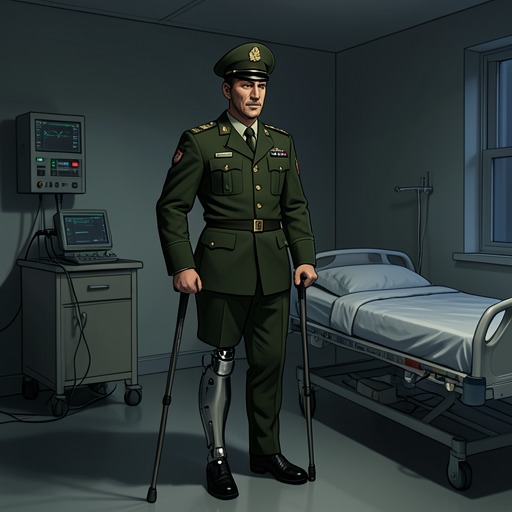
Alvin’s return from Montreal to Newark
The Plot Against AmericaAlvin Roth’s return from Montreal to Newark brings a wounded veteran back into the family at the moment when the political divisions shaping the household can no longer be kept at a distance. At Newark Penn Station, the reunion is at once an embrace and an encounter with what war has done to Alvin’s body. Through Philip Roth’s anxious childhood perspective, the scene also connects physical disability to secrecy, fear, and the difficulty of learning how to look at another person.
Discharge and the Journey Home
Alvin Roth had been discharged in January 1942 after a long rehabilitation in Canada. He had first given up his wheelchair and then his crutches, and Canadian army nurses had trained him to walk unassisted on his artificial limb. His discharge came with a monthly disability pension of $125, a little more than half of Herman Roth’s monthly earnings from the Metropolitan Life Insurance Company, as well as $300 in separation pay. As a foreign volunteer who had served in the Canadian forces, Alvin could also receive Canadian citizenship immediately upon discharge if he chose to stay.
Uncle Monty treated that possibility as an obvious alternative to coming home. He asked why Alvin did not remain in Canada and collect the benefits, especially since, in Monty’s view, Alvin could not stand America. The question brought economic calculation into a decision freighted with family and national loyalties: the pension and citizenship were real options, but Alvin returned to Newark rather than settling across the border. Monty’s bluntness suited his forceful manner. A prosperous wholesaler who had built a fortune in the Miller Street market, he was accustomed to judging choices by their practical returns; his challenge made Alvin’s return seem, to him, needlessly costly.
Nearly a year after Charles A. Lindbergh took office, Alvin arrived on an overnight train from Montreal, accompanied by a Canadian Red Cross nurse. He was missing half of one leg. The family drove downtown to meet him, as they had gone to meet Sandy Roth the previous summer, but this time Sandy was with them. The arrival thus joined two changes in the family’s life: Alvin was coming home from rehabilitation, while Sandy had become involved in a program promoted by the administration that Herman Roth opposed.
Secrets on the Platform
Before Alvin came back, Herman and Bess Roth decided that he should not immediately be told about Sandy’s work with Just Folks. Sandy had been speaking to congregations about his Kentucky experience and encouraging families to enroll their children; Herman and Bess planned to explain his work only after Alvin had settled in and had time to understand how America had changed. Their stated purpose was not to lie to Alvin but to protect his recovery from anything that might interfere with it. The care was sincere, but it also meant that the returning veteran was being ushered into a household where political realities had been temporarily withheld from him.
The train was late, and Herman passed the wait reading the Daily News, a right-wing tabloid he usually called a “rag.” He discarded it after reading, despite a household in which nickels and dimes mattered. His complaint was that the paper still treated Lindbergh as a hero. The narrator notes that, having kept the country out of the worldwide war as promised, Lindbergh had become a hero to almost every newspaper except PM. The newspaper at the station therefore makes the family’s political conflict part of the reunion’s setting: even before Alvin appears, the wait is filled by the public argument Herman cannot set aside.
When the train finally came in, Bess prompted the family toward the platform. Herman took Philip Roth by the shoulders and urged him not to be afraid of Alvin or his leg, but to let Alvin see how much he had grown. Sandy was the first to break away, racing toward the arriving car. The narrator understood that Sandy had been won over to the other side, yet watched him approach Alvin with the force of family affection. At fourteen, Sandy was now as strong as a young man of twenty; he dropped to his knees on the concrete so he could throw his arms around Alvin’s neck. Bess began to cry, and Herman took Philip by the hand, whether to steady his son or himself.
Philip then ran to Alvin and copied Sandy’s embrace. The closeness brought an immediate physical reaction: Alvin smelled bad, and Philip first assumed the odor came from his leg before realizing it came from his mouth. He held his breath and shut his eyes, letting go only when Alvin leaned forward to shake Herman’s hand. The reunion is not rendered as uncomplicated tenderness. The child’s impulse to embrace Alvin collides with sensory discomfort and fear, and the adults’ efforts to welcome him coexist with the visible consequences of his injury.
The Body Seen by a Child
Alvin was pushed off the train in a wheelchair by the Red Cross nurse, with wooden crutches strapped to its side. Although his rehabilitation had prepared him to walk without assistance, the arrival presents him in the chair; the account does not explain the difference between that journey and his trained ability. Philip’s first direct look finds Alvin skeletal and dejected. His eyes show neither fear nor tears, and he surveys Herman with such ferocity that the child imagines the guardian as the person responsible for making his ward a cripple. Alvin says only Herman’s name. Herman answers that he is there, that he is home, and that they are taking him home; Bess bends to kiss him, and Alvin addresses her as Aunt Bess.
The empty left trouser leg, falling straight from the knee, gives Philip a sight that is familiar to adults but startling to him. His memory turns to a man he had seen begging outside Herman’s downtown insurance office: a legless man who moved on a small plywood platform fitted with roller skates, wore heavy weatherbeaten gloves to protect the hands he used for movement, and called out baseball scores in a deep voice. The scores brought coins from men leaving the office, dropped into the battered laundry pail he used as an alms box. Philip recalls that Herman and the man greeted each other by name, though Herman did not know the man’s surname. The ordinary name Robert, like Philip’s own, had made the stranger’s bodily difference harder for the child to dismiss as something remote.
The recollection does not make Philip comfortable with Alvin’s injury. He remembers having been too frightened to look long enough to register the beggar’s clothes, and describes the prospect of a disabled person living in the family home as something he had never needed to consider before. The station scene therefore sets two forms of looking against one another: Herman’s familiar greeting of Robert, and Philip’s startled scrutiny of Alvin. The child’s description dwells on smell, missing limbs, and the shock of seeing, while Alvin’s own guarded silence and fierce gaze resist being reduced to the injury that has brought him home.
Reunion and Return
The station brings together affection, injury, and the political concealments surrounding Alvin’s homecoming. Sandy’s embrace is especially charged because he has committed himself to Just Folks, the very development the family has chosen not to disclose yet. Herman’s welcome, meanwhile, is both direct and protective: he insists that Alvin is home while trying to prepare Philip for the sight of his cousin. Bess’s tears and kiss give the reunion a tenderness that Alvin’s sparse words do not express in the same way.
The return also complicates the idea of rehabilitation as a simple passage from injury to restored independence. Alvin has learned to walk on an artificial limb and has left the wheelchair and crutches behind during his recovery, yet he arrives pushed from the train in a wheelchair, still visibly marked by what happened to him. The family’s welcome does not erase that difference, and Philip’s fear does not cancel his attempt to embrace him. By letting both responses remain in view, the episode makes homecoming less a neat resolution than the beginning of a difficult adjustment—for Alvin, for the family, and for the child who must learn to see the person and the injured body together.