Burton K. Wheeler
The Plot Against AmericaBurton K. Wheeler is a Montana politician whose changing alliances help make Charles A. Lindbergh’s isolationist government appear bipartisan, then place him at its head when Lindbergh disappears. As acting president, Wheeler invokes constitutional authority to assume the office, but his declaration of emergency is followed by martial law, political arrests, and the suppression of dissent. His tenure lasts only eight days before Congress and the courts dismantle his administration; Franklin D. Roosevelt later pardons him for offenses committed during that period.
Political Background and Changing Alliances
Wheeler’s career begins on the political left. He had represented radical labor leaders in Butte and opposed Anaconda Copper, a mining company that held considerable power in Montana. An early supporter of Franklin D. Roosevelt, he was suggested as Roosevelt’s vice-presidential candidate in 1932. His later political course moved sharply away from that position: in 1924 he left the Democratic Party to join Wisconsin reformers on the union-supported Progressive Party ticket, then abandoned the non-Communist American left and joined Lindbergh and other right-wing isolationists in founding the America First Committee.
The change mattered beyond Wheeler’s own career. His antiwar attacks on Roosevelt became so extreme that Roosevelt publicly condemned them as untruthful and unpatriotic. Yet the Republicans chose Wheeler as Lindbergh’s running mate partly because his Montana political organization had helped elect Republicans to Congress in the late 1930s. More importantly, he could present isolationism as a cause shared across party lines. As a Democrat serving beside a Republican presidential candidate, Wheeler offered a combative contrast to Lindbergh and attacked his former party on the ticket’s behalf.
Vice Presidency and Public Advocacy
Wheeler’s role was not simply to reinforce Lindbergh’s public image. The campaign relied on his willingness to criticize Roosevelt and the Democrats in language unlike Lindbergh’s more restrained manner. After Roosevelt spoke from Hyde Park against the invitation to Joachim von Ribbentrop, Wheeler accused him of playing politics with presidential foreign policy. Wheeler argued that the Democrats’ earlier policies had brought the country close to a European war, and predicted that their renewed rhetoric would cost them still more seats in Congress.
This response placed Wheeler at the center of the administration’s defense of its foreign-policy choices. He treated criticism of Lindbergh’s invitation as an attack on the president’s conduct of foreign affairs, while presenting the administration’s opponents as reckless advocates of war. The position also exposed the strain in his political identity: a former labor progressive and Roosevelt ally now used his national office to condemn the Democrats and sustain a Republican administration whose appeal depended on isolationism.
Acting President and Emergency Rule
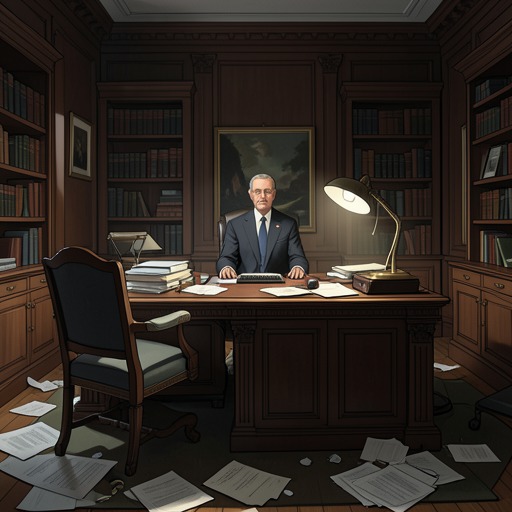
On October 8, 1942, after searches failed to find Lindbergh’s aircraft, Wheeler summoned the cabinet to his home. He announced that, after consulting the First Lady, congressional leaders, and the chief justice of the United States Supreme Court, he would assume the duties of acting president under Article II, Section 1 of the United States Constitution. The declaration placed him in charge while the president’s fate remained unknown. Newspapers carried the urgent headline asking where Lindbergh was, as the absence of the aircraft and its wreckage left the country without an explanation.
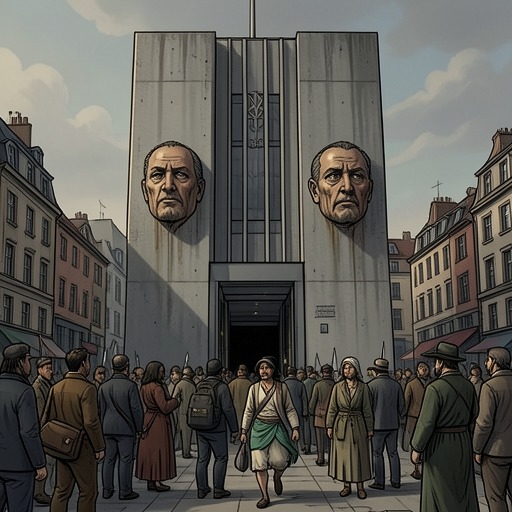
By the following morning, Wheeler’s administration had imposed martial law throughout the continental United States and its territories and possessions. At an emergency closed session of Congress, he said the Federal Bureau of Investigation had information that Lindbergh had been kidnapped and was being held somewhere in North America. He assured lawmakers that the government was working to secure the president’s release and prosecute those responsible. Meanwhile, the borders with Canada and Mexico were sealed, airports and seaports closed, and military forces, the National Guard, the Federal Bureau of Investigation, and local police assigned to maintain order.
The emergency measures did not prevent anti-Semitic riots in several states. In a radio address on October 13, Wheeler blamed the violence on the British government and its American supporters, rather than treating it as an attack requiring a reckoning with the forces behind it. Two days later, the Federal Bureau of Investigation arrested Lionel Bengelsdorf and other public figures on suspicion of involvement in an alleged conspiracy against the country. The same roundup included Governor Herbert Lehman. When Mayor Fiorello La Guardia and Eleanor Roosevelt publicly demanded the release of Lehman and the other accused people, La Guardia was also arrested. The sequence made Wheeler’s administration’s appeal to emergency authority inseparable from the growing restriction of political opposition.
Removal, Pardon, and Significance
Anne Morrow Lindbergh escaped from Walter Reed Army Hospital and broadcast a challenge to the acting administration. She called for detained people to be released, military forces to leave the cities, and constitutional procedures to be restored, including congressional action on the presidential succession and a special election. Congress and the courts then dismantled Wheeler’s administration. Its rule had lasted eight days, but its rapid collapse showed that the transfer of authority had not secured durable control over the constitutional order.
After the Democrats won control of the House and Senate and Roosevelt won a third presidential term, the country entered the war following the attack on Pearl Harbor and declarations of war by Germany and Italy. On the day after his inauguration, Roosevelt issued a pardon covering Wheeler’s offenses against the United States during his October 8–16 period as acting president. The pardon was presented as a way to spare the country a criminal trial of a former acting president and avoid that spectacle during wartime; it did not erase the significance of Wheeler’s brief rule. His arc links the political coalition that legitimized Lindbergh’s government to the emergency seizure of executive power that followed the president’s disappearance, and to the institutional effort to restore constitutional government afterward.