Canadian Armed Forces
The Plot Against AmericaThe Canadian Armed Forces are the wartime institution through which Alvin Roth turns his opposition to Adolf Hitler into military service. In the novel, they connect the family’s private arguments about right and wrong to a conflict unfolding across the Atlantic: they accept qualified American volunteers, train Alvin for commando operations, and send him to a secret staging area in the British Isles. His enlistment is at once a decision about how to fight and a break with the uncle who had raised him and imagined a different future for him.
A route into the war
The Armed Forces enter the family’s story against the background of the Lindbergh administration’s reversal of aid legislation enacted by Franklin D. Roosevelt’s Congress. Canada has consequently become virtually Britain’s only source of arms, food, medicine, and machinery. Reports of German submarines sinking Canadian ships carrying supplies across the North Atlantic make the danger tangible; some attacks occur close to Newfoundland’s coastal fishing waters. The military service Alvin joins is therefore presented not as a distant abstraction but as part of a supply and combat effort on which Britain depends.
That same wartime situation gives Canada a second meaning for the Roth family: it is both a place of refuge they consider and the country from which Alvin chooses to fight. During a 1941 family trip planned for Washington, D.C., the family briefly discusses changing course and driving north to Canada. Friends and neighbors have begun talking about emigrating there if the Lindbergh administration openly turns against Jews. For them, the trip might help familiarize the family with a possible haven. Alvin, however, has already left for Canada in February, intending to join its armed forces and fight on Britain’s side. The family’s tentative consideration of escape and his definite enlistment thus converge on the same country, but point toward different forms of response to danger.
Alvin’s enlistment and family conflict
The Canadian Armed Forces’ willingness to accept qualified American citizens makes Alvin’s decision possible. At twenty-one, he is a former family ward who has spent years under Herman Roth’s care. His parents are dead, and he lived with the Roths during the four years he attended high school. By the time he leaves, he is working for Abe Steinheim, a construction-company owner who has offered him a path to college and a place in the business. Herman regards that prospect, including the promise of a fully paid education at Rutgers, as an opportunity Alvin should not throw away.
Alvin sees the choice differently. He objects to being indebted to Abe and condemns the way he treats workers. Herman argues that Steinheim’s practices belong to a cutthroat building trade and insists that Alvin’s future matters more than his objections to the employer. Alvin answers that fighting Hitler is preferable to remaining in a job he considers morally compromised. Their argument is not simply over whether Steinheim is a good employer: it exposes a divide between Herman’s emphasis on education, security, and making one’s way within existing conditions, and Alvin’s refusal to accept a future that he regards as bought at another person’s expense.
Alvin leaves without telling the family, taking the express train from Newark Penn Station to Montreal. The departure follows weeks of argument with Herman and abandons the future Abe had proposed: college beginning in New Brunswick in September 1941, followed by a return to the company after graduation. For Herman, the loss is both personal and practical; he has been trying to protect Alvin and establish a stable future for him. For Alvin, accepting the offer would mean a lasting obligation to Abe. Enlistment therefore carries a family cost before it brings any news of military action.
From volunteer to commando
Alvin initially imagines that he can see combat quickly by serving aboard a Canadian destroyer protecting merchant ships that carry supplies to Britain. In Montreal, an American volunteer redirects his attention to the commandos. He learns that they carry out nighttime raids on the Nazi-occupied continent, sabotage utilities important to German forces, destroy ammunition arsenals, and attack dock and shipyard facilities along the western European coastline. These operations are conducted alongside British commandos and in cooperation with European resistance movements.
That account changes Alvin’s plan. He abandons the idea of joining the navy and volunteers for commando service, drawn to a unit engaged in direct operations on the occupied continent. The Canadian Armed Forces accept him as a qualified American citizen; after sixteen weeks of training, he is assigned to an active commando unit. The sequence matters to the narrative because the institution does more than provide a destination for his enlistment: it gives practical form to his desire to fight, translating a decision made in opposition to Herman’s plans into a defined military role.
After training, Alvin is shipped to a secret staging area in the British Isles. The secrecy of the location marks the boundary between what the family knows and the operations he has joined. They have heard nothing from him until a brief letter arrives, reporting that he is off to fight and expects to see them soon. Its few words confirm that he has reached active service, but offer no account of his whereabouts or duties beyond what the family can infer from the message.
Wounding and the family’s news
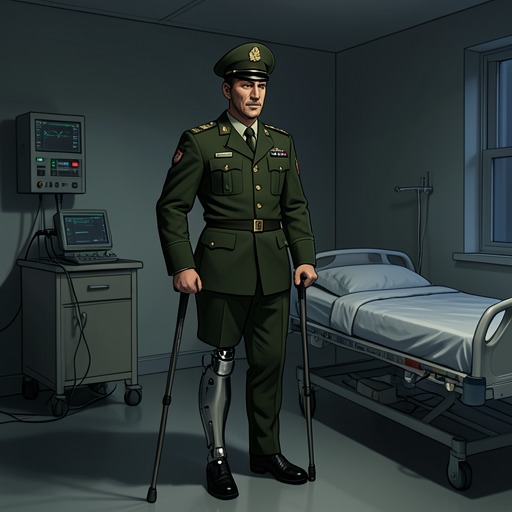
Days after Sandy Roth travels alone to Kentucky, another communication arrives, this time from the War Department in Ottawa. It informs Alvin’s designated next of kin that he has been wounded in action and is recovering in a convalescent hospital in Dorset, England. The notice supplies a concrete consequence of the military path he chose: he has reached combat and been injured. It does not describe the circumstances of the wound, and the family receives no detailed account of what happened to him in the field.
The notice also changes the family’s relationship to the Armed Forces. Before it, Alvin’s enlistment is a painful absence and a matter of argument over his future; now his service returns to the Roth household as official news that he has been wounded. At the kitchen table, Bess Roth prepares a reply on stationery reserved for important correspondence, speaking each sentence aloud so Herman can suggest changes. The family’s response is organized around a letter to a nephew who has left them to fight, while the formal notice from Ottawa stands between them and direct knowledge of his condition.
Narrative significance
The Canadian Armed Forces occupy a precise role in the novel’s account of American neutrality and family life. They accept an American volunteer at a time when the United States under Lindbergh has withdrawn aid legislation, and they offer Alvin a way to act against Hitler without waiting for his own country to enter the war. That contrast is grounded in the family’s experience: the same political situation that makes Canada a possible refuge for American Jews also draws Alvin into military service there.
Alvin’s path through the Armed Forces does not reconcile him with Herman. Instead, it gives their conflict an irreversible consequence: the young man leaves a household that had been his home, rejects an educational and business future, trains for commando operations, and is eventually reported wounded. The institution is therefore both a military presence and a hinge in the family narrative, carrying the stakes of international conflict into a sequence of choices, separations, and anxiously received news.