Danville
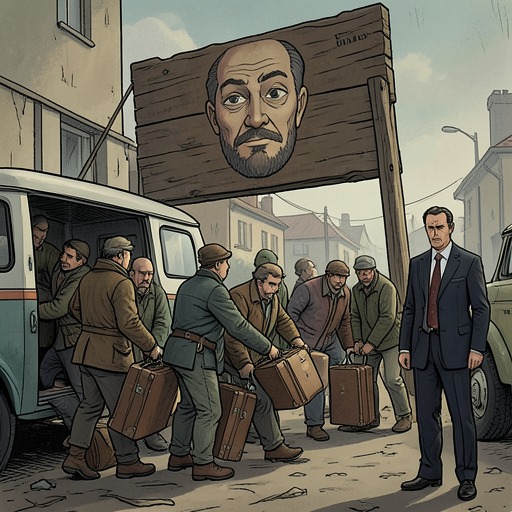
The Plot Against AmericaDanville is the rural Kentucky destination assigned to families relocated from Newark under Homestead 42. Introduced through a map and a promotional pamphlet, it first appears as a place its new residents might learn to accept; for the Roths and the Wishnows, however, the distance from home becomes a condition of separation and vulnerability. Danville’s small population, limited local business, and Seldon Wishnow’s loneliness give the relocation policy a human scale, while the violence that reaches his family makes the town a setting where national upheaval becomes immediate and personal.
Setting and the transfer
Several days after receiving the company’s letter, Herman Roth tells Bess Roth that, effective September 1, 1942, he is being transferred from the Metropolitan Life Insurance Company’s Newark district to a district office opening in Danville. The move is imposed through Homestead 42, and the letter turns what had been a government program into a decision about where the family will live. To explain the destination to his family, Herman finds Danville on a map of Kentucky included in the relocation packet presented by Mr. Kurth.
The pamphlet Herman reads aloud describes Danville as the county seat of rural Boyle County, about sixty miles south of Lexington, in what it calls beautiful countryside. He supplies other facts as well: Kentucky joined the Union in 1792 as the first state west of the Appalachians, and its 1940 population was 2,845,627. Danville itself, he finds in the pamphlet, has 6,700 residents. These details offer the family a geography to picture, but they cannot answer Bess’s central concern: how many Jewish people live in Danville, or in the state as a whole? Herman acknowledges that there are very few.
A destination made persuasive
Herman tries to make the transfer sound survivable by comparing Danville with the destinations assigned to other Newark agents. The Gellers are going to Montana, the Schwartzes to Kansas, and the Brodys to Oklahoma; seven men are leaving the office, and Herman insists that Kentucky makes him the lucky one. He emphasizes the countryside, climate, cheaper costs, a job, and the prospect of a house with a yard and separate rooms for the boys. His hopeful inventory is practical, but it also shows the pressure to translate a forced move into an opportunity.
Bess answers with what Danville cannot replace. Their families and lifelong friends are in Newark; the children have friends there and attend school among other Jewish children. The Roths live close to good schools, and their sons have not had to experience the loneliness Bess remembers from her own childhood. Her protest makes clear that relocation is not simply a change of address: it removes the family from familiar relationships and from a community in which the children belong. The contrast between Herman’s list of potential material advantages and Bess’s account of what is being taken away frames Danville as both a promised home and an imposed separation.
The Wishnows are also sent to Kentucky. After Philip tells Aunt Evelyn that Seldon is his best friend, although he cannot bear him, Mrs. Wishnow receives notice from the Metropolitan that her family has been selected to move there too. In Danville, the relocation does not bring the families together in Newark’s former social world; it places them far from that world and leaves them to manage the consequences in a new setting.
Isolation in Danville
Seldon’s account of life in Danville makes the distance concrete. He asks Bess whether Philip will visit for his birthday because he has nobody to invite. The children call him Saltine, and his only chess companion is a six-year-old neighbor whom he has taught to play. The younger child sometimes makes illegal moves, and Seldon wins repeatedly, but the games are no fun. The scene shows the difference between having a nearby person to pass the time with and having a friend: Seldon has learned to teach and correct his sole companion, yet still describes himself as alone.
The family’s economic prospects are similarly constrained. Mrs. Wishnow has been sent to work in the rural reaches of Boyle County, where there is little business to pursue. When she is asked to travel more than a hundred miles to the Metropolitan’s regional office in Louisville, Herman suspects the company intends to dismiss her and require her to surrender her ledger of collections. The former Newark agents are not earning anything close to their usual commissions in the sparsely inhabited places to which they have been transferred. Danville thus represents not just a distant home but a weakened livelihood: the company relocates its agents without moving the customer base that had sustained their work.
Violence, loss, and return
On the evening of October 12, while the Roths lie awake amid the fear spreading under Acting President Wheeler’s administration, Seldon calls them collect from Danville. He is ten, has not eaten, and cannot find his mother. Earlier that day Mrs. Wishnow had driven to Louisville at her supervisor’s request; the poor roads make the journey and return an all-day undertaking. Seldon fears that she is dead, and Bess tries to reassure him by suggesting a delay or car trouble. The following day, his fear is confirmed: his mother’s burned car and remains are found in a drainage ditch beside a potato field south of Louisville. She has been beaten and robbed, and the car set on fire during the anti-Jewish violence.
With Mrs. Wishnow dead and Seldon alone in Danville, Bess keeps him on the telephone and talks him through organizing his dinner and leaving the house for the Mawhinneys’ care. Her patient instructions turn the household phone line into a means of protection across the distance. On October 19, Herman and Sandy Roth drive to Kentucky to bring Seldon back to Summit Avenue; Mrs. Wishnow’s casket follows by train. Danville, first presented as a place where a family might find a house and a fresh start, becomes the setting from which a bereaved child must be brought home.
Narrative significance
Danville’s role is defined by the contrast between what the relocation scheme promises and what the characters experience. Herman’s map and pamphlet make the town legible through location, population, climate, and history; the later scenes measure it through isolation, meager business, a long drive to Louisville, and a child’s urgent call for help. The progression turns geographical distance into dramatic consequence without making Danville itself the source of the violence: the danger belongs to the wider political crisis, but the families’ enforced separation leaves them exposed to its effects far from the support they knew in Newark.
The town also becomes the destination shared by two families for different reasons and with different outcomes. The Roths initially face the prospect of settling there, while the Wishnows attempt to build a life there after their transfer. Seldon’s return to Newark after his mother’s death closes Danville’s brief place in his life not as a completed resettlement, but as the site of loss from which he has to be retrieved.