Fiorello La Guardia
The Plot Against AmericaFiorello La Guardia is the Republican mayor of New York City and one of the most conspicuous local officials willing to oppose Charles A. Lindbergh openly. A former congressman and three-term Fusion mayor, he brings both a reform politician’s ties to working people and an unusually direct public voice to a crisis in which opposition carries increasing risk. His role sharpens after Walter Winchell’s assassination: La Guardia makes the funeral a citywide demonstration of mourning and resistance, and later joins the effort to challenge Lindbergh’s hold on the presidency.
Identity and Political Formation
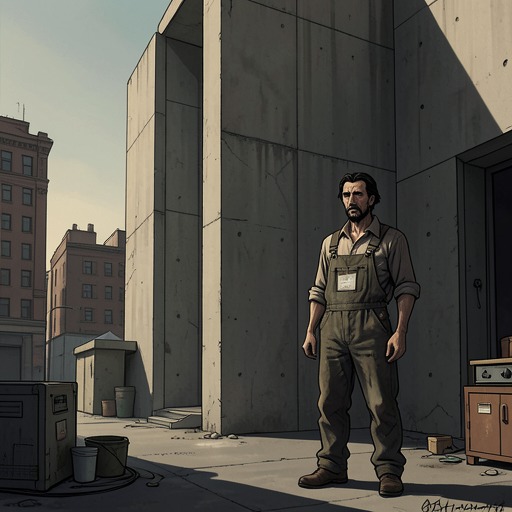
La Guardia is presented as a politician rooted in the city’s working-class neighborhoods. Before becoming mayor, he represented a crowded East Harlem congressional district whose residents included poor Italians and Jews. He was a forceful advocate for unions, people in need, and the unemployed, and fought congressional Republicans during the first dark year of the Great Depression. His willingness to call for heavier taxation of the wealthy set him apart even from members of his own party.
His political identity combines Republican affiliation with liberal reform. A critic of the Tammany political organization, he became the three-term Fusion mayor of the country’s most populous city, home to the hemisphere’s largest concentration of Jews. The narrative stresses the contrast between his party and his principles: he is the sole Republican described as displaying contempt for Lindbergh and for the doctrine of Aryan superiority associated with the president’s creed and following.
La Guardia’s opposition also has a longer history. As early as 1933, he condemned Adolf Hitler and advocated a boycott of German goods. The account connects this record to his family background: his mother was an unobservant Jew from Austrian Trieste, while his father was an Italian freethinker who came to America as a musician in the U.S. Army. The details do not reduce his politics to ancestry; rather, they place his opposition to racial supremacy alongside a career spent representing diverse and economically vulnerable constituents.
The Winchell Funeral
After Walter Winchell is assassinated, La Guardia turns the funeral into a public event on a scale that exceeds even his expectations. He designates the occasion as a citywide day of mourning for American victims of Nazi violence, with Franklin D. Roosevelt expected to deliver the funeral oration. Thirty thousand mourners pass through Pennsylvania Station to view Winchell’s flag-draped coffin. Across the city, people distribute black buttons bearing the question “Where is Lindbergh?” The question makes the absent president a focus of the mourning as well as a target of protest.
La Guardia’s participation joins civic ceremony to religious observance. Before noon, at the city radio station, he removes his broad-brimmed black Stetson, a reminder of his boyhood roots in the Arizona Territory, and recites the Lord’s Prayer. He then puts the hat back on and reads the Jewish prayer for the dead in Hebrew. At noon, a City Council decree brings the five boroughs to a minute of silence. The sequence makes the mayor’s public role explicit: he speaks as the city’s leader while acknowledging the Jewish dead and the mourning community gathered around Winchell.
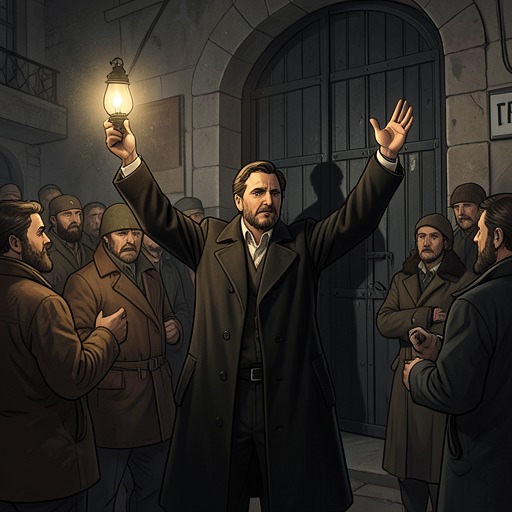
The cortege leaves Pennsylvania Station at one o’clock, escorted by a motorcycle honor guard of policemen wearing black armbands. La Guardia leads the procession from a motorcycle sidecar as it travels north along Eighth Avenue, east along 57th Street, and north again on Fifth Avenue to Temple Emanu-El. Dignitaries fill the temple, while loudspeakers carry the service to crowds assembled in Manhattan neighborhoods and to visitors who have come to Winchell’s hometown. The black-and-white buttons are now widely worn, turning a small emblem into a visible sign of shared defiance.
At the service, La Guardia’s voice links public authority to the familiar intimacy of his earlier broadcasts. He had narrated Sunday comic strips for children over the city radio station during a newspaper strike; now, in the same excitable, high-pitched voice, he addresses the mourners. He denounces the contrast between Lindbergh’s public decorum and Winchell’s noisy opposition to fascism and antisemitism, and says Winchell was killed for speaking his mind. Outside, listeners take up La Guardia’s repeated question about Lindbergh. Inside, he bangs the pulpit as an outraged citizen demanding an answer. The funeral’s broadcast and street crowds make that challenge impossible to confine to the temple.
Opposition to Lindbergh and Political Crisis
The funeral becomes a moment of political realignment. Franklin D. Roosevelt, present with members of his political circle, surprises them by endorsing La Guardia as a national-unity candidate against Lindbergh’s pursuit of a second term in 1944. The mayor’s role thus shifts from municipal host and eulogist to a possible national opponent of the president. His party affiliation does not disappear; instead, the episode makes his willingness to cross party lines part of the challenge to Lindbergh.
Later, as reports emerge that Lindbergh may have fled to Nazi Germany, La Guardia addresses reporters in New York. He frames his accusation conditionally: if the reports are true, and if American policy has been dictated by the Nazi regime, then the president’s conduct would amount to treason of extraordinary magnitude. He does not present the allegation as established fact. His statement instead underscores the stakes of the uncertainty, treating the possibility of presidential collusion as a danger that demands a public response.
The emergency then brings La Guardia into direct conflict with the acting government. At a press conference in New York, he stands with Eleanor Roosevelt and Roger Baldwin of the American Civil Liberties Union to demand the immediate release of Governor Herbert Lehman and the people accused alongside him. The account reports that La Guardia is subsequently arrested at the mayor’s mansion. The arrest follows from a specific public act: he has used his office and his presence beside other prominent critics to contest the detention of political opponents.
Narrative Role and Significance
La Guardia’s public actions give the novel’s opposition a civic center. The Winchell funeral gathers mourners, officials, and crowds into a shared ceremony, but its black buttons and repeated question also turn mourning into political accusation. His later statements and arrest carry that opposition into the struggle over presidential authority and the detention of dissenters. Across both moments, the mayor’s characteristic public visibility—his voice on the radio, his place at the head of the cortege, and his presence at the press conference—makes him a representative figure for resistance within the city’s institutions.
The narrative also emphasizes the tension in his position. La Guardia is a Republican in a party aligned with Lindbergh, yet the account identifies him as the party’s lone outspoken opponent of the president’s racial doctrine. His career among unions, the unemployed, and immigrant communities helps explain why that opposition is politically consequential, while the funeral shows how it can reach beyond elected officials into the streets. His arrest marks the narrowing space available for such dissent: the mayor who publicly organizes mourning and calls for the release of detainees becomes a detainee himself.