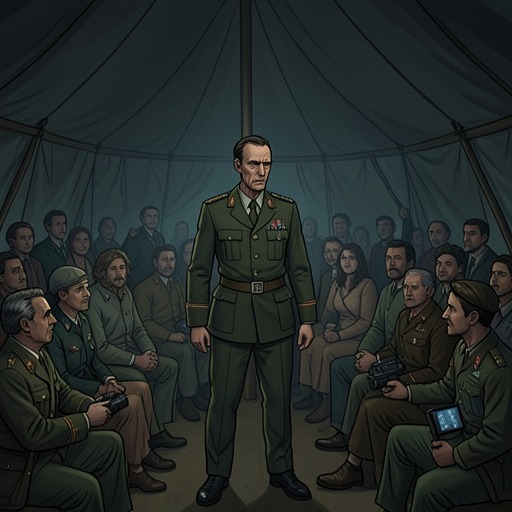
Herbert Lehman
The Plot Against AmericaHerbert Lehman, identified as New York’s Jewish governor, becomes one of the most visible public figures caught in the novel’s October 1942 political crisis. His progression from funeral dignitary to alleged conspirator and detainee shows how quickly public service and civic prominence can be recast as evidence of disloyalty when a government turns an emergency into a pretext for repression. The account does not give him a private scene or a developed personal history; it presents him through ceremonies, public accusations, and the state’s actions against him.
Identity and Public Role
Lehman’s defining identification in these episodes is his office: he is the governor of New York. The narration also calls him New York’s Jewish governor, making his Jewish identity part of how public life is described and, soon afterward, part of the rhetoric used to accuse him. The text supplies no account of his earlier life, policy record, or private relationships. Instead, it places him among the political leaders whose visibility gives the unfolding crisis a national dimension.
That public role matters because the accusations against him are not presented as arising from evidence disclosed to readers. German state radio later folds his name into an elaborate allegation of a Jewish conspiracy, representing him as a powerful governor supposedly helping to return Franklin D. Roosevelt to the White House. The contrast is sharp: Lehman is first seen in a civic ceremony, then redescribed by propaganda as a participant in a secret plot.
At Walter Winchell’s Funeral
After Walter Winchell is assassinated at a political rally in Louisville, Kentucky, the announced funeral arrangements include Lehman among the speakers. The service is to take place at Temple Emanu-El in New York City, following the transfer of Winchell’s body by train to Pennsylvania Station. The planned speakers also include Mayor Fiorello La Guardia, Democratic senator James Mead, and former president Franklin D. Roosevelt. Lehman’s place on this list situates him among the public representatives called upon to honor Winchell.
The memorial grows into a major civic gathering. Thirty thousand mourners pass Winchell’s flag-draped coffin at Pennsylvania Station, and the cortege proceeds under police escort to the temple. The city’s observance extends beyond the building: loudspeakers relay the service to crowds, and mourners wear black-and-white buttons asking where President Lindbergh is. The narrative names Lehman as one of the expected speakers, but does not record his words or describe an individual action by him during the procession or service. His significance here lies in his presence on the public roster, alongside elected officials and other prominent figures, at a mourning that has become an expression of political dissent.
Accused in the Lindbergh Disappearance
The political setting changes after Lindbergh disappears. By October 9, martial law has been imposed across the continental United States and its territories and possessions. Acting President Wheeler tells Congress that the president has been kidnapped, while borders are sealed, airports and seaports closed, and armed forces and police tasked with maintaining order. The emergency announcement establishes the conditions under which accusation and detention rapidly become instruments of government.
The following day, German state radio announces that Lindbergh’s kidnapping was carried out by a conspiracy of “Jewish interests.” Its account falsely names Lehman alongside Franklin D. Roosevelt, Treasury secretary Morgenthau, Justice Frankfurter, and others, presenting the New York governor as part of a plot to restore Roosevelt and provoke war. The broadcast also assigns responsibility for Winchell’s assassination to the same supposed group, recasting the funeral’s public protest as part of a conspiracy. These claims are reported as propaganda, not established facts: the text gives the radio’s allegations but no evidence supporting them.
Arrest and Public Opposition
On October 15, the Federal Bureau of Investigation arrests Lehman in a predawn roundup. Authorities describe the detainees as suspected participants in a plot against America, but the reported charge is not settled: the Federal Bureau of Investigation has not disclosed whether the suspects will be charged with conspiring to kidnap the president. The account therefore distinguishes the certainty of custody from the uncertainty—and political character—of the accusation.
In New York, La Guardia appears at a press conference with Eleanor Roosevelt and Roger Baldwin of the American Civil Liberties Union. They demand the immediate release of Lehman and the other alleged co-conspirators. La Guardia is subsequently arrested at the mayor’s mansion. The sequence links Lehman’s detention to a wider attempt to silence public opposition: the people asking for the governor’s release are themselves exposed to arrest, while military forces enter New York and the city’s newspapers and radio stations are shut down.
The next day, the First Lady escapes from Walter Reed Army Hospital and broadcasts an appeal to restore citizens’ rights. She states that there is no evidence that any detainee is responsible for what happened to Lindbergh or his plane, and calls for the release of those arrested. Her appeal directly challenges the justification for holding Lehman and the other suspects. The supplied account does not establish Lehman’s subsequent fate or state when he is released.
Narrative Significance
Lehman’s brief but consequential appearances trace the conversion of a governor’s public standing into a liability. At the funeral, his office places him among those mourning Winchell in a citywide ceremony marked by protest. In the German broadcast, the same office is recoded as proof of imagined political power within an antisemitic conspiracy. His arrest then makes the false accusation materially consequential, while the press conference and the First Lady’s broadcast show opposition trying to defend the detainees through public demands and constitutional rights.
The narrative does not develop Lehman through private motives or speeches of his own. Instead, he is made legible through competing public descriptions: governor and funeral speaker, conspirator according to foreign propaganda, detainee according to the American authorities, and a person whose release becomes a demand of their critics. That limited perspective is part of the episode’s force. The text shows how, under martial law, a name can pass from a civic program to a fabricated accusation and then into custody, without the evidence for the accusation ever being made clear.