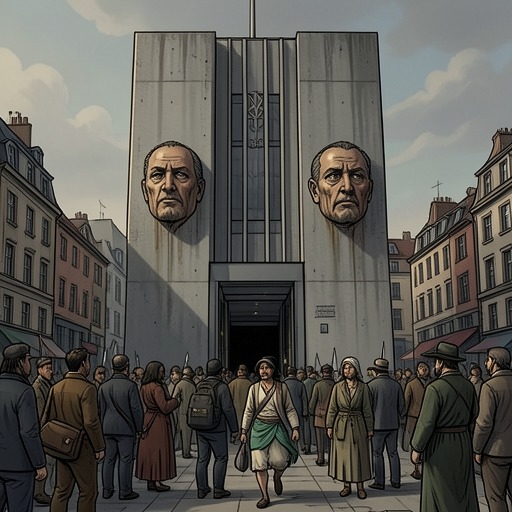
Japan
The Plot Against AmericaJapan is central to the Hawaii Understanding, a diplomatic bargain that extends the reach of Charles A. Lindbergh’s neutrality policy into East Asia. By recognizing Japanese sovereignty and declining to oppose its expansion, the administration draws the alternate-history United States closer to the Axis alignment even as it promises Americans that the country will stay out of foreign wars.
Diplomatic setting
Ten days after Charles A. Lindbergh returned from Iceland to Washington, he signed the Hawaii Understanding in Honolulu with Prince Fumimaro Konoye, premier of the Japanese imperial government, and Foreign Minister Matsuoka. The two Japanese representatives acted as emissaries of Emperor Hirohito. Their visit followed Japan’s entry into a triple alliance with Germany and Italy, signed in Berlin in September 1940. The alliance’s reciprocal language joined two regional projects: Japan endorsed the new order in Europe established under German and Italian leadership, while Germany and Italy endorsed the new order in Greater East Asia established by Japan. The three countries also pledged military support for one another if any were attacked by a nation not engaged in the European or Sino-Japanese war. Japan thus entered the agreement with an existing alliance, not as an isolated power seeking a bilateral accommodation.
The terms of the understanding
The Hawaii Understanding recognized Japanese sovereignty in East Asia and guaranteed that the American government would not oppose Japanese expansion on the Asian continent. The permitted expansion explicitly included the annexation of the Netherlands Indies and French Indochina. In practical terms, the agreement accepted a major alteration of regional power while presenting the bargain as a means of keeping the alternate-history United States outside the war. Japan, in turn, pledged to recognize American sovereignty on its own continent and to respect the political independence of the American commonwealth of the Philippines, which was scheduled to take effect in 1946. It also accepted Hawaii, Guam, and Midway as permanent American possessions in the Pacific. These provisions paired Japanese gains on the Asian continent with assurances about American territory and a future Philippine status; they did not erase the asymmetry between Japan’s expansion and the American promise not to resist it.
Neutrality and public response
The agreement followed Lindbergh’s declaration that the country would take no part in the war in Europe and would maintain strict neutrality while continuing to arm and train its forces. Public reaction condensed the policy into a promise of no more war and no more young men dying in combat. Many Americans trusted that Lindbergh could deal with Hitler, Mussolini, and Hirohito because they respected him personally. The popular confidence in his diplomacy stood in contrast to the agreement’s concrete recognition of Japanese expansion. For Jewish families, the new arrangements did not quiet anxiety about Lindbergh’s relationship with foreign leaders or the country’s direction. The younger children returned from school frightened by rumors about what had passed between Lindbergh and Hitler in Iceland, while adults speculated about future dangers and whom they could trust for protection. Against this background, Japan’s place in the narrative is not simply that of a distant signatory: the Hawaii Understanding makes Pacific diplomacy part of the domestic argument over whether declared neutrality can protect the country’s citizens and constitutional order.
Narrative significance
Japan’s role shows how the administration’s promise of noninvolvement coexists with active diplomatic choices. The agreement does not merely keep the alternate-history United States out of a conflict; it recognizes Japanese claims, sets limits on what America will oppose, and offers reciprocal assurances over Pacific possessions. The resulting tension gives the phrase of neutrality a material cost: staying outside the war is pursued through an accommodation that changes the political landscape in East Asia and leaves American Jewish characters weighing official reassurances against growing fear.