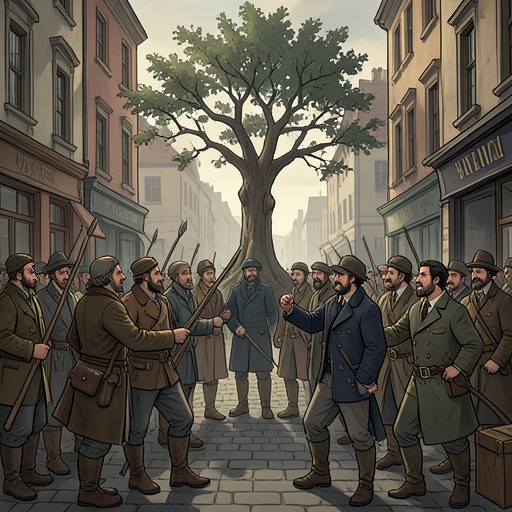
Jewish police of Newark
The Plot Against AmericaThe Jewish police of Newark was a volunteer corps organized in response to mounting fears of anti-Semitic violence. Recruited separately from the city’s civic committee, it was intended to provide local protection if public authorities proved unwilling or unable to defend Newark’s Jewish residents; its brief, dangerous history culminated in a gun battle with city police.
Formation and Purpose
As anti-Semitic violence spread and Newark’s Jewish community anticipated that disorder might reach its own streets, local leaders sought cooperation from city and state authorities. The Newark Committee of Concerned Jewish Citizens met with officials and pursued contingency planning, but Longy Zwillman made separate preparations for community defense. He feared that Newark police and state troopers might respond no more vigorously than authorities had during violence in Boston and Detroit.
Longy assigned Bullet Apfelbaum, his close associate and chief enforcer, to recruit and train a volunteer corps called the Provisional Jewish Police. Its members were young Jewish men who had not graduated from high school and who already occupied a marginal place in neighborhood life. They were distinct from the civic leaders working through the committee: the corps represented an improvised street-level response to the prospect that formal protection might fail.
Presence in the Neighborhood
The volunteers appeared on neighborhood streets, with members stationed at every second street corner. Their presence was visible to children and families living under the threat of violence. Boys were told to keep baseball bats ready in case they were summoned during the night, while the Jewish police themselves remained out on the streets through the night before a school day.
The school’s safety assembly described measures involving extra city police patrols and uniformed officers at school entrances and in corridors, but made no mention of the Jewish police. The distinction captures the corps’ unofficial status: it operated alongside preparations made by public authorities, yet was not part of the public safety arrangements presented to pupils and parents. Its members were still on duty the next morning, drinking coffee from thermoses and eating donated doughnuts.
Gun Battle and Deaths
The corps’ most consequential confrontation came during a night of gunfire near Chancellor Avenue. After the shooting ended, residents learned that the battle had been between city police and the Jewish police, not between police and anti-Semitic rioters. Three Jewish police members—Bullet Apfelbaum, Duke Glick, and Big Gerry—were killed. The account presents the episode as a shootout rather than a pogrom, while making clear that the deaths occurred amid the same climate of fear that had prompted the corps to form.
The police commissioner told the Newark Evening News that the vigilantes had opened fire without provocation on two foot patrolmen shortly before midnight. The neighbors, however, did not take that account seriously; nor was there much public grief for the three men, who were widely regarded as dangerous figures. The narrative suggests that the new mayor also wanted such men removed from the streets, in part as a signal to Longy. The encounter thus exposed a bitter contradiction in the community’s effort at self-protection: a force created because residents feared inadequate official protection became involved in a deadly clash with the city police.
Significance
The Jewish police of Newark embodied the shift from civic contingency planning to direct neighborhood defense as anti-Semitic threats became harder to dismiss. Its presence was both a practical answer to uncertainty and a sign that ordinary life had been overtaken by the expectation of violence. Yet the gun battle did not resolve that insecurity. In its aftermath, Herman Roth told Shepsie Tirschwell that fear had made it impossible for the family to live normally in Newark, and the Roths began making arrangements to leave. The corps’ story therefore marks not the restoration of safety, but the limits and costs of trying to secure it through improvised local force.