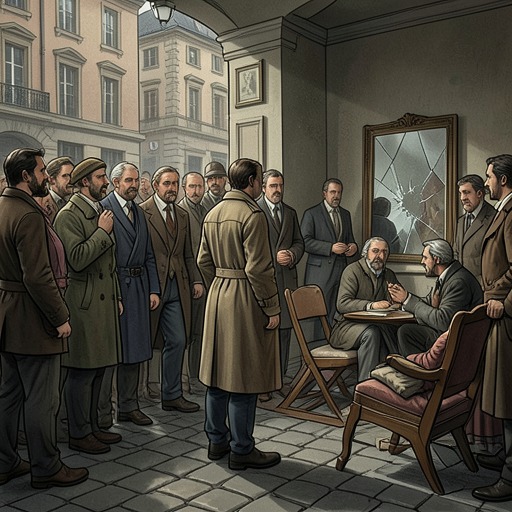
Joey Cucuzza
The Plot Against AmericaJoey Cucuzza is the irrepressibly playful, hard-of-hearing boy who becomes Philip’s new friend downstairs. Through Joey, the novel sets a child’s appetite for jokes, gadgets, and spectacle against a neighborhood unsettled by political danger: while Philip watches anxiously for the next alarming development, Joey is drawn toward whatever is happening outside. His hearing aid and his curiosity are not incidental traits; they shape the boys’ friendship and lead Joey into a night of disobedience with painful consequences.
Temperament and Family
When Joey is alone with Philip, his playful side is nearly all that the other boy encounters. He is jolly and prankish, with a distinctive hooting laugh; talkative, curious, and monumentally gullible, he thinks quickly, if unpredictably. This liveliness makes him difficult to pity simply as a boy who cannot hear well. Philip’s account holds together his vulnerability and his comic energy rather than allowing either to define him completely.
At home, Joey behaves very differently. His obedience to his family is painstakingly thorough, so much so that Philip finds it nearly as striking as the thorough lawlessness of Shushy Margulis. Joey’s devotion makes him an exemplary son within Italian Newark, and it helps explain why Bess Roth comes to find him irresistible. Joey’s family life thus gives his later disobedience a particular force: the boy who usually waits to be told what to do can also be carried away by his own excitement.
Hearing and the Hearing Aid
One night, as fear and political upheaval press in on the household, Joey removes his hearing aid and puts it into Philip’s hands. The equipment consists of an earpiece, a black microphone case, a battery, and its wires. Philip does not understand why Joey has given it to him, but Joey wants him to wear it. The gesture briefly turns a private feature of Joey’s everyday life into something the boys can handle and explore together.
Joey recounts how the man who sold him the device tested his hearing with a pocket watch and two half-dollars, moving farther away as Joey’s ability to hear them faded. The seller was not a doctor, Joey says, yet he wrote down the results before fitting the boy with the device and assuring Joey’s father that it would let him hear grass growing. The extravagant promise contrasts with the crude test Joey describes, in which the essential fact was how quickly ordinary sounds became inaudible.
The aid also becomes a toy in Joey’s hands. As he turns its dial, Philip hears something like water running into a bathtub, then thunder. The device that is meant to help Joey hear instead temporarily places Philip inside an unfamiliar, overwhelming soundscape. Joey’s delight in the effect contrasts with Philip’s discomfort, and Philip finally pulls the earpiece out. The scene presents the aid as both an instrument of access and an object through which Joey plays, experiments, and exerts control over what another person hears.
Friendship amid Political Fear
The boys’ different responses to danger sharpen their friendship’s limits. Philip is preoccupied with the arrests of Fiorello La Guardia, Franklin D. Roosevelt, and Lionel Bengelsdorf, and he fears the news still to come. Joey, by contrast, seems absorbed by his own interests. Philip wonders whether this is because Joey is Catholic and therefore has less to fear, or simply because he is irrepressible; the uncertainty belongs to Philip’s interpretation, not to any stated explanation from Joey.
Their closeness nevertheless allows Joey to tell Philip what he has heard about Nick, an eighteen-year-old orphan. Joey reports that older boys say Nick is Jewish, that he drank a horse’s blood, and that they intend to find him. When Philip asks why Nick would have done it, Joey repeats the antisemitic blood accusation that Jews drink blood. Philip rejects the claim as crazy and gives Joey back the hearing aid. Joey’s words expose how a hateful myth circulates among children as rumor, while Philip’s response makes clear that the claim is not treated as truth. Joey serves as a messenger of the talk around him, but the episode does not establish that he understands or endorses its prejudice.
The Police Horses and Joey’s Disappearance
Joey cannot remain away from the spectacle outside. He races from window to window to watch the horses and eventually rushes out of the door, despite his mother’s orders. Philip never sees him again that night. For Joey, the police horses appear to offer an excitement comparable to Buffalo Bill’s Wild West Show; for Philip, who is already afraid, Joey’s departure is another source of uncertainty.
Joey later claims that he saw Ned, a horse from the Eighth Precinct reputed to chew tobacco and tap out numbers with his right front hoof. The horse was said to let children swing from his tail without kicking them. Philip leaves open whether Joey really encountered this famous animal, but even the possibility helps convey the irresistible pull the horses held for him. Joey’s enthusiasm has taken him out of the safe, familiar household and into the unsettled street.
His disobedience has a severe consequence the following morning. After Joey’s father returns from work, he beats Joey’s haunches mercilessly with the black strap from the night watchman’s time clock. The punishment brings Joey’s departure back into the family sphere: the boy whose loyalty at home had seemed almost absolute has, in the face of an absorbing spectacle, failed to obey, and his father answers that failure with violence.
Narrative Role
Joey’s episodes reveal character through small, concrete actions rather than through political argument. He hands over a complicated hearing device, delights in making it produce strange sounds, repeats a vicious rumor, and bolts toward the horses. Each action shows a different part of the same unpredictable boy: playful, credulous, capable of relaying dangerous talk, and easily captivated by the immediate world around him.
His hearing loss is presented through material details—the pocket watch, the coins, the wires, the turning dial—and through the practical difference between Joey’s experience and Philip’s. The hearing aid does not simply stand for disability; in this scene it is a device Joey uses, a source of comic play, and a route by which Philip briefly encounters sound from Joey’s position. At the same time, Joey’s choices are not reduced to his hearing: his exuberance and fascination with the horses shape what he does, while family obedience and physical punishment shape what follows. His brief presence therefore complicates Philip’s fearful view of the neighborhood, bringing into the same night both a child’s play and the danger beyond the windows.