Longy Zwillman
The Plot Against AmericaLongy Zwillman is a wealthy and influential Newark mobster whose authority sits uneasily beside the city’s formal institutions and its established Jewish leadership. In the novel’s account of rising antisemitism, he responds to the community’s danger through his own channels: he helps Uncle Monty protect Herman Roth’s livelihood and separately organizes a volunteer Jewish force. His influence can offer practical protection, but it also brings the costs and hazards of power exercised outside civic authority.
Identity and Position
The narrator places Longy among the successful racketeers of industrial Newark, contrasting his standing with that of boys who lacked either the advantages needed to prosper or the path into organized crime. He is described as wealthy and enormously influential, and his reputation reaches beyond his underworld connections into local politics. Rumors circulated among Meyer Ellenstein’s enemies that Longy had once held an honorary place on the city’s Board of Commissioners under the preceding Jewish mayor; the account presents this as rumor, not established fact.
His influence does not translate into acceptance by the city’s most distinguished Jewish civic group. When the Newark Committee of Concerned Jewish Citizens assembles prominent community leaders, Longy is not invited. The narrator treats his exclusion as unsurprising despite his wealth and influence. The committee represents recognized civic standing and cooperation with public authorities; Longy operates separately, through personal connections and a reputation built outside those structures.
Surveillance and a Family’s Livelihood
The Federal Bureau of Investigation’s surveillance of the Roth family reaches Uncle Monty’s produce market and the diner where workers ate during the night. Agent McCorkle asks about Herman Roth: the inquiry concerns both Herman’s decision to leave his insurance-company job rather than participate in a government program and his opinions about America and the president. The information reaches Longy through Niggy Apfelbaum, who relays what McCorkle has told him. The episode makes surveillance more than observation: its pressure threatens to deprive Herman of work and reaches Monty through the people around Longy.
Monty asks Longy to let Herman continue working for him. He explains that his brother is an uneducated man supporting a wife and two children and poses little danger to the country by hauling produce crates. Longy’s response is not immediate protection without conditions. He points out that the Federal Bureau of Investigation is also watching him, and recalls that he had already removed his nephew Alvin from employment because of that scrutiny. The exchange exposes a practical limit on Longy’s patronage: helping Monty’s brother may draw the same authorities’ attention back to Longy’s own business.
Longy nevertheless gives Monty a day to resolve the matter before Herman must go. Monty approaches McCorkle at Sammy Eagle’s bar, buys him breakfast and a drink, and argues that Herman is simply doing his job. McCorkle invokes his friendship with Eagle as evidence that he is not hostile to Jews; Eagle confirms that McCorkle attended his son’s bar mitzvah and gave the boy a tie clasp. Monty accepts the explanation while privately handing McCorkle a small brown envelope. The episode shows how official scrutiny, personal assurances, and a covert payment intersect in the effort to preserve Herman’s job. Longy’s role is indirect but decisive: he gives Monty time and access to use the relationships available to him.
Organizing a Community Defense
As anti-Semites use Walter Winchell as a pretext for attacks, Longy acts apart from the civil authorities who have promised cooperation with the Newark Committee. He wants the city’s Jews to have protection if Newark police and New Jersey state troopers fail to respond adequately, as police elsewhere had during earlier disorder. This is a separate initiative, not a branch of the committee’s public-facing work.
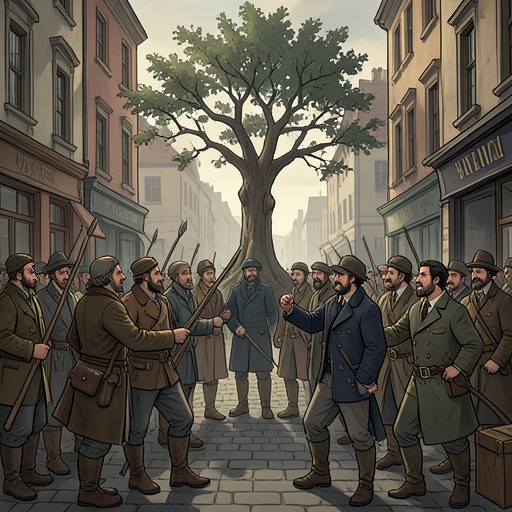
Longy assigns Bullet Apfelbaum, his close associate and chief enforcer, to recruit and train young Jewish men for a hastily assembled volunteer corps called the Provisional Jewish Police. Many recruits are described as school dropouts who had long been regarded by their neighbors as unruly and socially marginal. Now they appear at street corners, visit neighborhood institutions and local businesses, and urge able-bodied men and boys to be ready if called upon. The plan turns a group previously feared or pitied into a visible force for neighborhood defense, though its members’ reputation and methods also mark the sharp difference between Longy’s organization and the civic committee.
Consequences and Significance
The volunteers’ presence does not make Newark safer in a simple or lasting way. During a later night of gunfire, the family initially fears that anti-Semites have attacked the neighborhood. By morning, they learn that the confrontation was between city police and the Provisional Jewish Police, not between police and anti-Semites. Three members of the Jewish force, including Bullet Apfelbaum, have been killed. The account does not establish that they were killed because they were Jewish: their deaths are also understood in relation to a new mayor’s effort to clear dangerous men from the streets and signal that Longy no longer enjoyed his former political standing.
The episode leaves Longy’s protective project morally and politically compromised. The force he assembled was meant to answer the possibility that public authorities would not protect Jews; instead, it ends in a deadly confrontation with those authorities. Yet the absence of a pogrom that night does not dispel the family’s fear. Herman tells Shepsie Tirschwell that Newark no longer feels possible as a place to live normally, and the family begins making arrangements to leave. Longy’s power can secure a job, mobilize a defense, and influence local affairs, but it cannot restore the security the family has lost. His character thus embodies both the practical reach and the limits of informal authority in a community facing threats from within the state and beyond it.