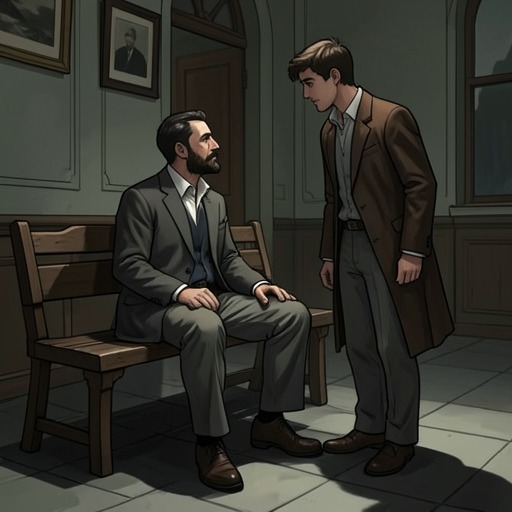
Mr. Wishnow
The Plot Against AmericaMr. Wishnow is the Roths’ downstairs neighbor, a Metropolitan Life Insurance Company agent whose prolonged illness and suicide make him a defining presence in Philip’s childhood. Though Philip knows him chiefly through his cough, his family’s care, and the circumstances of his death, Mr. Wishnow’s absence reshapes the lives of both boys: Seldon loses his father, while Philip becomes entangled in the loneliness and fear left behind.
Identity and Illness
Like Herman Roth, Mr. Wishnow works as an insurance agent for the Metropolitan. For more than a year, however, he has been on disability because cancer of the mouth and throat has left him too ill to work. He spends his days at home, listening to radio serials when he is awake and not coughing uncontrollably. The cough reaches Philip even in the cellar, where its sound seems to come from the darkness and makes the already frightening space feel inhabited by suffering as well as by the dead.
Illness alters the household’s livelihood as well as its routines. With the home office’s approval, Mrs. Wishnow takes over her husband’s work, becoming the first female insurance agent in the history of the Newark district. She keeps the same long hours as Herman, while Mr. Wishnow remains at home, increasingly dependent on others. His physical debility is made unmistakable when the boys bring him food: he waits in his pajamas with a napkin tucked into his collar, but looks scarcely able to feed himself.
Care and Domestic Encounters
Before she begins work at Hahne’s, Bess Roth checks on Mr. Wishnow several times a day. When Mrs. Wishnow cannot get home in time to prepare dinner, Bess makes extra food, and Philip and Sandy carry warm plates downstairs for Mr. Wishnow and Seldon. The gesture is practical and habitual, but it also brings the children face to face with an adult’s suffering. Mr. Wishnow asks whether the boys are all right and invites Philip to tell him a joke. His gentle, defensive joviality persists even as Philip struggles to look at a man who is visibly dying.
The visits bring Philip into closer contact with Seldon. When his father’s medicine needs refilling, Seldon asks Philip to accompany him to the drugstore. Philip feels obliged to go because he understands that Mr. Wishnow is doomed and that Seldon seems not to acknowledge it. The errand often ends at the chessboard in the Wishnow apartment. Mr. Wishnow had taught his son to play; he had once been champion at the Y, and had made their chessboard and found its wooden pieces himself. After his death, Seldon continues to recall those details as he tries to keep his father present through the game and its objects.
Death and Its Discovery
Mr. Wishnow dies by suicide in the family’s back-foyer coat closet. Weighing barely eighty pounds, he loops the living-room curtain cords around his neck after fastening them over the wooden rod, then falls forward from a kitchen chair. Seldon discovers him when he comes home from school and goes to put away his coat. The body is still in pajamas, on the closet floor among the family’s rubbers and galoshes.
The discovery brings police cars and an ambulance to the street outside the Roth home. Philip first thinks of the relief of no longer hearing Mr. Wishnow cough in the cellar or imagining that sound from his bed. The relief immediately turns into dread: he imagines that Mr. Wishnow’s ghost will join the dead he already fears beneath the house and haunt him for having felt relieved. While the neighborhood children wait to see the corpse, Philip hides with them rather than face the back hallway as the body is carried downstairs.
Bess finds Philip as the ambulance is about to leave. When he cries out that Mr. Wishnow cannot breathe, she gently shakes him and tells him that Seldon’s father died from his illness that afternoon. Philip cannot tell whether she is trying to keep him from hysteria or telling him what he wants to believe. Her explanation gives a sick child a gentler account than the circumstances he has heard, but it cannot erase what he fears he has learned about the closet and the manner of death.
What His Absence Leaves Behind
Mr. Wishnow’s death becomes a continuing condition of Seldon’s childhood. Seldon has no one to play chess with except Philip, and he repeatedly describes the board and the pieces his father chose and made. The drapes stay drawn in the apartment, both to save electricity and to keep curious neighbors from watching Seldon’s descent into fatherlessness. At home, the coat closet becomes inseparable from the death: Philip anticipates having to put his own coat there if the Roths move in with the Wishnows, and later imagines his father sleeping in Mr. Wishnow’s former place beside Mrs. Wishnow.
The possible move is a child’s fearful projection, not a change that has already occurred. Even so, it shows how the death reorganizes Philip’s sense of home and family. He imagines himself sharing a bedroom with Seldon and being subjected to the boy’s unceasing need for companionship. He would rather take the money hidden in his shoe, travel to Philadelphia, find Alvin, and care for his stump than join the Wishnow household. Mr. Wishnow’s absence thus presses Philip toward an attempted escape, while the practical strain of caring for Seldon continues to bear on both families.
Legacy in the Boys’ Story
After Philip steals Seldon’s clothes for his runaway attempt, the bereaved household is still visible in ordinary domestic details. Mrs. Wishnow sits at the kitchen table with clenched fists, watchful over her son; Philip, Sandy, and Seldon eat sandwiches while the adults’ routines briefly resume. Herman returns the Wishnows’ bridge chairs to the closet where Mr. Wishnow killed himself. The supper and radio comedy do not undo the loss: they place a fragile semblance of ordinary life beside its continuing mark.
Mr. Wishnow’s most consequential legacy is the bond formed under the pressure of his absence. When Philip is injured during his escape, Seldon follows him into the dark, runs back to alert the Roths, and guides them to the place where Philip lies. Seldon saves his life. The boy who had seemed to Philip an unwanted burden becomes his rescuer, and his father’s death stands in the background of that reversal: Seldon’s loneliness has made him persistently attentive to Philip, and that attention proves decisive. Mr. Wishnow is therefore more than the subject of a neighborhood tragedy. Through the care he receives, the objects and habits he leaves behind, and the son who acts in his stead, his death binds fear to obligation and loss to an unexpected act of rescue.