National Guard
The Plot Against AmericaThe National Guard is deployed across the country during the October 1942 political crisis that follows Charles A. Lindbergh’s disappearance. First presented as part of the machinery enforcing martial law, it is later directly addressed by Anne Morrow Lindbergh, whose appeal to disarm and return to civilian life makes the Guard’s allegiance a question in the struggle to restore constitutional government.
Deployment Under Martial Law
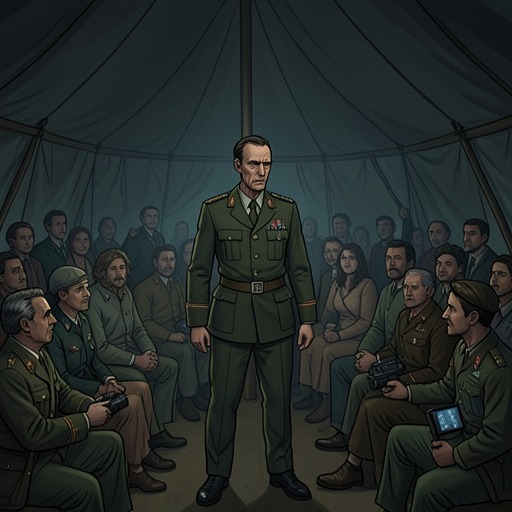
By the morning of October 9, martial law has been imposed throughout the continental United States and its territories and possessions. Acting President Burton K. Wheeler announces that law and order outside Washington, D.C., will be maintained by the National Guard in cooperation with the Federal Bureau of Investigation and local police. The Guard is thus assigned a nationwide domestic-security role while the president’s whereabouts remain unknown and the government describes his disappearance as a kidnapping.
The emergency measures extend beyond the Guard’s deployment: the borders with Canada and Mexico are sealed, and airports and seaports are shut down. In this setting, the Guard’s presence in the streets gives the administration’s declaration of martial law a visible, coercive force.
Riots and Federal Reinforcement
The Guard’s patrols do not prevent anti-Semitic riots from breaking out after sundown. They begin in eleven states and continue through the night and into the morning, with rioters setting fires. Federal troops sent by Wheeler to support Guard units are not able to quell the disturbances until approximately eight o’clock the next morning. By then, 122 American citizens have been killed.
The episode exposes the distance between the administration’s claim to be maintaining order and the violence unfolding under its emergency rule. The Guard is charged with keeping order, yet the scale and spread of the riots require federal military reinforcement before the worst fires and disturbances can be brought under control.
Anne Morrow Lindbergh’s Appeal
On October 16, Anne Morrow Lindbergh broadcasts from a concealed transmitter after escaping from Walter Reed Army Hospital, where the authorities had held her under guard. She asks all National Guard units to disarm and disband and their members to return to civilian life. In the same address, she calls on the armed forces to leave the cities and regroup at their home bases under authorized senior officers, and demands the release of people detained on accusations of conspiring against her husband.
Her appeal recasts the Guard’s duties as a matter of lawful authority: rather than continue to serve an acting administration she calls illegal, its units are asked to withdraw from the streets. She also demands that Congress remove Wheeler and follow the Presidential Succession Act of 1886, linking the return of the Guard to civilian life with a broader restoration of constitutional procedures.
Role in the Crisis
The Guard’s appearances mark two stages in the breakdown of political order: its deployment helps enforce nationwide martial law, while its patrols, even with federal support, fail to stop a deadly wave of anti-Semitic violence. Anne Morrow Lindbergh’s broadcast then makes the same force a potential participant in ending the emergency, asking it to disarm and leave the cities. The account records that appeal and the subsequent dismantling of Wheeler’s administration, but does not specify how individual Guard units responded.