New York City
The Plot Against AmericaNew York City serves as a national political stage in the novel, where broadcast rhetoric, street campaigning, public mourning, and emergency rule turn abstract conflict into urban experience. Its importance lies not only in its size or political prominence but in the way its communications and civic spaces gather people: a radio voice can reach far beyond the city, a soapbox can draw a crowd, and a funeral procession can become a public challenge to the government.
Media, politics, and the national audience
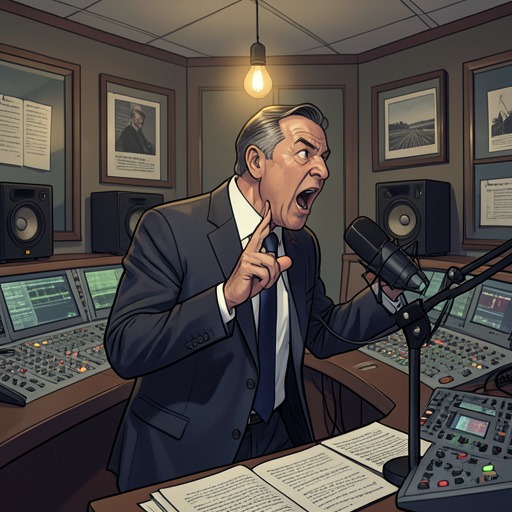
The city’s influence is established through Walter Winchell, whose Sunday-night radio program and widely syndicated newspaper column make him a national figure. His rapid delivery and reputation for exposing political and social wrongdoing help explain why his attacks on Charles A. Lindbergh carry weight beyond New York City. The narrative presents Winchell as a man connected to several kinds of power: he is a broadcaster and tabloid columnist, but also a familiar presence to political figures and a force feared by his opponents. His New York identity and public platform make the city a point from which resistance can be transmitted across the country.
That media role becomes especially important in the account of Lindbergh’s rise. In the wake of the nomination, newspapers and public commentary provide counterweights to the fear felt by Jewish communities. The Newark Evening News challenges the nomination, while the New York publication PM devotes extensive coverage to Lindbergh and his political associations. Winchell’s broadcast adds a forceful voice to this opposition. The novel thus places New York City within a wider media network: the city is where prominent voices operate, but their arguments circulate nationally and affect people well beyond its boundaries.
Madison Square Garden and the campaign
Madison Square Garden becomes a major campaign venue during Lindbergh’s nationwide flying tour. With the election approaching and national polling still favoring the incumbent, Republican leaders organize a large rally to interrupt the repetitive pattern of Lindbergh’s barnstorming and create a more energetic political spectacle. The event is broadcast nationwide. Its fifteen introductory speakers represent different occupational and religious constituencies, each warning that war would damage a particular part of American life, from farming and labor to industry and religious values.
The rally’s setting gives those arguments a concentrated public form. New York City is not merely a backdrop for a campaign appearance: the Garden allows political organizers to assemble varied speakers before a mass audience and then use national broadcasting to extend the meeting’s reach. Lionel Bengelsdorf’s participation in the rally links the city’s public spectacle to a deeper dispute within American Jewish life. His support for Lindbergh is presented as a claim about Jewish loyalty and national belonging, while his prominence at the event provokes dismay among many Jews, including the Roth family. The rally therefore brings electoral strategy, mass persuasion, and contested communal representation into the same urban space.
Winchell’s street campaign
On September 8, 1942, Winchell begins a congressional campaign in New York City, speaking from a soapbox at Broadway and 42nd Street. His appearance recalls his earlier presidential-campaign announcement from the same wooden platform. The street setting changes the character of his political work: instead of addressing listeners through the radio, he confronts people gathering around him in the city. Within minutes, mounted police are diverting traffic as working people arrive to see and hear him.
That day, Winchell carries his message through Manhattan neighborhoods, with sharply different responses. He is largely ignored at Wall Street, shouted down in Little Italy, ridiculed in Greenwich Village, intermittently cheered in the Garment District, and welcomed by Roosevelt-supporting Jews on the Upper West Side. In Harlem, a crowd gathers at Lenox Avenue and 125th Street, but most listeners remain unconvinced. The route makes the campaign’s limits as visible as its reach: Winchell can draw people into the street, but the city’s distinct communities do not respond as one audience.
Winchell then spends a full day in each of the other four boroughs before traveling north to Connecticut and onward through Rhode Island and Massachusetts. The account distinguishes the broad itinerary from the campaign’s uncertain political effect. His former newspaper treats the effort as self-promotion, and Democratic congressional candidates avoid associating themselves with his rhetoric. New York City is the campaign’s point of departure, but it cannot by itself supply either a unified constituency or an assured electoral result.
Assassination and public mourning
After Winchell is killed at a political rally in Louisville, his body is brought overnight by train to Pennsylvania Station. The arrangements announced in the narrative give New York City the role of receiving and publicly honoring him: the coffin is to lie in state in the station’s great hall, and a funeral service is scheduled at Temple Emanu-El. The scale of the planned observance makes the city a national forum for interpreting the assassination, not simply the place where the dead man is buried.
The subsequent account records thirty thousand mourners filing past Winchell’s flag-draped coffin at Pennsylvania Station. Fiorello La Guardia has made the killing the occasion for a citywide day of mourning for American victims of Nazi violence. Black buttons asking where Lindbergh is circulate outside the station and at other locations. At noon, the City Council’s decree produces a minute of silence across the five boroughs. The funeral cortege then travels from Penn Station through the city toward Temple Emanu-El, accompanied by a police honor guard and led by La Guardia in a motorcycle sidecar.
The memorial service joins civic, religious, and political authority. La Guardia recites a Christian prayer and then, in Hebrew, a Jewish prayer for the dead; loudspeakers carry the service beyond the synagogue to crowds gathered in Manhattan neighborhoods. His repeated question about Lindbergh becomes a public refrain, taken up by listeners outside the temple. The urban geography of the ceremony matters: the station, streets, synagogue, and loudspeakers make mourning both a communal ritual and a political demonstration.
At the service, Franklin D. Roosevelt endorses La Guardia as a national-unity candidate against Lindbergh’s effort to win a second term in 1944. The endorsement transforms the funeral into a moment of political reorganization. New York City’s capacity to gather mourners also gives national opposition a visible center, as the city’s mayor and former president use a public memorial to challenge the sitting administration.
Emergency rule and the city under pressure
Later, New York City becomes a focal point of the federal crackdown during the political crisis. La Guardia joins Eleanor Roosevelt and Roger Baldwin in demanding the release of Governor Lehman and other arrested figures; La Guardia is then arrested at the mayor’s mansion. When Franklin D. Roosevelt travels from Hyde Park to address an emergency protest rally convened by a citizens’ committee, police take him into custody, ostensibly for his protection.
The military measures described in the narrative alter the city’s public life directly. The Army shuts down newspaper offices and radio stations in New York, imposes a round-the-clock curfew after dark, and closes the bridges and tunnels leading into the city with tanks. These actions strike at the same networks and spaces that had enabled dissent: the press and radio that circulated political arguments, the streets where crowds assembled, and the routes connecting New York with the surrounding region. New York City’s movement through the novel—from media center and campaign arena to site of mass mourning and restricted access—gives the national crisis a concrete civic geography.