Newark
The Plot Against AmericaNewark is the Roth family’s home and the central city through which the novel measures the changing security of Jewish-American life. Its streets and institutions first appear as the ordinary geography of childhood: a family apartment, a nearby church and orphanage, school routes, local businesses, and the hospital where neighborhood children were born. As political pressure and violence intensify, those same streets become spaces of surveillance, armed confrontation, and threatened departure. Newark’s significance lies in this transformation: it remains the family’s home even as the possibility of living there safely becomes uncertain.
Neighborhoods and everyday geography
The Roth family lives in a five-room second-story apartment in Newark, while several of the family’s produce-business uncles live in nearby Maplewood, in large houses with lawns and Cadillacs. The contrast gives the city’s geography a social dimension. The family’s circumstances are modest beside the uncles’ prosperity, although Newark’s commercial life offers the family a close view of the enterprise behind that wealth. Monty Roth made his fortune wholesaling fruit and vegetables near the railroad tracks at the Miller Street market. His business included buying green tomatoes from Cuba and ripening them in heated rooms in his warehouse so they could be sold in winter. The enterprise, begun by Jack Roth, tied family history to the practical, competitive economy of the city.
The western edge of Weequahic is described as Newark’s Jewish frontier, built up after older institutions already occupied the area. Near the neighborhood stood St. Peter’s, a Catholic parish whose church grounds covered several blocks. Its bell tower, steeple, rectory, school, and orphanage formed a substantial presence in a district the Jewish children understood as culturally separate. The orphanage housed about a hundred children, alongside a smaller number of local Catholic pupils, and the school and orphanage were run by German nuns. The narrator recalls Jewish children crossing the street when the nuns approached, a childhood response that conveys how sharply the neighborhood’s religious boundaries could be felt even in a generally tolerant household.
Other local landmarks made childhood movement through Newark precise and habitual. Beth Israel Hospital, nearly a mile down the Lyons Avenue hill from St. Peter’s, was where the narrator and the boys he knew had been born. Chancellor Avenue and Summit Avenue marked familiar routes between home and school. These places are not merely a backdrop: they make the neighborhood small enough for children to recognize one another’s routines, and for a disturbance outside one house to become a matter of collective attention.
Local power, work, and public figures
Newark’s political life is represented through both formal office and informal influence. Meyer Ellenstein, a former dentist and lawyer, became mayor in 1933 after being chosen by the city’s fellow commissioners. He was Newark’s first and only Jewish mayor and served two terms, ending in 1941. His successor, Vincent Murphy, served from 1941 to 1949 and was also a major figure in New Jersey labor politics. These changes in city leadership form part of the background to a period when residents look to local authorities for protection and watch closely to see whose interests the authorities will serve.
The city’s power structure also includes the competing reach of organized crime. Ruggiero Boiardo, a Newark crime figure with strong influence in the Italian First Ward, was a local rival of Longy Zwillman, whose criminal operations extended across New Jersey. During the crisis, Newark’s mayor is described as seeking to remove dangerous figures from the streets and to signal that Longy Zwillman no longer held an honored position in city government. The story presents these relationships as rumors and political calculations rather than as a simple account of municipal authority: local power is divided among elected officials, police, and figures whose influence is less official but widely understood.
Religious leadership also shapes Newark’s capacity to respond. Rabbi Prinz, rabbi of Temple B’nai Abraham from 1939 to 1977, is credited with retaining influence among those in power. During the period described, that influence matters because, as the narrator’s father understands it, no Jewish family in Newark has yet been forced to relocate. The protection is limited and precarious, however. It cannot remove the wider fear that discrimination could become government-sanctioned persecution.
A neighborhood under pressure
The city’s sense of danger sharpens after anti-Semitic violence elsewhere. A synagogue in Cincinnati is firebombed and burns, while Jewish-owned stores in several other cities are attacked. In Newark, school officials respond with a special assembly for pupils in grades four through eight. The principal, a representative of the Board of Education, a deputy from Vincent Murphy’s office, and the PTA president explain safety measures and distribute instructions for children and parents. Police are assigned to the school doors and corridors, and families are told to expect extra patrols in the neighborhood. The protections are practical and visible, but their very presence changes the ordinary school day into a lesson in public danger.
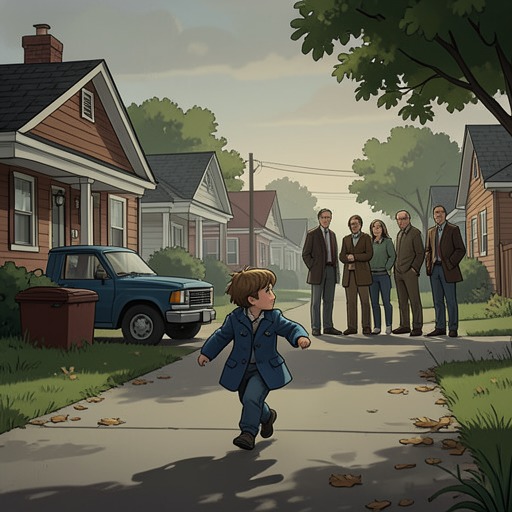
The neighborhood’s children also witness the abrupt arrival of emergency services at home. Three police cars stand outside the Roths’ building, an ambulance blocks the alley, and adults gather on their stoops while children peer from across the street. The immediate cause is the death of the downstairs neighbor, Mr. Wishnow, who has died by suicide; his son, Seldon Wishnow, discovers him after returning from school. The narrator first feels relief that the sick man’s coughing will no longer frighten him, then imagines that the dead neighbor may become another of the ghosts associated with the family’s cellar. The episode places death inside the ordinary architecture of the block and registers how a child’s private fears can attach themselves to public events.
A later night of gunfire brings the city’s conflicting forms of authority into the same residential area. The firing lasts less than an hour, and the family remains indoors until dawn. Mr. Cucuzza eventually scouts the area and learns that the shooting was between city police and the Jewish police, not between police and anti-Semites. Three Jewish men are killed: Duke Glick, Big Gerry, and Bullet Apfelbaum. The deaths are not presented as proof that a pogrom has taken place; the account says that the men were also targets of a new mayor seeking to clear the streets and curb Longy Zwillman’s influence. Still, the location of the shooting, within earshot of the Roth home and near streets children use on their way to school, makes the distinction between a political clash and anti-Semitic violence less reassuring than it might otherwise seem.
Newark as home and threatened point of departure
The morning after the gun battle, the local crisis becomes a family decision. Herman Roth phones Shepsie Tirschwell in Winnipeg and admits that Bess Roth and the Tirschwells had been right about the dangers they feared. He has spent much of the conflict trying to preserve reason and ordinary life, but the shootings have shaken his confidence that those habits can keep the family safe. The call turns to emigration and the arrangements required to leave. As Philip Roth and Sandy Roth leave for school, they understand that their family is preparing to flee Newark and become foreigners. The narrator weeps on the way to school and recognizes the end of the American childhood associated with the city.
That departure is threatened rather than completed. The narration later states that Lindbergh is gone, the family is safe, and the nightmare has ended. But the return to safety does not restore the earlier confidence: Newark remains the birthplace and home of the Roth family, yet the narrator cannot recover the child’s former sense that a protective republic and responsible parents made security dependable. The city’s literary role therefore depends on both continuity and reversal. Its streets, schools, markets, and religious institutions remain recognizable, while the meaning of living among them changes under political pressure. Newark is at once the setting of an intimate neighborhood childhood and the place from which the family nearly has to escape.