Newark Committee of Concerned Jewish Citizens
The Plot Against AmericaThe Newark Committee of Concerned Jewish Citizens was a civic response to the prospect that anti-Semitic violence spreading elsewhere might reach Newark’s Jewish neighborhoods. Its organizing joined prominent community figures with city and state officials to plan for public safety; alongside it, a separate volunteer force prepared for the possibility that authorities would not act effectively. The two efforts reveal the difference between seeking protection through law and preparing for danger outside its guarantees.
Formation and Purpose
After Detroit’s anti-Jewish violence, Newark’s roughly fifty thousand Jews faced the prospect of serious disorder in a city of more than half a million. The concern was not simply that Walter Winchell might visit New Jersey: residents also feared that unrest could spread to cities where Jewish neighborhoods bordered large working-class Irish, Italian, German, and Slavic communities. The account describes the expectation that organized bigots could turn these local tensions into a destructive mob, rather than reporting an attack on Newark itself.
Almost overnight, Rabbi Prinz and five other prominent Newark Jews established the committee. It was conceived as a practical, local body: its immediate purpose was to prepare for the worst possibility by enlisting public authorities and arranging contingency planning. The committee’s example was soon followed by similar ad hoc Jewish citizens’ groups in other large cities, giving a local initiative a broader model for community preparedness.
Work with Public Authorities
The committee first arranged a meeting at City Hall with the mayor, the police chief, the fire chief, and the director of public safety. The meeting also marked a change in the city’s political leadership: Vincent Murphy presided, having taken office after Meyer Ellenstein’s eight-year tenure as mayor. The committee then went to the State House in Trenton to meet the Democratic governor, Charles Edison, the superintendent of the New Jersey State Police, and the commanding officer of the New Jersey National Guard.
David T. Wilentz, the state attorney general and an acquaintance of all six committee members, attended the Trenton meeting. In a bulletin to New Jersey newspapers, the committee reported that he had assured Rabbi Prinz that anyone who assaulted Newark’s Jews would be prosecuted to the full extent of the law. The assurance offered a clear legal promise, while the meetings themselves sought to turn that promise into coordination among city and state authorities before violence reached Newark.
The committee also tried to bring the federal Jewish-affairs adviser into its consultations. It telegraphed Lionel Bengelsdorf requesting a meeting in Washington, but was told the matter was local rather than federal and advised to continue working with state and municipal officials. The response reinforced the committee’s reliance on local and state channels, even as the danger it feared was described as part of a wider national crisis.
Membership and Community Standing
The six members represented several forms of Newark’s civic leadership. Alongside Rabbi Prinz and former mayor Meyer Ellenstein were Jenny Danzis, a longtime civic leader associated with immigrant-child Americanization programs in the Newark school system and the wife of Beth Israel Hospital’s leading surgeon; Moses Plaut, a department-store executive and ten-time president of the Broad Street Association; Michael Stavitsky, a prominent property owner and former president of the Newark Conference of Jewish Charities; and Dr. Eugene Parsonette, chief of Beth Israel’s medical staff.
The committee’s composition gave its appeal the weight of established civic, commercial, charitable, and medical institutions. Yet its respectable public standing did not encompass every source of power in Newark’s Jewish community. Longy Zwillman, a wealthy and influential local racketeer who was also described as distressed by the anti-Semitic threat, was not recruited to join. His absence from the committee foreshadowed a parallel approach to protection, organized beyond the official meetings.
Parallel Preparations and Significance
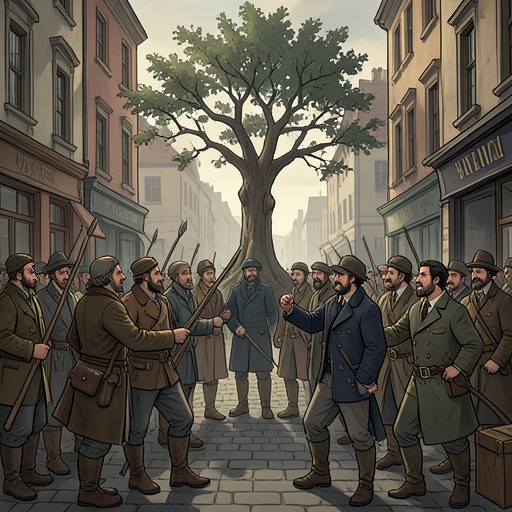
Separately from the committee and the authorities who had promised cooperation, Longy Zwillman decided that Newark’s Jews should not be left unprotected if police and state troopers responded no more vigorously than officials had during disorder in Boston and Detroit. He assigned his close associate Bullet Apfelbaum to supplement the committee’s efforts by recruiting local young men for a hastily assembled volunteer corps called the Provisional Jewish Police. This was a distinct undertaking, not a committee program: the committee pursued contingency planning through public institutions, while Longy’s organization prepared a community force in case those institutions failed to respond.
The committee therefore occupies a crucial middle ground in the novel’s account of threatened civic order. Its members did not treat danger as merely private anxiety; they translated it into meetings, official contacts, and a reported promise of prosecution. But the simultaneous creation of the Provisional Jewish Police shows the limits of reassurance. In Newark, the demand for safety moved along two tracks at once—through the machinery of law and through preparations made by people who doubted that the machinery would be enough.