Perpetual fear
The Plot Against AmericaPerpetual fear is the emotional condition that organizes the narrator’s memories of growing up Jewish in an America led by Charles A. Lindbergh. It begins not as an abstract political judgment but as a family’s and neighborhood’s bodily response to an unexpected presidential nomination. As public assurances of peace coexist with antisemitism and uncertainty about Jewish safety, fear becomes at once a child’s private terror and a community’s sustained vigilance.
A Childhood Recalled Through Fear
The chapter headed “Perpetual Fear” names the force that presides over the narrator’s account of childhood. The adult narrator acknowledges that childhood is never free of terrors, but wonders whether he would have been less frightened had Lindbergh not become president—or had he not been born to Jewish parents. That qualification gives the fear two sources that cannot be separated: the ordinary vulnerability of a child and the extraordinary political danger perceived by a minority family.
The memories begin with the shock of Lindbergh’s presidential nomination in June 1940. The narrator’s family is presented in specific circumstances rather than as an abstraction: his father is thirty-nine, a grade-school-educated insurance agent earning just under fifty dollars a week; his mother, thirty-six, had given up the hope of teachers’ college because of its expense and carefully managed the household budget. Sandy, twelve, is a seventh-grader with an exceptional gift for drawing. The narrator is seven, a third-grader and an emerging stamp collector. These details establish the ordinary domestic world whose security the political crisis unsettles.
The Nomination as a Household Shock
When the nomination is announced, the family is woken by neighbors shouting “No!” The children return to the radio with the adults. Their mother sits beside their father in a robe over her nightdress, fingers pressed to her mouth; Alvin cannot stay seated and paces the small room with the force of someone seeking an enemy. Fear is registered through gestures and movement before the children can fully understand the political stakes.
The disturbance spreads from the radio into the street. Families emerge at dawn in pajamas, nightdresses, bathrobes, and slippers, while men who are usually lighthearted neighbors or quiet breadwinners curse openly. The narrator remembers the anger as transformative: ordinary people who had believed their families had escaped an earlier, miserable struggle are abruptly made to feel exposed again. The absence of a new attack in Lindbergh’s nomination speech does not reassure them. They interpret his silence about Jews as a possible deception, a way to lull them and catch them off guard. Their fear thus attaches not only to explicit hostility but also to uncertainty about what apparent restraint conceals.
The neighbors’ alarm reaches for historical comparisons beyond their immediate surroundings, including the Kishinev pogroms. The recollection emphasizes how quickly a political shock can displace confidence in present-day protections: although Franklin D. Roosevelt and the Constitution remain sources of possible security, the street’s response is an atavistic feeling of being undefended. Reports of Roosevelt’s defiant reaction to Lindbergh’s nomination bring the family some solace the following day, but that reassurance does not erase the initial shock.
Fear Inside the Child’s Private World
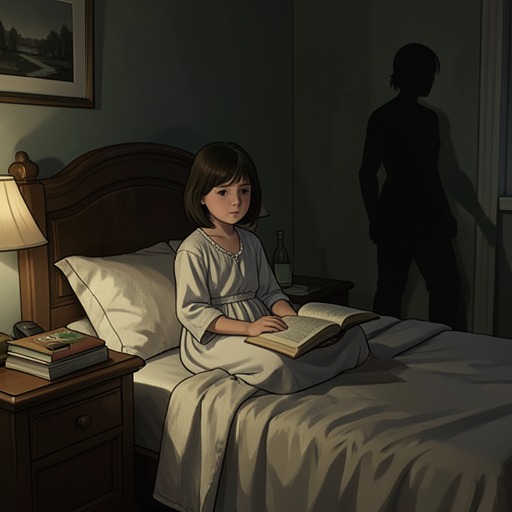
The narrator’s fear appears in sleep as well as in political conversation. After Lindbergh’s appearance at Newark Airport, he falls out of bed for the first time in years; his parents place kitchen chairs beside the mattress to keep him from rolling out again. He denies remembering a bad dream, yet privately recognizes that Lindbergh drawings kept in Sandy’s portfolio haunt him whenever he tries to sleep. The discrepancy between what the child says and what he knows gives the fear a private, guarded form.
The drawings also turn the brothers’ relationship into part of the narrator’s anxious landscape. Sandy is the brother whose reassurance the younger boy most needs, but the images beside the bed make him feel unapproachable. The narrator wants the drawings hidden in the cellar storage bin, yet cannot ask for that because he has promised not to reveal their existence. He also cannot bring himself to part with his own Lindbergh stamp. The feared figure is therefore present through two contrasting objects: the images that disturb him and the stamp he continues to collect. His attachment to the stamp does not cancel his dread; it shows how fear can coexist with a child’s fascination and ordinary habits.
Public Reassurance and Political Uncertainty
As the novel’s political situation develops, assurances that the country will remain at peace sharpen the contrast between public confidence and private alarm. After the Iceland and Hawaii Understandings, many Americans celebrate the promise that there will be no war and no young men dying overseas. Jewish elders, by contrast, speculate about what may be done to them, whom they can trust, and how they might protect themselves. Children return from school frightened by older boys’ stories about what Lindbergh and Adolf Hitler may have said about Jews during their meals in Iceland.
The Roth parents decide to continue with long-planned travel to Washington, D.C., partly to convince Sandy and the narrator that the change of president has not made America a fascist country. Their argument recognizes both continuity and danger: the administration is Republican and isolationist, and it includes antisemites, but the parents distinguish that fact from a claim that the country has already become Nazi. Newspapers and reporters also matter as evidence that political scrutiny remains possible. The father reads PM, and the family follows critical voices including Walter Winchell and Dorothy Thompson. For the narrator, holding the newspaper becomes tangible proof that, despite the speed with which Jewish Americans’ standing seems to be changing, the country still has a free press.
Fear at the Lincoln Memorial
The Washington trip makes the divide between patriotic reassurance and felt insecurity visible at the Lincoln Memorial. After an encounter that has shaken the family, the father urges everyone to take one last look at Abraham Lincoln and insists that the incident should not ruin the trip. The narrator cannot recover the earlier rapture of patriotism. Descending the marble staircase beside his frightened mother, he feels that he ought to become brave enough to support her, with something of Lincoln’s courage attached to him. But what he can actually do is take her offered hand and clutch it.
That gesture brings the concept back to the child’s scale. His stamp collection still represents most of what he knows about the world; he cannot turn a national monument or a parent’s encouragement into certainty. Perpetual fear is therefore not simply a forecast of violence. It is the continuing gap between constitutional and patriotic symbols that promise belonging and the child’s perception that his family may be unprotected. The chapter title gathers these recurring pressures—political hostility, fearful rumors, disturbed sleep, guarded speech, and the effort to reassure children—into a single condition that follows the narrator through otherwise ordinary family life.