Philip Roth
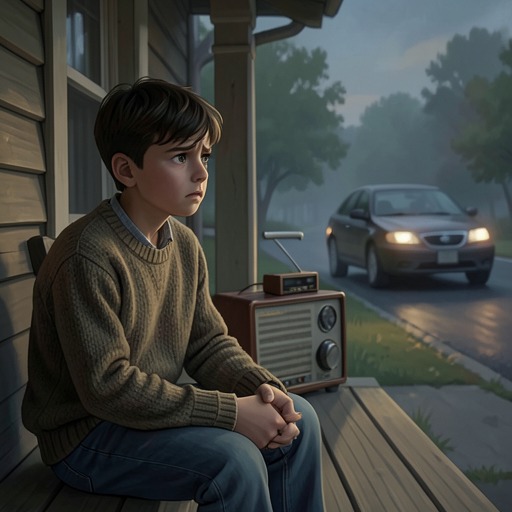
The Plot Against AmericaPhilip Roth is the child narrator whose recollections turn the political crisis surrounding Lindbergh’s presidency into a history of childhood fear. At seven, he watches public events unsettle the security of his family and neighborhood, while trying to make sense of experiences that arrive faster than he can absorb them. His stamp album, his attention to adult conversations, and his eventual attempt to leave home make his childhood both specific and inseparable from the larger danger around him.
Identity and Background
At the time of Lindbergh’s Republican nomination in June 1940, Philip was a third-grader, a term ahead of his class, and an emerging stamp collector. He lived with Herman Roth, Bess Roth, and his twelve-year-old brother Sandy in a second-floor flat in Weequahic, the Newark neighborhood where the family’s ordinary routines had long felt secure. Herman worked as an insurance agent, earning just under fifty dollars a week; Bess managed the household budget carefully, and Sandy had an exceptional talent for drawing. The family’s modest means and close domestic life establish the everyday world Philip fears losing.
His childhood imagination also formed around national heroes. Lindbergh’s solo flight from Long Island to Paris in the Spirit of St. Louis coincided with the day Bess discovered she was pregnant with Sandy. The family preserved that coincidence as an anecdote, and Sandy later drew Bess pointing toward the plane above Newark while realizing she had conceived. For Philip, this joined the aviator’s public legend to family mythology. That inherited admiration makes Lindbergh’s later political prominence feel not merely remote or partisan, but like an assault on the safe world that had helped shape Philip’s earliest understanding of America.
A Child’s Political Inheritance
By the time Philip began school in 1938, Lindbergh’s name already provoked indignation at home, alongside the radio broadcasts of Father Coughlin, whose antisemitic rhetoric reached a large audience during the Depression. The previous year, Kristallnacht had brought the destruction of Jewish homes, businesses, and synagogues in Germany, as well as the forced removal of Jews to concentration camps. When Lindbergh declined to return the Service Cross of the German Eagle after the pogrom, Philip’s later account presents the choice as part of the political context that made the aviator’s nomination frightening to his family.
Philip describes Lindbergh as the first famous living American he learned to hate, in contrast to Franklin D. Roosevelt, whom he was taught to love. The 1940 nomination therefore unsettles more than a child’s political preference: it shakes the sense of protection Philip had taken for granted as a Jewish boy in an American school, city, and family. His memories register the collision of national politics with domestic security through a child’s limited but increasingly alert perspective.
Family Conflict and Sudden Loss
As the political situation intensifies, Philip listens to the arguments of adults without being able to settle their competing claims. Herman insists that the family should not flee, invoking the Supreme Court, the ballot box, and the possibility that good men in government will uphold the law. Bess questions whether there will be time to wait for the election. Their argument exposes Philip to the uncertainty beneath the household’s ordinary routines: even the adults cannot agree on whether the family is protected or already in danger.
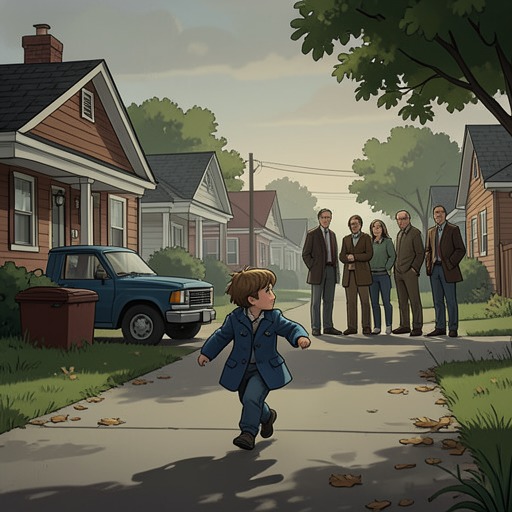
Philip’s growing awareness is sharpened by events in the apartment building. After he tells an FBI agent that Aunt Evelyn is marrying Lionel Bengelsdorf, who heads the Office of American Absorption, Philip runs home rather than remain in the agent’s company. He finds police cars outside, an ambulance blocking the alley, and neighbors gathered on their stoops. Mr. Wishnow, the family’s downstairs neighbor, has died by suicide; his son Seldon discovered him in a closet. Philip’s first response includes relief that he will no longer hear the dying man’s cough when alone, followed by confusion and shock at what Seldon has witnessed.
The death disrupts Philip’s sense of what can be known or trusted. He wonders what the law means, whether Herman is truly alive, and whether the FBI questioning he remembers might have been a dream. He describes himself as having to grow up at an accelerated pace. When he urges Sandy to call Bess, he begins vomiting and collapses; the narration suddenly presents the image of his leg blown off and blood everywhere. The violent image joins private bodily terror to the surrounding wartime atmosphere without giving the child a stable explanation for what he is experiencing.
The Attempt to Leave Home
After seeing Aunt Evelyn’s visit to the White House in a newsreel, Philip is confronted by Mr. Tirschwell, who rebukes his tears and points to the suffering he has just witnessed. Philip says he wanted to see his aunt, but the encounter makes clear that the adult’s anger is directed at more than the child. Philip experiences the newsreel and the adults’ reactions through a mixture of fascination, confusion, and fear rather than a settled political judgment.
Later, Philip decides to leave home and head toward the orphanage grounds. He rejects the explanations his parents eventually offer, including that he was sleepwalking, and insists that he was awake and knew his purpose. He does not want to imitate Sandy’s ambition to become a boy caught up in history; he wants, instead, to become an orphan and disappear from the danger gathering around his family. The decision is deliberate in his own account, though success remains uncertain.
Before leaving, he changes into Seldon’s pants in the dark storage bin, trying to ward off the memory of Mr. Wishnow and the sight of Alvin’s empty wheelchair. He takes his stamp album, unwilling to leave it vulnerable to being broken up, discarded, or given to another boy. He also takes a musket-shaped letter opener bought at Mount Vernon, the tool he used to open the stamp approvals sent to him from Boston. These objects make the attempt more than a flight from home: even as he tries to abandon his life, he carries the small possessions that preserve its familiar order.
Narrative Role and Significance
The account of Philip’s attempted escape is shaped by a gap in his memory. He recalls leaving the house and starting down the empty street toward the orphanage, then remembers waking the next day in Beth Israel Hospital with his parents beside the bed and a doctor removing a tube from his nose. He had been found bleeding and unconscious. Doctors ruled out a skull fracture and nerve damage; a three-inch laceration required eighteen stitches, and he had no memory of the blow itself. The missing interval preserves the limits of a child’s knowledge rather than resolving the episode into a clear adventure.
Philip’s significance lies in this tension between acute observation and incomplete understanding. He remembers concrete details—the police cars, the closet, the album beneath his clothes—with striking precision, yet the political forces connecting those moments remain frighteningly difficult for him to grasp. His account makes national history intimate by showing how it is registered in family arguments, neighborhood emergencies, bodily panic, and a boy’s choice to take his stamps with him when he tries to get away.