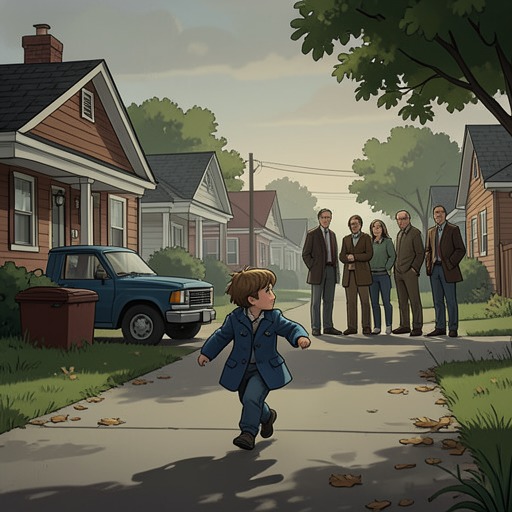
Philip tries to escape to Boys Town
The Plot Against AmericaPhilip’s attempt to escape to Boys Town is a plan for flight built out of fear and guilt rather than a completed journey. Facing the prospect of Seldon Wishnow’s return, Mrs. Wishnow’s funeral, and a political crisis that seems to threaten everyone around him, Philip imagines erasing his identity and beginning again far from Newark. His practical preparations lead him toward a cellar that he associates with the family’s past, where an unexpected voice stops him before he can leave.
Crisis and the decision to run
Joey Cucuzza’s arrival as a new boy downstairs becomes the immediate occasion for Philip to decide that he cannot stay. Joey demonstrates his hearing aid, turning nearby sounds into an experience that Philip finds overwhelming. At the same time, Philip is preoccupied by reports that Fiorello La Guardia, Franklin D. Roosevelt, and Lionel Bengelsdorf have been arrested. He imagines that the new boy will be as difficult to live with as Seldon, and his thought leaps from the domestic inconvenience of sharing a house to the danger outside it.
Philip’s list of what he wants to escape includes Seldon’s return, anti-Semites, the arrival of Mrs. Wishnow’s body, and the funeral he will have to attend. He also wants to flee what he has done and what he has failed to do. The thought gives his plan a double purpose: he would be running from external threats as he understands them, and from responsibility for the consequences of the family’s decisions. He believes that he helped make Seldon a target and that Mrs. Wishnow’s death has left the boy an orphan. His proposed departure is therefore not simply a bid for safety; it is also an attempt to remove himself from the life in which that guilt has taken shape.
The fantasy of starting over depends on becoming unknown. Philip first imagines going to Elizabeth and claiming to be deaf and mute, so that he could find work at a pretzel factory without having to explain who he is. He pictures himself as a boy whom nobody knows, separated from his family, his past, and the events that have made home seem unlivable. The plan offers a sharp contrast to his actual dependence on his family: in imagination, he can make himself both unrecognizable and self-sufficient.
The pretzel factory as an escape route
Philip’s first destination is not his final one. He remembers an article in the Sunday Call about a factory owned by Mr. Kuenze, which he had clipped while preparing a school report on a New Jersey industry. The article said that pretzel-making could be taught quickly to anyone capable of learning. It also reported that the factory employed deaf-mutes, as well as boys and girls who worked after school. Those details allow Philip to turn a desperate disguise into a seemingly workable plan: he can present himself as deaf and mute, ask for a job, and claim that he is an orphan who wants to learn.
The article’s particulars matter because Philip treats them as instructions. He remembers that Mr. Kuenze had one hundred employees and that he considered salt in the dough essential, while salt on the outside was included only to satisfy customers. Philip does not need to master the trade before arriving; the owner’s claim that a worker could be taught overnight makes the factory appear accessible to someone with no experience. A school assignment has unexpectedly become a resource for imagined escape, its ordinary facts repurposed as a route out of the family crisis.
Philip also knows which bus passes the factory. It is the same bus he and Earl Axman once took while following a Christian whom Earl had noticed on their way home to Elizabeth. Philip anticipates the possibility of encountering him again and plans to leave the bus and wait for the next one if necessary. Even in his hurried scheme, he thinks through a route, a contingency, and the paper he will need to explain himself. He drafts a note addressed to Mr. Kuenze, presenting himself as deaf and mute, an orphan, and eager to learn pretzel-making; at first, he signs it with Seldon’s name.
From a job to Boys Town
A short-term job is not enough for Philip. He recalls that his father has spoken of the need for a long-range plan, and imagines saving his wages to buy a one-way train ticket to Omaha, where Edward Flanagan ran Boys Town. Philip knows the institution through a film he saw as a five-year-old with Sandy Roth, and through his parents’ annual contribution. In his memory, Boys Town takes in boys from the street, including those who have already become thieves or gang members, and offers them food, clothing, education, baseball, choir singing, and instruction in citizenship.
The detail that Boys Town welcomes boys regardless of race or creed makes it seem to Philip like a refuge beyond the identity he wants to escape. He knows that most of its residents are Catholic, some are Protestant, and a few are Jewish. Yet he does not intend to identify himself as Jewish if he reaches Omaha. He imagines saying that he does not know what he is or who he is: the destination promises not only distance from Newark but the possibility of declining to define himself at all.
His imagined future there also reveals how closely the plan is tied to Seldon. Philip offers his family, in his thoughts, the place he would otherwise occupy: Seldon could have his bed, his brother, and his future. Philip would leave the family to raise Seldon as their own child and make a different life with Edward Flanagan in Nebraska, farther away than Kentucky. This proposed sacrifice does not undo what Philip believes he caused; instead, it converts his guilt into a fantasy of relinquishment, as if giving up his home and future could settle his debt to Seldon.
Preparations and interruption
As the plan develops, Philip changes the name on his note from Seldon Wishnow to Philip Flanagan. The new name joins the imagined orphan to the person who would care for him in Omaha, while distancing him from the name he had borrowed from the boy whose circumstances trouble him. He then goes toward the cellar to retrieve the cardboard suitcase in which he had hidden Seldon’s clothes before his earlier attempt to run away. This time, he intends to pack his own clothes. He also plans to carry a miniature pewter musket from Mount Vernon, whose small bayonet he had used as a letter opener. He regards it as the only protection he can take with him.
The descent into the cellar gives the preparations a weight that the bus route and note do not. Philip tells himself that this will be the last time he has to go down there and face the wringer, the alley cats, the drains, or the dead. He remembers the wall where Alvin, after losing a leg, had expressed his grief. The cellar collects objects and memories from the family’s life, making the intended departure feel like an effort to leave not only a house but the places where earlier distress has accumulated.
From the foot of the stairs, Philip directs his flashlight toward the unused furnaces. He imagines them as burial vaults and wonders whether Seldon’s dead father has gone to Kentucky to fetch his dead wife. He understands, however, that this imagined ghost remains with him. Philip pleads that he did not mean for the family to move and did not mean to make Seldon a target. Then he hears a woman moaning his name from beyond the furnaces. He interprets the voice as the return of someone who has died only hours earlier, but the scene does not establish the voice’s identity or what happens next.
The interruption leaves the escape attempt unresolved. Philip has assembled a destination, a new name, an employment story, a route, clothes, and a small object for protection, but the evidence ends before he leaves the cellar or begins the journey. The elaborate plan therefore exposes both his ingenuity and its limits: each practical step carries him closer to departure, while memory and fear keep drawing him back into the house.