Provisional Jewish Police
The Plot Against AmericaThe Provisional Jewish Police was a volunteer neighborhood-defense corps assembled in Newark as Jewish residents feared that anti-Semitic violence would spread to their streets. Organized separately from civic efforts to prepare for unrest, it turned a group of young men long treated as outsiders into armed local protectors, exposing the uneasy choices a threatened community faced when formal safeguards seemed uncertain.
Formation and purpose
After anti-Semitic rioting elsewhere intensified fears in Newark, the city’s Jewish residents began preparing for violence at home. The Newark Committee of Concerned Jewish Citizens sought cooperation from municipal and state officials and contingency plans for protecting the community. Longy Zwillman acted on a different track: he wanted Newark’s Jews to have protection if local police and state authorities failed to respond effectively.
To create a volunteer force, Longy assigned his close associate Bullet Apfelbaum to recruit and train young men as a cadre for the Provisional Jewish Police. The corps was conceived as a supplement to the committee’s civic work, not as a replacement for it. Its formation reflected a practical fear that official assurances might not be enough if a mob emerged.
Recruitment and neighborhood deployment
The recruits were young men who had not graduated from high school and who had previously been known in the neighborhood for fighting and petty disorder. Many were now in their twenties, occupied with activities such as running numbers, shooting pool, or washing dishes in local restaurants. Their earlier exclusion from respectable community life made their new assignment striking: people whom other families had once warned their children to avoid were now being entrusted with neighborhood security.
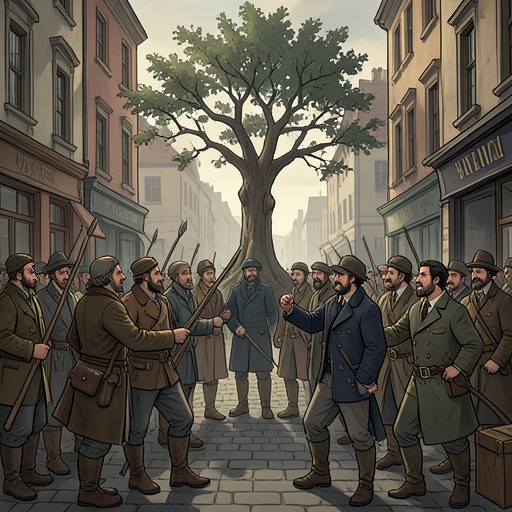
The force was visible on the streets. Its members were stationed at alternating street corners, and Bullet’s recruits approached children on Chancellor Avenue to tell them to keep baseball bats ready in case they were summoned during the night. The men also visited the Y, ball fields, and local stores to enlist able-bodied adults. Their aim was to assemble a squad of three people on each block for emergencies.
Bullet supplied revolvers from his own collection, and members carried them strapped to their calves. The corps therefore joined informal recruitment and street-level presence to access to firearms. Its organization was local and immediate: the block, rather than a distant authority, became the scale at which residents were expected to respond to danger.
Leadership and community tensions
The chain of responsibility ran from Longy, who initiated the effort, through Bullet, who recruited and trained the cadre. Bullet was known across the city as Longy’s chief enforcer. His polished appearance contrasted with his reputation for carrying out intimidation and violence on Longy’s behalf, making him an unsettling organizer for a project framed as communal protection.
The recruits, too, embodied a contradiction. They were described as the crude and troublesome figures their parents had hoped to leave behind, yet they were now cast as guardians. Their patrols brought people once kept at the margins into the center of the community’s preparations. The arrangement did not erase their earlier reputation; it made that reputation part of the force’s uneasy purpose, as their capacity for confrontation was redirected toward defending Jewish neighbors.
Place in the unfolding crisis
The Provisional Jewish Police arose alongside, but apart from, the Newark committee’s efforts to secure public protection. That distinction matters: one response worked through meetings with city and state officials, while the other prepared a volunteer street presence in case those authorities did not act. The novel presents both strategies as products of the same fear, without suggesting that either could control the larger crisis.
The danger soon became national in scale. During the October emergency, martial law was imposed across the country, while reports falsely blamed Jewish people for the riots and revived an old blood-libel accusation about the kidnapped Lindbergh child. These developments show the climate in which local Jewish self-protection had seemed necessary. The evidence establishes the corps’s recruitment, weapons, and preparations, but does not describe it taking part in a particular clash or establish what ultimately happened to the organization.