Spirit of St. Louis
The Plot Against AmericaThe Spirit of St. Louis is the monoplane that carried Charles A. Lindbergh across the Atlantic in 1927 and, in the novel, became both a treasured image of American possibility and the vehicle at the center of a president’s disappearance. Its meaning changes with its appearances: first an aviation achievement woven into the Roth family’s story, then a carefully revived campaign emblem, and finally an aircraft that vanishes without a confirmed explanation.
The 1927 Flight and Family Memory
In the spring of 1927, the Spirit of St. Louis completed a thirty-three-and-a-half-hour nonstop solo flight from Long Island to Paris. The achievement made its young pilot an international hero and seemed to promise an age of extraordinary aeronautical progress. The flight also coincided with the day Bess Roth discovered she was pregnant with her older son, Sandy. In the family stories that gave Philip Roth’s childhood a sense of coherence, the two events became joined: the plane’s passage overhead and the beginning of a new life were remembered together as a double marvel.
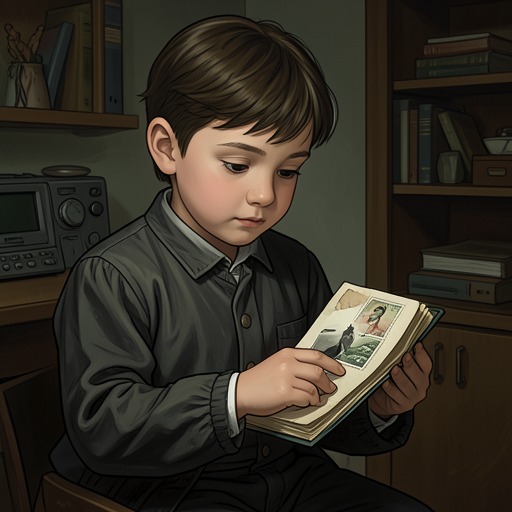
Sandy later made that family association visible in a drawing completed when he was nine. It places his mother at the busy intersection of Broad and Market in Newark, surrounded by a joyful crowd and dressed in her floral kitchen apron. One hand rests across the front of the apron; the other points toward the plane passing above downtown at the moment she realizes she has conceived Sandy. The aircraft appears not simply as a machine but as the skyborne counterpart to a private family event. In this remembered image, national fame and domestic life share the same instant, and the plane’s flight becomes part of the family’s own origin story.
That intimacy rests on the plane’s larger public meaning. For nearly a decade, Lindbergh had been a neighborhood hero as well as a national one. The aircraft gave that heroism a recognizable form: a small plane and a solo crossing made a technical feat legible as daring, self-reliance, and possibility. The family’s reverence for the pilot therefore belonged to a broader culture of admiration, even as the flight acquired a uniquely personal place in the Roths’ recollections.
The Plane Reappears in the 1940 Campaign
When the Republicans nominated Lindbergh for president, the family’s inherited admiration collided with political alarm. The Spirit of St. Louis returned to public view as the centerpiece of an unexpected campaign gesture. On the Saturday before Labor Day in 1940, Lindbergh failed to appear at the Detroit parade where he had been expected to launch his campaign. Instead, the plane had been transported under a tarp to a remote hangar at the Long Island airfield from which its transatlantic flight had begun. The next morning, Lindbergh taxied it out and took off westward across the United States.
The choice of aircraft turned the campaign’s opening into a reenactment of an older public memory. Lindbergh was no longer merely the aviation consultant, the decorated visitor to Berlin, or the candidate whose radio address had blamed influential Jews for efforts to bring the country into war. The plane presented him as the celebrated airmail pilot once again: the young, apparently unspoiled Lone Eagle remembered for having done what no aviator had done before. The journey did not set a new coast-to-coast record; a more advanced aircraft had already surpassed the old plane’s practical capabilities. Its force lay elsewhere, in the public recognition the machine carried with it.
After landing at Los Angeles Airport, Lindbergh showered, ate, and rested before flying the plane on to San Francisco and Sacramento. During the following month and a half, he spent a day in each of the forty-eight states, making frequent stops in cities and towns, sometimes landing on highways or in pastures when no airstrip was nearby. His remarks from airfields reached local radio audiences, while broadcasts from state capitals carried his message to the nation. The plane made a political tour feel like a return of the earlier aviation spectacle; its familiar presence helped frame his argument that the election offered a choice between Lindbergh and war.
The journey also exposed the gap between the plane’s aura and its physical vulnerability. Twice, bad weather left Lindbergh lost for several hours before radio contact was restored. In October, as news arrived that German bombing had struck St. Paul’s Cathedral in London, an alarming report said the Spirit of St. Louis had exploded over the Alleghenies and fallen in flames. For six hours, the report went uncorrected, and the Roths’ telephone rang as friends and relatives discussed the possibility that Lindbergh had been killed. The eventual correction was that engine trouble had forced him to land on difficult terrain in western Pennsylvania. He emerged safely from the undamaged plane and waited for a replacement part before resuming the campaign. The episode revealed how quickly the aircraft’s celebrated history could be recast as a possible site of death—and how unsettled the family remained between relief and silence.
The Louisville Flight and Disappearance
On October 7, 1942, Lindbergh again piloted the Spirit of St. Louis from Long Island, taking off from the runway associated with his transatlantic departure. With no escort, he flew over New Jersey, Pennsylvania, and Ohio before turning toward Kentucky. The White House learned his destination only an hour before he was due to land. At Louisville’s Bowman Field, a crowd estimated at more than a hundred thousand filled surrounding fields and roads. A mechanic stood ready to inspect and prepare the aircraft for its return flight.
Lindbergh addressed the crowd, then climbed back into the cockpit. After the mechanic signaled that the plane was ready, the aircraft took off eastward. Flying low over farming towns, it cleared telephone wires along Route 58 by a narrow margin and rose into the air. It was never seen again. The immediate image is one of departure: the most famous small plane in aviation history leaving Louisville, its return journey expected, but never completed.
Searchers found no wreckage along the regular route between Louisville and Washington. The Army, Coast Guard, Navy, National Guard units, and civilian volunteers searched across multiple states and along the coasts, but by the following evening there had been no reported sighting of the aircraft or its remains. The lack of physical evidence left the plane’s fate unresolved and made its absence consequential well beyond aviation. With no wreckage to establish a crash and no confirmed account of where the aircraft had gone, its disappearance became inseparable from the question of what had happened to the president.
Competing Accounts and the Plane’s Afterlife
German state radio offered one explanation: it claimed that a Jewish conspiracy had arranged Lindbergh’s kidnapping, disabled the plane’s radio, and forced the Spirit of St. Louis to land at a hidden airstrip in Canada after British fighters intercepted it. The broadcast cited purported military intelligence and blamed political opponents for the disappearance. These allegations appeared amid the crisis over Lindbergh’s absence; they were claims made by the German state, not a verified discovery of the aircraft or its fate. The plane itself remained missing, while American authorities continued searching for evidence of a crash.
The account told to the Roth family later offered another layer of hearsay. After Rabbi Bengelsdorf’s arrest, Aunt Evelyn said that Anne Morrow Lindbergh had confided details to him shortly before being removed from the White House and held at Walter Reed. The passage introduces this as the most elaborate and unbelievable story, while leaving the president’s fate unconfirmed. The novel ultimately says that Lindbergh was never found or heard from again, even as rumors and reports of supposed clues continued during the war and for years afterward.
The aircraft’s arc thus moves from a celebrated crossing, to a public relic brought back to animate a political campaign, to an absence around which competing explanations accumulate. Its importance is not that it supplies a conclusive answer: the novel provides none. Rather, the plane links personal memory to national spectacle and then to historical uncertainty. The same small machine that once made a distant horizon seem conquerable becomes the missing evidence at the center of a crisis, leaving its most consequential flight suspended between departure and disappearance.