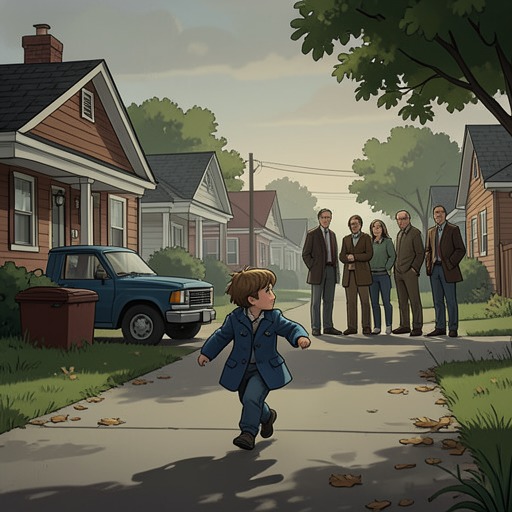
Summit Avenue
The Plot Against AmericaSummit Avenue is the Roth family's home street, but in the novel it is more than a fixed address. It anchors the routines and tensions of domestic life while opening onto bus routes, neighboring households, and the increasingly dangerous world beyond the family's five rooms. For Philip Roth, the street changes meaning as childhood independence, family estrangement, and political fear intrude on the home: it is at once a place to return to, a place people vanish from, and a boundary that can seem dangerously thin.
Home and neighborhood
The family home on Summit Avenue sits within a network of ordinary local landmarks and daily routines. The avenue is close enough to the route up which buses climb Chancellor Avenue hill for their sounds to reach Philip at school. At home, by contrast, the street is the setting for household changes that make the family feel less available to him. His mother works all day at Hahne's, while Sandy Roth works after school for Lindbergh. The shift in their schedules accompanies a more profound change: Philip has watched his father, Herman Roth, break down in grief over Alvin's lost leg, and the childhood security he had taken for granted is no longer intact.
The street also gives the Roth household a recognizable place among its neighbors. The Axmans live on Summit Avenue, and the family's departure registers not as distant news but as the physical clearing of a nearby home. Later, the Cucuzzas are close enough to offer practical help when the Roths are separated by the crisis of martial law. Summit Avenue's domestic world is therefore made of proximity: the people who live nearby can share a child's private adventures, disappear from his life, or keep him company while his family is away.
Bus journeys and childhood escape
Summit Avenue is a home base for Philip's secret excursions with Earl Axman. After school, Earl takes him along on trips to follow men from bus stops to their homes. The boys travel downtown, ride buses behind their chosen passengers, and watch from a distance as the men enter their houses. They do not go inside; the point is the illicit journey and the glimpse of lives beyond their own neighborhood. Earl's experience makes the city seem open-ended, while Philip's participation turns secret disobedience into a new form of freedom.
The return journey makes Summit Avenue part of the ritual. From Penn Station the boys catch the 14 home, completing another bus ride before Philip returns to family dinner. The contrast between the ordinary destination and the clandestine route sharpens the appeal: at home, he must resume the part of the dutiful child, while the journey has shown him that he can go farther than his parents know. Even the sound of a bus climbing Chancellor Avenue hill can draw his thoughts away from school and back toward the possibility of leaving.
The excursions end shortly before Christmas. On their final trip, the boys follow a man carrying gift-filled department-store bags on the Linden bus, through Hillside and into Elizabeth, New Jersey. The journey is followed by a sudden rupture in the Axman household: Earl's mother suffers a nervous breakdown and is taken away in an ambulance; on New Year's Day, Earl's father takes Earl and his stamp collection away. Later in January, a moving truck removes the household furnishings from the Summit Avenue home. Philip watches the house emptied, including the bureau that had been part of his mischievous visits, and the Axmans are not seen again. The street's familiar address becomes a marker of disappearance.
A threshold before Alvin's return
Summit Avenue also lies along the route of Alvin's return to the Roth household. As Philip rides home, he measures the remaining distance from a bus window: the bus passes the Riviera Hotel, where his parents spent their wedding night, and approaches B'nai Abraham, whose imposing building feels remote to him. These landmarks make the approach home feel like a passage toward an unavoidable change. Alvin is coming back after losing a leg, and the family has prepared for him by cleaning his clothes, arranging a share of Philip's bedroom, and moving Sandy's belongings to the sun parlor. The preparations cannot make the reunion emotionally simple; Philip would rather sleep alone than accept his mother's proposed arrangement for the first night.
When Alvin later visits with Minna Schapp, the home on Summit Avenue becomes the site of a hoped-for reconciliation and renewed conflict. Alvin has called to thank Herman and Bess Roth for caring for him and to introduce his fiancée. Bess, who cannot maintain a personal grudge, prepares the foods Alvin loves despite her fear of going out while violence threatens the city. He arrives in a pearl-gray suit and brings gifts: an apron for Bess, a sketchpad for Sandy, a Phillies cap for Philip, and a certificate for a free lobster dinner for Herman. The presents briefly make the household look reunited, but the old antipathy between Alvin and Herman remains, and the evening ends in a serious clash rather than a settled peace. Summit Avenue holds both the warmth of family welcome and the limits of what that welcome can repair.
The street under siege
During the later political emergency, Summit Avenue becomes a place of waiting and imagined danger. Shortly before six-thirty, Bess leaves for an emergency meeting at Chancellor Avenue School. Philip stays home to answer the telephone and accept the charges if Herman calls from the road. The Cucuzzas promise to look after him, and Joey Cucuzza comes up the stairs to keep him company. The expected call does not come: martial law has placed telephone facilities under military control, civilian long-distance service is jammed, and the family has not heard from Herman for forty-eight hours.
The avenue's position near the Newark-Hillside boundary shapes Philip's perception of that night. He can hear mounted police moving on the nearby streets and, when he opens his bedroom window, faintly follow the horses as they travel toward the point where Summit Avenue gives way to Liberty Avenue in Hillside. From that local geography he imagines anti-Semitic fury advancing westward along Route 22 and pouring into the family's alley and up the back stairs. The police horses seem, in his frightened vision, a barrier against the imagined flood. Their presence does not erase the danger; it gives him a concrete sound and image with which to picture protection.
Across these episodes, Summit Avenue remains the same residential street while the security associated with home repeatedly changes. It is the place Philip returns to after secret journeys, the address from which Earl vanishes, the destination toward which Alvin's difficult homecoming proceeds, and the exposed edge of the neighborhood during the riots and martial law. Its significance comes from that contrast: the domestic world feels solid when measured in rooms, buses, stairs, and familiar neighbors, yet history can empty a nearby house, divide a family, or make the route outside the window seem like a channel for danger.