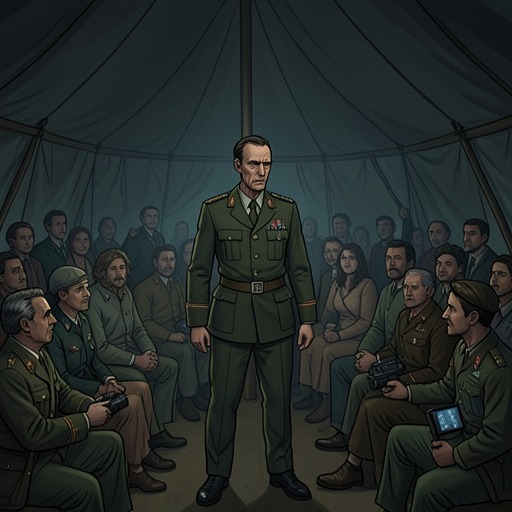
United States Army
The Plot Against AmericaThe United States Army is depicted not through an individual soldier or a conventional battle, but through its expanding role in the 1942 political crisis. Under Burton K. Wheeler’s acting presidency, Army forces first support efforts to contain anti-Semitic riots and then take part in the military occupation of New York City, where the closure of news and radio offices makes the Army’s presence part of a wider assault on civic life. Anne Morrow Lindbergh’s broadcast directly challenges that use of force, though the account does not establish what the Army does in response.
Deployment during the riots
After martial law is imposed across the country on October 9, anti-Semitic riots break out in eleven states. National Guard units patrol major cities, but the violence continues through the night; by the time federal troops arrive at about eight the next morning, 122 American citizens have been killed. The troops, dispatched by Burton K. Wheeler to support the National Guard, help quell the disturbances and bring the worst fires under control. The episode presents military deployment as a response to violence that civilian and state forces have not contained, while recording its devastating human cost.
Entry into New York City
On October 15, Army tank and infantry units enter New York City to assist the National Guard in suppressing sporadic antigovernment street violence. The deployment takes place amid broader martial-law restrictions: protest demonstrations against the Federal Bureau of Investigation in Chicago, Philadelphia, and Boston lead to hundreds of arrests, while New York faces a more extensive military intervention. The Army’s role in the city is not limited to assisting the Guard in the streets. It shuts down newspaper offices and radio stations, and tanks close the bridges and tunnels into the city. These measures turn the Army into a force controlling not only public order but also access to communication and movement.
The Army and the constitutional challenge
The Army’s actions form part of a larger crackdown following the reported disappearance of Charles A. Lindbergh. The Wheeler administration invokes the crisis to impose martial law, while federal authorities arrest political figures and the military closes New York’s news outlets. The account distinguishes among these actions: the Federal Bureau of Investigation makes arrests, and police take Franklin D. Roosevelt into custody; the Army’s stated roles include entering New York, assisting suppression of street violence, and shutting down newspapers and radio stations.
The next day, Anne Morrow Lindbergh broadcasts a demand that members of the United States armed forces leave the cities and return to their home bases under authorized senior officers. She also calls for the reopening of the seized newspapers, magazines, and radio stations, invoking the First Amendment to the United States Constitution. Her appeal makes military deployment a constitutional question: the issue is not simply whether troops can restore order, but whether emergency authority can lawfully be used to occupy a city and silence its press. The account records her demand, but does not establish the Army’s subsequent response.
Narrative significance
The Army’s successive functions mark an escalation in the crisis. It first appears as federal assistance after widespread violence has overwhelmed local control; in New York, it becomes part of a system that restricts the city and its communications. The contrast gives its presence a double meaning: force can be deployed to contain mob violence, yet the same institutional power can also help enforce an emergency order that suppresses public information. By ending this sequence with Anne Morrow Lindbergh’s appeal for withdrawal and restored civil rights, the narrative leaves the Army at the center of an unresolved contest over who commands force and under what constitutional authority.