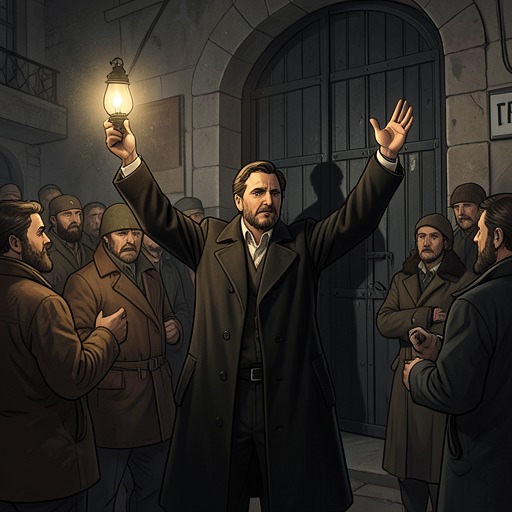
Vote for Lindbergh or Vote for War
The Plot Against AmericaVote for Lindbergh or Vote for War is the campaign slogan that reduced Charles A. Lindbergh’s presidential appeal to a stark either-or choice: elect him to keep the United States out of another world war, or choose war. Repeated during his nationwide flying tour, it turned his case for non-intervention into a memorable refrain and cast his opponent’s promise of peace as misleading.
Formulation and Claim
In California, after Lindbergh arrived unexpectedly to address a cheering crowd, he stated that his purpose in running was to preserve American democracy by preventing the country from entering another world war. He then dismissed a conventional candidate-versus-candidate framing: “It's not between Charles A. Lindbergh and Franklin Delano Roosevelt. It's between Lindbergh and war.” The speech amounted to forty-one words, including the A in his name. Its compression made the campaign’s central claim difficult to separate from its stark choice: Lindbergh presented avoiding war not as one policy among many, but as the decisive test of the election.
Repetition Across the Flying Tour
Over the next month and a half, Lindbergh spent a full day in each of the forty-eight states, traveling from town to town in the Spirit of St. Louis. He spoke at airfields and, when necessary, landed on highways or pasture so he could address people in remote farming communities. Local and regional stations carried his airfield remarks; several times a week, from the state capital where he stayed overnight, he broadcast a message to the nation. The repeated formulation sharpened the slogan’s logic: “To prevent a war in Europe is now too late. But it is not too late to prevent America from taking part in that war. FDR is misleading the nation.” He closed with the campaign’s binary choice: “Vote for Lindbergh or vote for war.”
Political Stakes and Contrast
The refrain made Lindbergh’s argument portable across a vast campaign: whether delivered to a crowd or over the radio, it returned listeners to the same choice between his candidacy and war. It also recast the political dispute. Rather than answer Franklin D. Roosevelt on a range of issues, Lindbergh suggested that the president’s assurances of peace concealed a path toward American involvement. Roosevelt, by contrast, remained in the White House and focused his public remarks on the international crisis, including the danger of a German invasion of Britain, a proposed peacetime draft, and aid to Britain. The slogan’s force lay in that collision: Lindbergh made non-entry into war the campaign’s singular test, while Roosevelt presented the danger as an unfolding situation requiring presidential action.