Walter Winchell
The Plot Against AmericaWalter Winchell is a nationally influential columnist and radio broadcaster whose denunciations of Charles A. Lindbergh turn him into the most prominent public opponent of the administration. For the Roth family and their neighbors, his Sunday-night program offers more than political commentary: it is evidence that someone is still willing to challenge the president aloud. His firing, street-corner campaign, and assassination show how that oppositional voice moves from the radio into public life—and how quickly public dissent becomes dangerous.
Identity and Public Influence
Winchell’s authority rests on an unusual combination of celebrity journalism and political access. A Manhattan-born former vaudeville dancer, he rises to prominence as a Broadway columnist whose items are syndicated in hundreds of newspapers. The novel associates his distinctive news style with rapid insinuation: the three dots that introduce his items lend even tenuously grounded gossip the appearance of authenticated news. His column can damage reputations and make or break entertainment careers, while his Sunday broadcast reaches an enormous national audience.
The narrator presents him as both an insider and an outsider. Winchell is described as a friend of J. Edgar Hoover, a neighbor of the mobster Frank Costello, a confidant of Franklin D. Roosevelt’s circle, and an occasional White House guest. Yet his public manner is that of a combative man-about-town who makes enemies as readily as he commands attention. The qualities that make him formidable as a broadcaster—speed, cynicism, immoderation, and a taste for exposure—also leave him open to charges of sensationalism and self-interest.
After the rise of Adolf Hitler, Winchell directs his hostility toward fascists and anti-Semites. He attacks the German-American Bund and its leader, Fritz Kuhn, whom he portrays as a secret foreign agent. His public opposition to Lindbergh grows out of the same campaign: he identifies the president’s pro-Nazi sympathies as a threat to American democracy and gives voice to suspicions that many Jewish families fear expressing openly. The book’s account repeatedly places him against an administration whose supporters promise peace while its critics warn that the country’s democratic protections are weakening.
The Radio Voice and Its Listeners
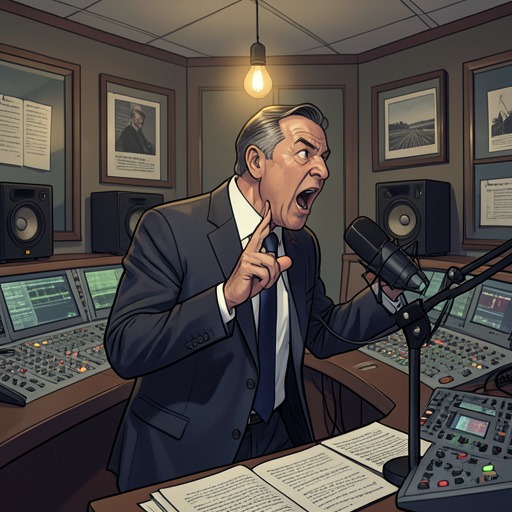
On a Sunday night at the end of June 1940, the Roth family waits through the comedy programs for Winchell’s broadcast. When his attack on Lindbergh begins, applause breaks out from across the alley. The neighbors come outside after the program ends, and what begins as a family walk becomes an impromptu block gathering, with beach chairs and pitchers of lemonade. Winchell is physically far away, broadcasting from Manhattan, but the shared sound of his denunciation briefly makes the neighborhood feel united and secure.
That response explains why his listeners invest his voice with such importance. The Roths’ neighbors tune in devotedly, even as Winchell’s warnings unsettle them. After Lindbergh takes office, the Roth parents point to his broadcasts, along with reporting in the left-wing newspaper PM, as evidence that the administration is still being scrutinized. Herman Roth quotes Winchell’s questions about what Lindbergh and Hitler may have agreed concerning American Jews. In this exchange, Winchell’s willingness to raise the question matters as much as any answer: he articulates a fear that the family cannot dismiss simply because the government has not publicly confirmed it.
Herman also relies on Winchell’s voice when explaining his own suspicions about the political bargain made in Iceland. He imagines Lindbergh using a sham peace conference to permit German expansion and the installation of an English fascist government, and insists that this is his own analysis, not merely a report from the broadcaster. Even so, he treats Winchell as one of the last people on the radio willing to speak against the president. The distinction between reporter and listener’s interpretation remains important: Winchell supplies a public language of alarm, while Herman extends that alarm into his own political argument.
As Jewish neighbors begin to accept the administration as tolerable, Winchell continues to attack Lindbergh on Sunday nights. His persistence contrasts with the growing confidence some place in Rabbi Lionel Bengelsdorf’s assurances. For a time, however, the feared consequences have not arrived, and that gap between Winchell’s warnings and the neighbors’ everyday experience makes his influence more complicated. He remains a source of vigilance, but his predictions compete with the desire to believe that the country’s institutions will hold.
Homestead 42 and the Break with the Airwaves
Winchell’s warnings become especially urgent when the Roth family faces Homestead 42, a government relocation program that threatens their home and community. Herman begins writing Winchell a letter, arguing that the program resembles an incremental method of persecution: if no one raises an alarm when the first measure is introduced, more severe measures may follow. Bess fears that the letter will be diverted to the Federal Bureau of Investigation rather than reaching its addressee. Her concern reflects the family’s experience of being questioned and watched, and turns the act of appealing to Winchell into another source of risk.
When Winchell finally addresses Homestead 42 on air, his broadcast recasts the relocation program as the opening phase of organized persecution. He alleges that it is connected to Lindbergh’s agreement with Hitler and warns that relocation could lead to imprisonment. The claims are Winchell’s, delivered in the emphatic, accusatory style that has made him famous; the novel shows their effect as well as their political content. The broadcast electrifies the Roth household, but Sandy responds by denouncing Winchell as a liar. That outburst exposes a fracture inside the family: Winchell’s attacks no longer unite listeners automatically, particularly when Sandy has become invested in Lindbergh’s public image and political program.
The following Sunday, after Winchell has finished broadcasting, his sponsor, Jergens Lotion, dismisses him. The company’s stated case is that his accusations have irresponsibly inflamed the public and slandered the president. His loss of the microphone is a decisive change in his position: the broadcaster who had reached millions must now find another way to carry his message. The New York Times supports the sponsor’s action, adding to the sense that even established institutions consider Winchell’s rhetoric beyond acceptable limits. For the Roth family, his firing is personally entangled with a night of crisis; the narrator notes that the news arrives only hours after he has run away.
Campaign and Escalating Violence
Winchell moves from broadcasting to direct political campaigning. On the Tuesday after Labor Day, he appears on a wooden soapbox at Broadway and 42nd Street, dressed in shirtsleeves with his tie loosened and fedora pushed back. Workers pour into the street, and the crowd grows from hundreds to nearly ten thousand. He argues that he was dismissed not for warning of a fire but for naming fascism, and vows to continue speaking to crowds despite the loss of his radio platform and newspaper column.
He carries the campaign beyond New York City, addressing factory workers and small street-corner gatherings in Connecticut, Rhode Island, and Massachusetts. His ability to draw a crowd does not depend on the setting: he speaks with the same fervor outside factories and shipyards as he does in Times Square. Yet his appearances also expose him to danger. In Boston, heckling directed at him as a Jew escalates into a mob at Perkins Square. A man approaches with a burning cross, shots are fired into the air, and rioters surge toward the soapbox. Winchell’s bodyguards get him away and take him to Carney Hospital, where he receives treatment for facial wounds and burns.
The Boston assault sharpens the danger perceived elsewhere. In Newark, where roughly fifty thousand Jews live among large working-class Irish, Italian, German, and Slavic communities, residents fear that anti-Semitic violence may spread from Boston and Detroit. The possibility that Winchell might return to New Jersey becomes one element in preparations for disorder. The Newark Committee of Concerned Jewish Citizens seeks cooperation from city and state authorities, while Longy Zwillman separately arranges for Bullet Apfelbaum to recruit young men into the Provisional Jewish Police. Winchell’s campaign does not create these community defenses by itself, but the violence surrounding his appearances helps make the danger—and the need to prepare—immediate.
Assassination and Political Legacy
On October 5, 1942, a radio bulletin interrupts the World Series to announce that Winchell, now identified as a Democratic presidential candidate, has been killed while addressing a political rally in Louisville, Kentucky. The news reaches the Roth household as the family is already confronting the prospect of protecting itself. Outside, members of the Jewish police tell residents that Winchell is dead and urge neighborhood children to fetch their baseball bats. The ordinary excitement of a baseball game gives way to a sense that local violence may follow the assassination.
Reports say Winchell had begun his speech by appealing to civic pride in Louisville. Before he could complete his reference to Louis D. Brandeis, he was killed near the Jefferson County Courthouse. The family hears that the shots came from one of the building’s front windows. By evening, Jewish families on the Roths’ street are behind locked doors, following radio bulletins and telephoning one another. News of the killing does not merely confirm Winchell’s vulnerability; it intensifies fears that the violence directed at his campaign may reach the Jewish community more broadly.
Winchell’s body is taken by train to Pennsylvania Station in New York City, where it lies in state under police protection before his funeral at Temple Emanu-El. At the service, Mayor Fiorello La Guardia refuses to present Winchell as a spotless public figure. He acknowledges his vanity, indiscretion, and imperfect journalism, then contrasts those faults with the moral significance of his opposition to fascism and anti-Semitism. The eulogy’s force depends on that contrast: Winchell need not be decorous or selfless to have spoken against what La Guardia identifies as a grave political danger.
La Guardia’s address turns Winchell’s death into an accusation against Lindbergh’s administration, while Franklin D. Roosevelt’s appearance makes the funeral a political turning point. Roosevelt pledges support to La Guardia as a national-unity candidate against Lindbergh’s pursuit of a second term. Winchell’s own campaign ends with his assassination, but his death helps redirect opposition toward a new electoral challenge. In the novel, he is therefore both a contentious journalist, whose methods invite distrust, and a catalyst whose silenced voice leaves behind a public question about where political power has gone and who will oppose it.