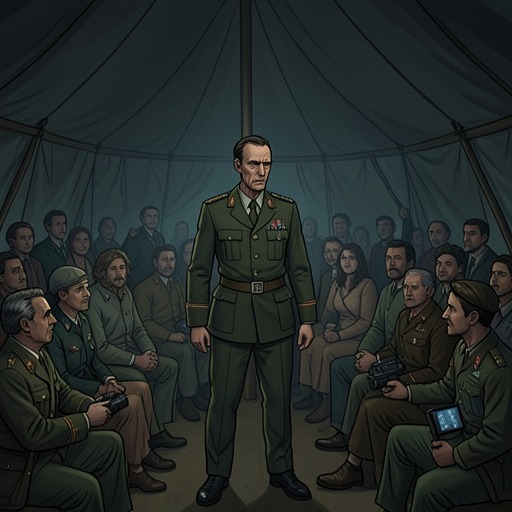
Wheeler administration's nationwide martial law order
The Plot Against AmericaThe Wheeler administration's nationwide martial law order is the decisive shift from escalating political intimidation to direct emergency rule in the novel. After Charles A. Lindbergh disappears, Acting President Burton K. Wheeler announces martial law across the continental United States and its territories and possessions. Under its authority, borders are sealed, transport hubs closed, armed forces deployed, and political opponents arrested. The order is presented as a response to an unresolved national emergency, but its implementation suppresses the very rights and institutions that might question the government's account of that emergency.
Proclamation and Scope
By the morning of October 9, 1942, martial law is in effect throughout the country. At noon, Burton K. Wheeler travels under military guard to the Capitol and tells an emergency closed-door session of Congress that the Federal Bureau of Investigation has information establishing that Charles A. Lindbergh has been kidnapped and is being held somewhere in North America. Wheeler promises that the government is working to secure the president's release and bring those responsible to justice. The location of the president and the identity of the alleged captors remain unknown, leaving the announcement to frame uncertainty itself as a reason for exceptional state power.
The measures extend well beyond an investigation. The borders with Canada and Mexico are sealed; airports and seaports are shut down. In the District of Columbia, the United States armed forces are assigned to maintain order, while elsewhere the National Guard is to work with the Federal Bureau of Investigation and local police. The emergency is thus administered through a combined military, federal investigative, and local law-enforcement apparatus, with ordinary movement and civic life subject to the government's security response.
From Political Crisis to Enforcement
The order follows a period in which political dissent and anti-Semitic violence have already narrowed the space for public opposition. Walter Winchell, fired from his national broadcast, begins campaigning from a soapbox against what he calls fascism. His rallies draw large crowds, but in South Boston a gathering escalates into a mob attack; police arrive only after the violence has begun. After disorder in Detroit, Newark's Jewish leaders fear that similar violence could reach their own streets. The Newark Committee of Concerned Jewish Citizens seeks cooperation from municipal and state authorities, while Longy Zwillman separately arranges for Bullet Apfelbaum to recruit a volunteer Provisional Jewish Police.
These preparations show a community attempting to protect itself amid both public violence and uncertain official protection. They are not the same as the later nationwide order: they precede it and are organized locally in response to threats. But they form part of the crisis in which the order takes hold. Earlier government programs had already linked administrative pressure to Jewish identity: Just Folks sends Sandy Roth to a Kentucky farm, and a Metropolitan Life letter presents Homestead 42 as a government-supported relocation opportunity for selected employees and their families. The Federal Bureau of Investigation also questions members of the Roth family and monitors Herman Roth after he quits his insurance job rather than participate in the relocation program. Martial law therefore arrives in a society where surveillance, pressure on dissenters, and coercive policies affecting Jews are already part of daily life.
Arrests, Occupation, and Restrictions
The crisis intensifies on October 15. The Federal Bureau of Investigation arrests Lionel Bengelsdorf on suspicion of taking part in an alleged Jewish conspiracy against the country. The roundup also includes Herbert Lehman, Bernard Baruch, Felix Frankfurter, and other political, labor, and media figures. The authorities do not disclose whether the kidnapping charge will be brought against any or all of those detained. The accusation gives the arrests a national-security rationale, but the uncertainty about evidence and charges leaves the public without a clear way to distinguish investigation from political detention.
Military force is also brought into New York City. United States Army tanks and infantry enter to assist the National Guard in suppressing sporadic antigovernment street violence. Attempts to hold demonstrations against the Federal Bureau of Investigation in Chicago, Philadelphia, and Boston are treated as violations of martial law; police report hundreds of arrests and only minor injuries. In New York, Mayor Fiorello La Guardia, Eleanor Roosevelt, and Roger Baldwin of the American Civil Liberties Union publicly demand the release of Herbert Lehman and the other alleged conspirators. La Guardia is subsequently arrested at the mayor's mansion. When Franklin D. Roosevelt travels from Hyde Park to address an emergency protest rally, the police take him into custody for his own protection.
The restrictions reach beyond arrests and street deployments. The United States Army shuts down New York newspaper offices and radio stations, and tanks close the bridges and tunnels into the city. An after-dark curfew is enforced around the clock until further notice. In Buffalo, officials announce plans to distribute gas masks; Rochester begins a bomb-shelter program amid fears of a Canadian attack. Reports of small-arms fire on the border between Maine and New Brunswick, together with warnings of wider international danger, make the emergency feel both domestic and continental. Yet closing communication channels and curbing assembly also prevent citizens from freely testing official claims or organizing opposition.
Challenge and Constitutional Stakes
Even as the government imposes control, the narrative emphasizes the gap between its security measures and the evidence made public. The National Guard reports no violence prompted by Lindbergh's disappearance, while the Ku Klux Klan's Grand Wizard and the leader of the American Nazi Party call on Burton K. Wheeler to take extreme measures against a supposed Jewish coup. Their appeal illustrates how conspiracy claims can reinforce the emergency atmosphere without establishing the truth of the kidnapping allegations. In Newark, the local Jewish committee continues arranging meetings and seeking promised police protection as fear of attacks persists.
On October 16, Anne Morrow Lindbergh escapes from Walter Reed Army Hospital with assistance from Lindbergh loyalists inside the Secret Service and broadcasts to the nation. She calls for National Guard units to disarm and disband, for the armed forces to leave the cities, and for the release of those detained on conspiracy charges. She says there is no evidence that any detainee is responsible for what happened to her husband or his plane. She also demands that seized newspapers, magazines, and radio stations resume normal operations under the First Amendment, and asks Congress to remove the acting president and follow the Presidential Succession Act of 1886, including its provision for considering a special election.
The broadcast makes the order's constitutional stakes explicit: the question is no longer only how the state searches for a missing president, but whether emergency authority can be used to arrest opponents, suspend public communication, and displace normal procedures without disclosed proof. Anne's appeal contests those actions and proposes a lawful route back to civilian government. The order's significance lies in this combination of measures and challenge: military control is made to appear necessary by a crisis whose facts remain unsettled, while its most visible opponents insist that the methods themselves threaten the constitutional order they claim to defend.