Where Is Lindbergh
The Plot Against AmericaWhere Is Lindbergh? is a recurring public expression in the aftermath of Walter Winchell’s assassination: at once a memorial badge, a shouted political challenge, and a newspaper headline. Its force comes from the movement between those forms. A question small enough to print on a button is taken up by a city, voiced from a synagogue pulpit, and finally set in the largest type on newspaper front pages as the president’s disappearance deepens the crisis.
Origins and Public Circulation
On October 6, 1942, as mourners came to Pennsylvania Station to view Winchell’s flag-draped coffin, silent men and women distributed black buttons about the size of half-dollars. Their white lettering asked, “Where is Lindbergh?” The distribution extended beyond the station to numerous locations across New York City. By the time the funeral service reached Temple Emanu-El, the button had become a recognizable mark of solidarity: virtually every man, woman, and child among the mourners and onlookers wore one.
The buttons connected private remembrance to a public question. The occasion was a citywide day of mourning for what La Guardia called American victims of Nazi violence, but the badge did not name Winchell alone. It asked after the president, whose absence from public view gave the question its immediate political edge. Worn by local residents and thousands of visitors who had come to Winchell’s hometown, the badge made the inquiry visible in the streets before La Guardia amplified it from the pulpit.
From Inscription to Public Chant
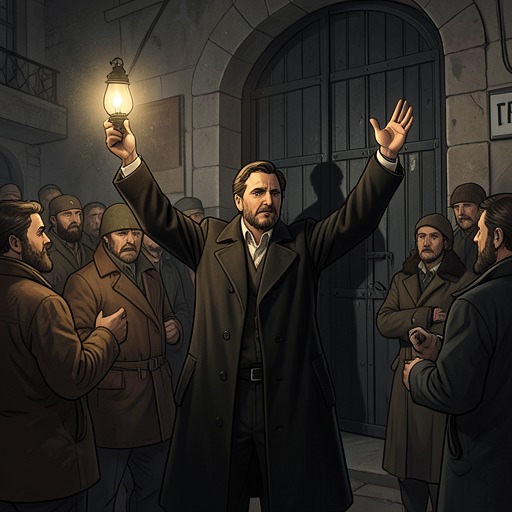
At Winchell’s funeral, La Guardia turned the printed words into an accusation. He contrasted the murdered broadcaster’s opposition to Nazism with Charles A. Lindbergh’s relationship to fascism and his failure, in the mayor’s account, to confront Nazi violence in the United States. La Guardia tied Winchell’s assassination in Louisville to the political conditions at home, then repeated the question as the culmination of his address. The expression’s meaning thus shifted from asking where the president was to demanding an account of his conduct and leadership.
The question did not remain La Guardia’s alone. People gathered around loudspeakers in the streets took up his words, and their chant spread across the city. Inside Temple Emanu-El, La Guardia repeated the short phrase and struck the pulpit, pressing the mourners for an answer; outside, the same words moved through a dispersed crowd. The call-and-response joined the funeral audience to listeners who could not fit inside the temple. Its repetition made the question sound less like an isolated speaker’s challenge and more like a collective demand.
The setting sharpened that transformation. La Guardia had led the funeral cortege from Pennsylvania Station to the temple, where political and labor figures gathered alongside the mourners. The city had observed a minute of silence at noon, while loudspeakers carried the service to people assembled throughout Manhattan. Against that organized silence, the repeated question supplied words for protest. The expression remained brief, but its circulation—from badge to pulpit to street—gave it a reach that no single speaker could command.
Headline and Political Stakes
The question acquired a further public life when the search for Lindbergh produced no reported sighting of his plane or wreckage. Ground searches covered the route between Louisville and Washington; military services and volunteers joined the effort. As the crisis continued, Burton K. Wheeler announced that he was assuming the duties of acting president. In dozens of newspapers, the evening headline appeared in exceptionally large, dark type: WHERE IS LINDBERGH? The account explicitly presents the headline as intended to shame La Guardia, making the expression both a reference to his funeral challenge and an intervention in the political struggle surrounding the disappearance.
The headline also changes the scale of the question. On a button, it is a portable sign worn by an individual; in the funeral chant, it becomes a shared utterance; across newspaper front pages, it reaches readers far beyond the streets and the service. Its wording remains constant while its public function expands. The expression binds Winchell’s killing to the search for the missing president without treating the two events as identical: the funeral makes the question a charge about political responsibility, while the headline places it against the unresolved fact of Lindbergh’s disappearance.
Narrative Function
The expression’s recurrence gives a concise verbal shape to a widening uncertainty. It begins amid mourning, gathers force through La Guardia’s denunciation, and returns as a headline when the authorities still have no reported sighting. The repeated question is therefore not answered by repetition; each new appearance makes the absence more consequential. Its movement through physical media and public spaces records how grief becomes political speech and how political speech travels beyond its original occasion.
That movement also preserves a tension between asking for information and making an accusation. The words appear to request Lindbergh’s whereabouts, yet La Guardia’s funeral address makes clear that they also challenge the president’s political silence and the forces operating in his name. The newspaper headline restores the literal uncertainty of his location while carrying the accusation forward. In this way, Where Is Lindbergh? becomes more than a slogan: it is the story’s recurring public measure of an absence that is at once personal, political, and unresolved.