White House
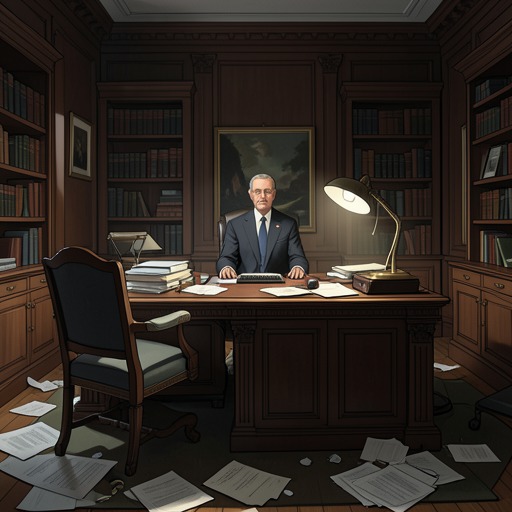
The Plot Against AmericaThe White House is both the center of presidential power and a stage on which the Lindbergh administration presents its politics as reassurance and national ceremony. A meeting there becomes a key part of Rabbi Lionel Bengelsdorf’s defense of Charles A. Lindbergh, while a 1942 state dinner honoring Joachim von Ribbentrop makes the residence a flashpoint in the country’s dispute over accommodation with Nazi Germany. The novel sets that public pageantry against the administrative machinery that reshapes Jewish communities elsewhere.
Presidential Access and Political Reassurance
Bengelsdorf tells the Roth family that he had spoken with the president at the White House the previous morning. He presents his access as evidence that Lindbergh can be persuaded: according to Bengelsdorf, the president had acknowledged the ignorance behind earlier anti-Semitic clichés and, after private conversations, come to appreciate the diversity of Jewish life in America. Bengelsdorf also says that Lindbergh wants his help to overcome divisions between Christians and Jews. The White House, in this account, is where political influence is exercised through personal access and where Bengelsdorf claims to have helped alter the president’s understanding.
That reassurance is tied to the administration’s public policies. Bengelsdorf points to neutrality, Just Folks, and the Office of American Absorption as evidence that Lindbergh is not an enemy of American Jews. He contrasts the president’s democratic election and professed support for individual enterprise with dictatorship and state violence. His defense makes the White House encounter carry more than personal prestige: it is offered as proof that the administration’s policies should be judged by their stated aims and by Bengelsdorf’s influence, rather than by Lindbergh’s earlier remarks or Jewish suspicion of him.
The Ribbentrop Dinner and Public Opposition
In the spring of 1942, Charles A. Lindbergh and his wife host Joachim von Ribbentrop at a White House state dinner celebrating the Iceland Understanding. The foreign minister had negotiated alongside Adolf Hitler during the Iceland meetings and had promoted Lindbergh to Nazi colleagues as Germany’s ideal American presidential candidate even before the Republican Party nominated him in 1940. He was also the first Nazi leader invited to the United States by an American government official or agency since the fascists had come to power nearly a decade earlier. The dinner therefore makes the White House a conspicuous setting for a relationship that the administration presents as diplomatic cordiality but critics regard as politically consequential.
The announcement prompts strong criticism in the liberal press and rallies across the country. Former president Franklin D. Roosevelt breaks his seclusion with a nationwide address from Hyde Park, urging Lindbergh to withdraw the invitation in view of the millions of Americans whose ancestral countries live under Nazi rule. Vice President Burton K. Wheeler attacks Roosevelt for intervening in a sitting president’s foreign affairs. The dispute places competing claims about neutrality and the danger of Nazi power in direct opposition, with the White House dinner itself at the center of the argument.
By the time engraved invitations go to Lionel Bengelsdorf and Evelyn Finkel for the dinner on April 4, 1942, Lindbergh’s thirty-city solo flying tour has further strengthened his reputation as a practical, plain-speaking leader. Walter Winchell has called the dinner a political blunder, but much of the Republican press recasts the controversy as a Democratic misrepresentation of a cordial event for a foreign dignitary. The invitation also reaches into the Roth family: Evelyn and Bengelsdorf arrange for Sandy Roth to accompany them. His parents are stunned, having already objected to Evelyn’s service in the administration. The White House occasion thus converts a national political alignment into a family rupture and a striking elevation of Sandy’s public position.
Ceremony and the Machinery of Policy
The dinner’s language of welcome and inclusion sits beside government programs that act on Jewish households far from the White House. On May 22, 1942, Metropolitan Life Insurance Company informs a senior employee that, at the request of Homestead 42 and the Office of American Absorption, the company is offering relocation opportunities to selected employees. The letter invokes the Homestead Act of 1862 and describes the new initiative as an opportunity for families to strengthen their Americanness. Its language of opportunity makes a state-directed transfer sound voluntary and patriotic.
The process is rendered materially through maps, pins, and assignments. Evelyn explains to Philip Roth that pins mark families chosen for relocation and the places across the country to which they have been assigned; she emphasizes that the decisions involve many people, corporate partners, Washington headquarters, and the destination states. In Newark, the consequences include two Summit Avenue flats vacated by Jewish families in September and occupied by Italian families from the First Ward on October 1. Under the Good Neighbor Project, the government offers a fifteen-percent rent discount—$6.37 off a monthly rent of $42.50—for five years, with payments made to the landlord during the initial three-year lease and its first two-year renewal. The program is officially described as enriching the Americanness of the neighborhood; at home and sometimes at school, people suspect its purpose is to weaken Jewish social and electoral solidarity. Against these dispersed administrative actions, the White House dinner’s ceremony becomes part of a broader contrast between assurances of inclusion and policies that reorganize the communities those assurances invoke.