Winnipeg
The Plot Against AmericaWinnipeg is presented as a Canadian refuge where a Jewish family can rebuild a life beyond the mounting danger they fear in the United States. For the Roth family, it is at once a practical destination—made reachable by community assistance, work, housing, and a loan—and a source of anxious news arriving in letters and Canadian postage.
A Refuge Made Possible
The Tirschwells’ move is not an abstract plan to emigrate but a carefully arranged departure for a whole extended family. Representatives of Winnipeg’s small Jewish community help Shepsie Tirschwell find work as a projectionist at a neighborhood movie house and locate apartments for the family in a modest Jewish neighborhood like the one they are leaving behind. Their aid also includes a low-interest loan to cover the move from America and help support Shepsie’s elderly in-laws until his wife can find work and contribute to their expenses.
The arrangements make Winnipeg a haven through practical acts of welcome. The family is not asked to arrive first and solve its problems alone: employment, housing, and temporary financial support are coordinated in advance. Their departure nevertheless entails substantial loss. Shepsie hates leaving his native city and old friends, and regrets giving up his distinctive job as a projectionist at Newark’s Newsreel Theater.
The Tirschwells’ Departure
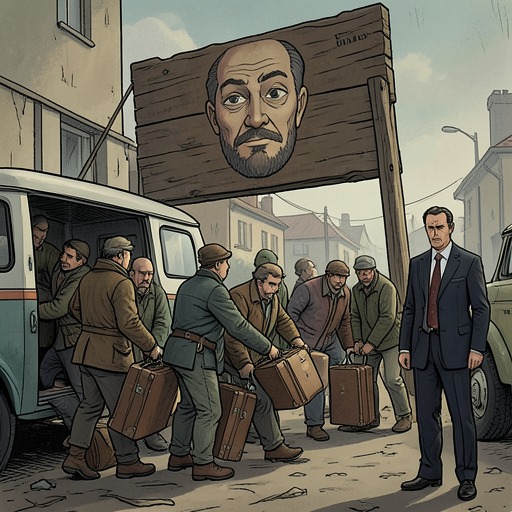
A few weeks after the White House dinner for Joachim von Ribbentrop, Herman Roth stops at the Newsreel Theater to see filmed coverage of the occasion. After the screening, he visits Shepsie in his projection booth and learns that the family will leave for Winnipeg on June 1. They are to go together: Shepsie, his wife, their three children, his mother, and his wife’s elderly parents. Winnipeg thus enters the narrative through a conversation at work, where a familiar face turns the possibility of flight into an imminent family separation.
Shepsie’s decision is shaped by what he believes the newsreels have shown him over several years. He is convinced that the secret terms of the Iceland Pact between Charles A. Lindbergh and Adolf Hitler would allow Hitler to defeat the Soviet Union and conquer England, while Japan overran China, India, and Australia. In Shepsie’s forecast, those victories would clear the way for Lindbergh to establish an American Fascist New Order, followed by a German campaign to conquer and Nazify South America. He further fears that, after Lindbergh wins another presidential term and the United States closes its border with Canada, the government will turn en masse against the country’s four and a half million Jews. This is Shepsie’s deeply pessimistic reading of the pact’s future consequences, not an account of events already established as having occurred.
News from Winnipeg and the Roth Family
Herman is more alarmed by Shepsie’s forecast than by his own predictions, and the news leaves him shaken. Since Lindbergh’s inauguration a year and a half earlier, an estimated two to three hundred Jewish families have taken up permanent residence in Canada; the Tirschwells are the first such fugitives Herman knows personally. He keeps their departure from his family that evening, fearing the news will terrify Philip, anger Sandy, and prompt Bess to insist on emigrating at once. Winnipeg’s distance is therefore felt inside the Roth home before the family has heard that anyone is leaving: Herman’s silence is an attempt to contain the fear that the destination has come to represent.
The move remains present in the household through correspondence. When a letter from Estelle Tirschwell arrives reporting on the family’s progress in Winnipeg, Bess reads it twice at the kitchen table while Philip and Sandy eat lunch. She folds it into her apron pocket and rereads it many more times before passing it to Herman when he gets up to go to the market. The letter is both reassurance and a focus for worry, its repeated reading registering how closely Bess follows the family’s new life.
Winnipeg also leaves a small, concrete trace in Philip’s collection: the canceled Canadian stamps that come with the correspondence. Bess gives them to him to help start a new collection. The stamps turn the family’s distant refuge into something that can be held and kept, while the letters make clear that departure has not erased the ties between those who leave and those who remain.