Appearance and Essence
The Portable DoorAppearance and Essence is the novel’s recurring question of whether a pleasing surface can stand in for substance—and whether a person is defined by what they do or by who they are while doing it. The idea moves from comic social friction to a serious measure of Paul Carpenter’s choices: he rejects an uncomplicated attraction, grows suspicious of his own appetite for consequence-free magic, and comes to distinguish love for Sophie Pettingell from the desire simply to have someone.
Surface as Performance
After the Ankara incident, Mr Tanner’s mum presses Paul to accept her as she presents herself: a goblin who can choose an alluring human appearance and keep it for as long as she wants. She treats this surface as neither disguise nor embarrassment. It is a deliberate, durable choice, and she makes clear that she can alter its details to suit a viewer. Her confidence unsettles Paul, who cannot reconcile her manner with his idea of what a goblin should be. The scene makes appearance a form of agency, but also exposes how readily attraction can be cultivated and directed.
Mr Tanner’s mum turns the exchange back on Paul. She describes herself as shallow and openly motivated by desire, while mocking his romantic attention to Sophie as no more substantial than the behaviour he criticizes in her. Her teasing is not a neutral philosophical argument: she wants Paul to consider joining the goblins, and she presents their social advantages as a practical alternative to his human reserve. Yet her candour gives the challenge force. She does not pretend that a beautiful appearance proves inner virtue; she asks why Paul should treat the surface as disqualifying when he, too, may want what it offers.
Her later explanation sharpens the difference between the goblin and human standards. She says that goblins take pride in shallowness, whereas Paul expects something solid beneath an appealing exterior. In her account, the human demand for depth is itself a preference, not a universal measure of worth. The contrast remains unresolved: she can be frank about the limits of her appeal, while Paul’s refusal depends on believing that surface attraction cannot provide what he needs.
The Portable Door and the Appeal of Ease
Paul’s uncertainty extends beyond romance. At lunchtime he continues to set up the Portable Door, but since Ankara he has been unable to bring himself to travel through it. The hesitation is not only fear of encountering Mr Tanner’s mum again without recognizing her in time. He has also lost his taste for the experience itself. The door once made travel feel like effortless adventure: Paul could visit unfamiliar places without spending money or time, and without the ordinary consequences of food and drink. He now sees that convenience as another kind of thinness, an experience detached from the costs that would make it fully his.
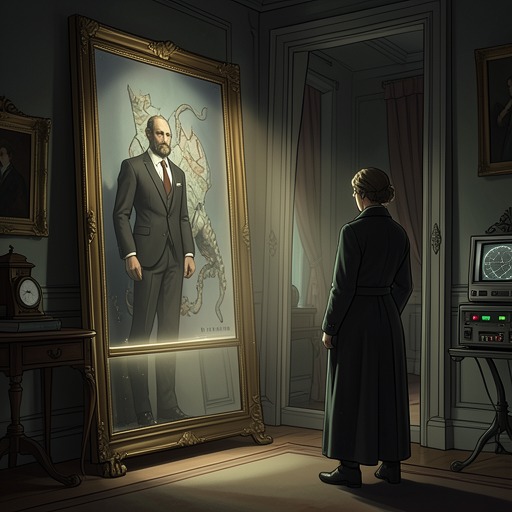
That judgment sends him back toward the ordinary routines of Paul Carpenter. He reconnects with friends, meets Duncan and Jenny at pubs, listens to Neville complain about Microsoft, defrosts frozen pizzas, and catches up on his reading. These habits are familiar rather than transformative, and he knows they can be shallow too. The distinction is therefore not simply between magic and mundane life. Paul worries that he is choosing routine because it is real, but also recognizes that routine can become another surface—an expected version of himself maintained without much thought. His fear that his reflection might show a goblin snout and tusks gives that uncertainty a physical image, without confirming that his appearance has actually changed.
Identity Beyond Place and Time
Paul’s reasoning about the Portable Door becomes more explicit when he considers using it to alter the past. He imagines preventing Sophie from meeting the performance potter, but recognizes that removing one possible partner would not determine whom she might meet next. He then wishes the door could take him back to the day before his interview and erase his memory of Sophie. Its limits matter: he remembers Mr Lundqvist and the Mortensen Counters, and cannot use travel to become someone untouched by what has happened.
The possibility of changing place or time thus confronts Paul with the persistence of identity. The Portable Door can alter where he is, and his experience of time can become disordered, but neither offers a way to revise himself into a person without his memories or attachments. His return to an earlier conversation with Sophie makes the point practical rather than abstract: he must face the awkwardness again, now knowing what is at stake. The device’s apparent freedom cannot relieve him of the person making the choices.
Occupation, Self-Image, and Sophie
Sophie’s reflection on the performance potter develops the same idea from another direction. She can see the appeal of his creative life—working with his hands and living outside a conventional routine—without claiming to love him. She admits that she does not really like him, despite admiring what his way of life seems to represent. Her disappointment is partly directed at an imagined alternative self: someone who might have become a sculptor or blacksmith rather than a trainee witch commuting in suits and court shoes, with a life her parents approve of.
Paul answers by distinguishing magical work from identity. The people at J.W. Wells & Co. are business people in a supernatural line of work; their occupation does not automatically make them the kind of person Sophie imagines a witch to be. Sophie then articulates the principle that holds the concept together: what matters is not simply the work someone does, but who that person is while doing it. Her wish to inspect her reflection in the conference table suggests that she, too, remains unsure what lies beneath her occupational role and her ideas about the person she ought to have become.
Love, Motive, and the Unfinished Test
The distinction becomes decisive for Paul when he considers what his relationship with Sophie might have been if events had gone differently. He recognizes that he loves her, and separates that feeling from his familiar wish to find a girlfriend because other people seem to have one. Sophie is not interchangeable with an imagined partner or a solution to loneliness. This recognition changes the meaning of his earlier longing: what looked like a generic romantic pursuit now has a particular person at its centre.
But the recognition does not make their situation simple. Paul’s thought turns to the plastic bottle of JWW Valentine Express Love Philtre, which is still presumably on Sophie’s bedside table. The object brings the problem of appearance and essence back into the relationship: apparent affection cannot by itself establish whether a feeling is freely and genuinely held. The evidence ends with that concern unresolved. The concept therefore remains more than a contrast between beauty and depth; it is a continuing demand to examine motive, consequence, and the self that stands behind an outward role or desire.