Danny Corbett syndrome
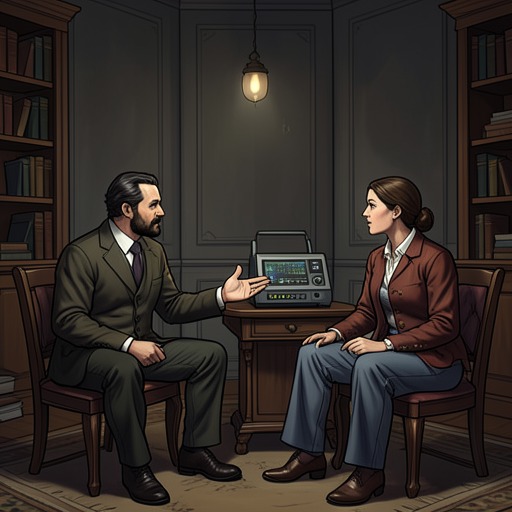
The Portable DoorDanny Corbett syndrome is Neville’s joking explanation for why two people who appear to dislike one another might nevertheless become a couple. In conversation with Paul Carpenter, Neville turns the history of Danny Corbett and Fiona Mascetti into a theory of romance: persistent irritation can coexist with attachment, and the absence of idealization may even help a relationship endure. The expression is not presented as a medical condition, but as an irreverent label that helps Neville make sense of Paul’s contradictory feelings—and push him toward a decision.
The diagnosis and its example
Neville applies the label after Paul admits that his feelings for a woman at work are more complicated than he has let on. Paul dislikes her rudeness and the way she puts him down, yet concedes that he quite likes her. His complaint and his attraction sit side by side; the contradiction is the point Neville seizes on. Calling it a syndrome makes romantic ambivalence sound like a familiar case rather than an embarrassing confession.
To explain the diagnosis, Neville recalls Danny Corbett, a red-haired, freckled boy from school who nearly got expelled in fourth year after filling Werewolf Dave’s coat pockets with aerosol cream during a maths test. The anecdote first establishes Danny as a memorable, foolish figure, then leads into his later relationship with Fiona Mascetti, described as a large girl who became a mechanic in the Royal Engineers. The school prank is not evidence about the romance itself; it is part of Neville’s comic portrait of Danny, whose adult courtship is all the more unexpected for beginning from this unpromising introduction.
Neville’s account of Danny and Fiona is built from mutual insult. Each regarded the other as an appalling specimen of humanity: Fiona likened Danny to a slug left in the rain until it had gone rusty, while Danny wondered why he stayed with a woman who could eat two cream doughnuts at once and still keep talking. Their contemptuous descriptions make affection difficult to recognize in conventional romantic terms. But the story ends not with a breakup, as their complaints might lead a listener to expect, but with their marriage in June and the news that they are expecting their first child in April. The reversal supplies Neville’s diagnosis with its evidence: whatever the pair said about one another, they continued together and built a shared future.
Irritation as a theory of lasting attachment
Neville does more than point out that Danny and Fiona married despite their insults. He proposes that starting out annoyed with one another may make for a smoother, better-balanced long-term relationship. In his account, mutual irritation allows a couple to skip the idealizing phase in which each person seems exceptionally wonderful, and to arrive early at the friction he regards as typical of lasting partnerships. The supposed advantage is not that antagonism disappears, but that neither partner has to discover, after years together, that the other can be exasperating.
This is Neville’s theory, delivered in deliberately exaggerated language rather than established as a general fact. He imagines the standard romantic progression as a movement from infatuation to disappointment, with the later realization of incompatibility made more painful by shared investments such as kitchen units and curtains. Under the syndrome’s logic, an unvarnished awareness of irritation from the beginning avoids that particular disillusionment. Danny and Fiona’s reported insults become a comic form of foreknowledge: they already know how much the other annoys them, yet remain together.
The expression therefore describes neither simple dislike nor uncomplicated love. Its comic force depends on holding both together. Danny and Fiona’s hostile judgments are not softened into compliments, and their marriage does not erase the insults; instead, the contrast between what they said and what they did makes their attachment legible. Neville presents their endurance as a counterexample to the assumption that romantic promise must begin with admiration. In his telling, an unpleasant first impression can coexist with commitment rather than rule it out.
What the expression means for Paul
Neville invokes the syndrome because Paul is using his dislike of the woman at work as part of an argument for leaving. Paul says that a sensible person would clear out, especially given how much he dislikes the job. Neville’s earlier reading of the situation is that Paul remains there because he has become attached to someone. Paul’s admission confirms the attraction but does not resolve his ambivalence: he still describes the woman as rude and dismissive. Danny Corbett syndrome gives Neville a way to treat that very irritation not as proof that the attraction is mistaken, but as something compatible with it.
The diagnosis is also a device for converting emotional uncertainty into practical advice. Neville tells Paul that, if he is interested, he should stop hesitating and make his feelings known. He lays out two possible outcomes. If the woman rejects him, Paul can leave the job he hates and seek a better one; if she does not, he will have both the job and a sweetheart. In either case, Neville casts the confession as a move that leaves Paul better off. This is not a guarantee that the romance will succeed; it is a calculation designed to make the risk of rejection seem manageable.
When Paul asks whether he should act, Neville recommends that he do so first thing in the morning, comparing a declaration of feeling to going to the dentist: unpleasant to face, but liable to become worse the longer it is delayed. Paul points out that the next day is Saturday. Neville revises the plan to Monday, leaving Paul the weekend to prepare his words and tactics. The adjustment gives the advice a mundane timetable, while preserving its urgency. The syndrome has moved from a story about another couple to a prompt for Paul’s next action.
Comic use and limits
The label’s authority comes from its example and from Neville’s confidence, not from any formal diagnosis. He presents one couple’s marriage as grounds for a broad account of long-term relationships, and the sweeping tone is part of the humor. His recollection offers no account of Danny and Fiona’s private life beyond their insults, marriage, and expected child. Their story supports the narrower point that mutual irritation did not prevent them from marrying; Neville’s claims about why that irritation might help a relationship remain his own comic interpretation.
The episode also lets Paul hear his own contradiction reflected back at him. He is unhappy at work and irritated by the woman he likes, yet neither feeling cancels the other. Neville’s phrase makes that contradiction sound less like a reason to retreat and more like a recognizable romantic pattern. Whether or not the theory is sound, it gives Paul a practical choice: continue to conceal his feelings or risk saying them aloud. In that sense, Danny Corbett syndrome works less as an explanation of love than as Neville’s irreverent argument against waiting.