Discovery of the goblin imposture behind Shaz
The Portable DoorThe discovery of the goblin imposture behind Shaz turns what had seemed to Paul Carpenter like a personal romantic disappointment into a deception involving magic and a family connection. Sophie Pettingell tells him that Shaz was not who he appeared to be: an imp-reflecting sheet of tinfoil exposed him as George, a goblin related to Mr Tanner’s mum. George claimed that she had set the scheme in motion to separate Paul and Sophie. The revelation answers one question about Sophie’s past relationship while leaving another unresolved: who put the foil in place, and whether Sophie’s account of the plot is complete.
The conversation and its immediate cause
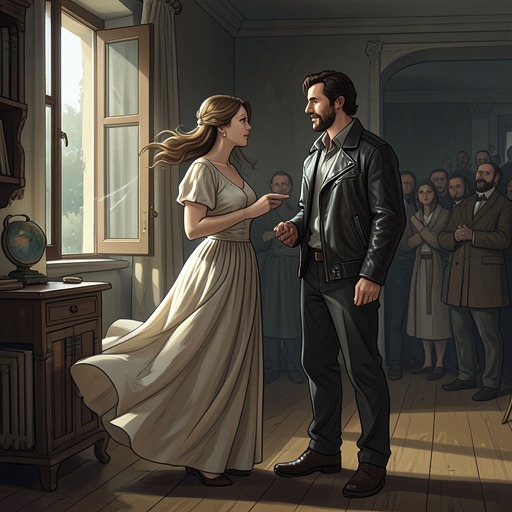
Paul raises Shaz’s name because he wants to understand what happened between Sophie and the ceramic artist. His hesitation makes the question feel consequential before Sophie answers: he recognizes that he need not ask, and that doing so may intrude on her privacy. Sophie nevertheless agrees to explain, describing the matter as embarrassing. The disclosure is therefore not presented as a confrontation with George, but as a difficult piece of history Sophie chooses to tell Paul.
The conversation moves from the question of Sophie’s former relationship to the magical means by which Shaz’s identity was exposed. Paul recognizes the effect as that of an imp-reflecting mirror, a device he had encountered as a boardroom tabletop. Sophie corrects the assumption built into its name: the revealing surface need not be a mirror, or even a tabletop. In this case, ordinary tinfoil produced the same effect. The revelation depends not on an impressive enchanted object, but on a commonplace material used in an unexpected place.
The foil and the exposure of George
Someone had entered Shaz’s bus and fixed a sheet of tinfoil to the ceiling directly above the bed. Sophie says that when Shaz later came round after she had struck him with a saucepan, he told her his real identity. She identifies him as George and confirms Paul’s inference that he was a goblin. The reflective foil thus serves as a test of appearance: it makes visible a distinction between the person Shaz seemed to be and the being concealed behind that appearance.
The choice of tinfoil also makes the mechanism easy to overlook. It is not a purpose-built mirror or a conspicuously magical instrument, but a familiar household material. Its location above the bed and its ability to reveal a hidden identity connect the mundane setting of Shaz’s bus to the supernatural business around Paul and Sophie. Yet the foil’s presence does not, by itself, identify the person who placed it there; the means of discovery is clear while the agent behind it remains uncertain.
The alleged scheme and its uncertainty
George reportedly said that Mr Tanner’s mum had put him up to the deception. Sophie is unsure of the precise family relationship, describing George as either her second cousin or her first cousin once removed. His account gives the apparent purpose of the scheme: to keep Paul and Sophie apart so that Mr Tanner’s mum could pursue Paul herself. This motive reaches Paul through Sophie’s retelling of George’s claim, rather than through a direct confession from the alleged organizer, so the article of intrigue remains an allegation rather than a fully verified account.
Sophie offers a separate clue about the foil’s placement. She does not know for certain who installed it, but notes that it had been stapled to the ceiling rather than glued or attached with tape. Paul recognizes that this detail may point toward someone with access to a stapler and connects it, by implication, to the people around the magical firm. The clue sharpens suspicion without resolving it. The apparent plot has a named intermediary and an alleged motive, but the identity of the person who planted the revealing material is still not established in their conversation.
Paul’s response and the event’s significance
For a moment, Paul considers using the J.W. Wells portable door to return to the recent past and avoid asking the question that prompted Sophie’s disclosure. He rejects the idea because it would be cheating and says, in effect, that he is finished with that kind of evasion. The choice matters to the scene: the discovery unsettles him, but he does not erase the conversation or take back his question. He remains with the uncomfortable knowledge and lets Sophie continue speaking.
His response also shows that the information touches more than curiosity about Shaz. Paul says that if Shaz had been the person he appeared to be, Sophie’s choice of him would have been acceptable to Paul, even if it left him wondering about his own feelings. The revelation that Shaz was George changes the meaning of that choice: it was made within a deception, not simply a straightforward comparison between Paul and another suitor. Paul then turns to a related uncertainty about the love philtre he and Sophie had handled while carrying out their earlier scheme involving Ashford Clent. He recalls that Sophie had needed a drink and that he may not have warned her about the potion. The account supplied here does not establish whether she drank any; the question remains open at this point.
As a plot event, the discovery works through a chain of partial disclosures rather than a complete explanation. The tinfoil reveals George’s hidden identity; George’s account implicates Mr Tanner’s mum; and the staple offers a clue about the installation without proving who arranged it. That pattern makes the scene’s central contrast one of appearance and knowledge: an ordinary-looking object can expose a supernatural disguise, while the story behind the disguise remains dependent on testimony and inference. Sophie and Paul gain an explanation for Shaz, but not certainty about every part of the scheme.