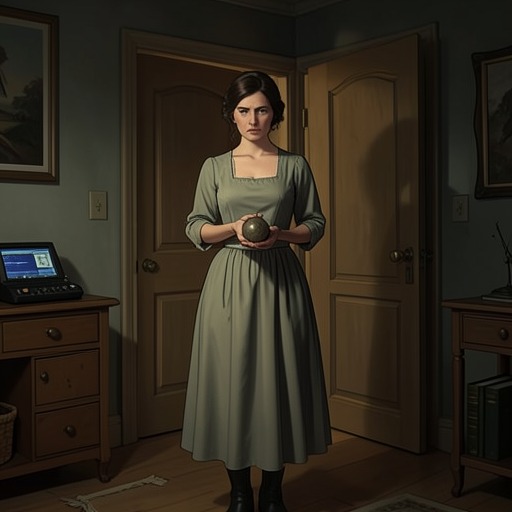
J.W. Wells & Co. office
The Portable DoorJ.W. Wells & Co. office is the firm’s London workplace at 70 St Mary Axe, London W1, and a building whose bewildering scale makes ordinary orientation difficult before its supernatural business is even understood. For Paul Carpenter, its corridors, locked rooms, odd rules, and hidden passageways turn a new clerical job into an education in how little the office’s conventional appearance can explain.
Address and layout
The firm’s letterhead identifies its address as 70 St Mary Axe, London W1. Inside, the building is large enough to feel less like a straightforward workplace than a maze: Paul finds himself in a basement beneath thick green glass through which he can see shoes passing overhead, then later emerges onto a flat roof covered in lead. The succession of levels and routes gives the building a practical disorientation. Getting from one place to another is not a simple matter of following a corridor.
Its rooms deepen that impression. A door that Paul calculates should open onto a fourth-floor landing instead leads into a portrait-lined boardroom, where two dozen men are seated around a table. They swivel to stare at him as he apologizes and retreats. Elsewhere he discovers two lavatories, a kitchen on an enormous scale, a stationery cupboard packed with typewriter rubbers, and a door that opens directly onto a solid brick wall. These are not merely unfamiliar offices: the expected relationship between a door and the space beyond it repeatedly fails.
The building’s strangeness is set against the practical demand that a new employee simply find his way around. The receptionist has advised Paul to ask someone for directions, but, apart from the gathering in the boardroom, the place seems deserted. He worries that he could be left to wander its corridors indefinitely before colliding with a partner from his interview. The encounter brings him back into contact with the people who work there, but does not make the premises any less difficult to navigate.
Workplaces and routines
Paul’s induction presents the office as an intricate system of procedures. Christine guides him through corridors, stairs, doors, and landings while rapidly listing his employee reference, restricted lavatories, computer rules, meal breaks, printing arrangements, stationery locations, and telephone instructions. The volume and pace of the information make the workplace feel as labyrinthine administratively as it does architecturally: even its ordinary functions require routes, rules, and warnings to be learned.
The instructions make the building’s organization concrete. The partners-only toilets are on the third floor; the laser printer is on the second, where paper jams require someone to stand over it; and paper clips and rubbers are in a green cupboard on the fourth. Notepads and pencils must be signed out from the closed-file store, while pens are obtained from Christine. Paul is told to dial 9 for an outside line and to return the long stapler to its proper place. The small back office he is assigned to share with the other new clerk, Sophie Pettingell, was once a second interview room and suffers from chronic damp. Its bare desk, scratched filing cabinet, plain chairs, dusty ceiling, and worn floor make a modest, cramped contrast to the building’s immense kitchen and maze-like extent.
The rules also hint at a hierarchy that Paul does not yet understand. The strongroom keys are kept in reception, and employees are warned not to forget them and leave with them. Christine adds instructions about the partners’ coffee preferences, including that Professor Van Spee takes no milk because he is lactose-intolerant. For Paul, this dense mixture of practical detail, unusual restrictions, and personal routines is difficult to absorb; the office initially appears to demand fluency in a system whose purpose remains unclear.
Restricted spaces and hidden business
The strongroom links the office’s routine administration to the firm’s more concealed activities. Its keys are part of Christine’s new-staff instructions, and the room later becomes the setting for a consequential discovery by former employees. While clearing and organizing its securities, they receive a box of miscellaneous items from Humphrey Wells’s secretary, Julia. Inside is a cardboard tube containing an india-rubber mat shaped like a door. After reading its instructions, they set it against the strongroom wall, open the door that appears, and use it to travel to their own lodgings. There, they discover that the ordinary door connecting their rooms to the rest of the building is missing.
The passageway does not offer a harmless escape from the firm. Humphrey Wells appears in the magical doorway and, after the employees refuse to give him a talisman, slams it shut. The door vanishes, leaving them trapped in a room with no exit. The episode makes the office’s locked and restricted spaces part of a larger pattern: an apparently administrative workplace contains objects and routes whose effects exceed ordinary office procedure, while control of access can become a means of imprisonment.
The building’s significance lies in the contrast between its recognizable clerical details and its unstable spatial logic. Keys, file stores, desks, printers, and staff instructions anchor the setting in routine employment; doors onto brick walls, impossible routes, and the portable passage unsettle the assumption that an office is a space whose layout can be mastered. Paul’s first encounters with the premises make that uncertainty a feature of his job from the beginning: the firm asks him to learn how its workplace functions even as the building keeps demonstrating that its spaces cannot be taken at face value.