J.W. Wells & Co. underground strongroom
The Portable DoorJ.W. Wells & Co.’s underground strongroom is both the firm’s neglected archive and a space where its magic becomes tangible: a room of dusty records, puzzling objects, and concealed histories that becomes the setting for a deadly imprisonment. When Paul Carpenter and Sophie Pettingell are assigned to catalogue it, the work begins as an exercise in sorting and recording. The objects they encounter, and the Portable Door they find among them, turn the strongroom into something more consequential: a repository whose contents connect the firm’s past to the dangers unfolding in its present.
Setting and Appearance
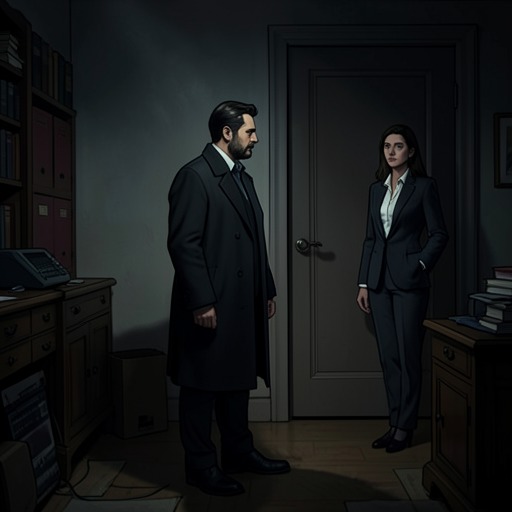
The strongroom lies below the offices, and its first impression is of a place built to preserve things while discouraging anyone from enjoying the task. Paul sees an old-fashioned library crossed with a maximum-security prison, with something of the mines of Mona about it. Dust covers the shelves; enormous cobwebs sag from the corners, and the air feels thick and stale. Someone began painting the ceiling battleship grey about fifty years earlier, then abandoned the job halfway through. The unfinished paintwork gives the room a visible history of neglect rather than a finished, orderly appearance.
The space is larger than Paul’s bedsit by half again. Shelves run along all four walls, packed with black tin boxes, files, folders, ledgers, and large beige envelopes. Its size and density matter: the strongroom is not merely somewhere to put a few forgotten curiosities, but an archive whose contents have accumulated beyond easy retrieval. Sophie defines the assignment as making a complete list of what is there and where it is, then arranging everything so it can be found again. She proposes that one of them inspect each box and call out its contents while the other records them, with numbered yellow sticky notes to identify the objects. The room’s disorder makes cataloguing an attempt to impose practical order on a history that is anything but ordinary.
The Inventory and Its Contents
The inventory exposes the range of material held in the strongroom. Among the early finds is a ragged map that Sophie identifies as relating to King Solomon’s mines. Elsewhere, the pair encounter a dried animal paw once kept safe at the request of Celia Garvin in 1919; a tree sketch on the back of an envelope addressed to R. Matisse; Confederate banknotes worth just under a quarter of a million dollars; and a newspaper clipping from the 1930s advertising patent bicycle seats. An envelope of hair and nail clippings adds a more macabre item to the collection. These objects vary from financial records and ephemera to things whose original purpose is obscure, making the strongroom’s contents difficult to reduce to a single coherent collection.
Item thirty-two has a particular effect on the two cataloguers. It is a cracked, sepia photograph dated 1891, showing Professor Van Spee in a top hat and frock coat, holding a black lacquered walking stick and white cotton gloves. The old catalogue gives no name or reference number for it, but Paul immediately knows what to enter in the Property Of column. The photograph turns the archive into evidence of a connection between the present-day workplace and a much earlier period. Its discovery also contrasts with the mundane procedure of numbering and recording: the inventory is meant to make objects legible, but some entries raise questions rather than settle them.
The same unease becomes personal when Paul finds seventeen Victorian love letters, bound in faded red ribbon. The old register lists them as the property of Paul Carpenter, Esq., and records their arrival in 1877; the address on the letters is his own. He copies the entry into his notebook, then privately reacts to the apparent coincidence. The next day, while Sophie is away getting coffee, he checks the letters and other documents, including bank books, title deeds, and a death certificate. Those records bear the name Philip Catherwood, which reassures him for the moment without explaining why the letters carry his own name. The strongroom’s archival function thus becomes entangled with Paul’s uncertainty about the identity and history represented in its records.
The Portable Door and the Room’s Transformation
Among the boxes is a folded, thin rubber object printed with the outline of a paneled door, complete with hinges and a doorknob. Paul initially struggles to identify it and records it in deliberately cautious terms. In retrospect, this object is the Portable Door, preserved in the strongroom before Paul and Sophie understand what it can do. Its plain, flexible material sits incongruously among the dusty papers and boxes, but the difference between its appearance and its function makes the strongroom’s inventory more than a record of obsolete office property.
Pip later recounts how he and Arthur found the object in the strongroom after Humphrey Wells had ordered the room cleared and its securities put in order. They read the instructions, spread the rubber mat against the wall, opened the magical doorway, and wedged it ajar with a heavy book. Cautiously, they directed it to take them only to their lodgings. They emerged there, but discovered that the ordinary door connecting their rooms to the rest of the building was absent. Humphrey then appeared in the magical doorway. Because they had refused to hand over the talisman and knew too much about his business, he said they should be removed from harm’s way, slammed the door, and made it vanish. Pip and Arthur were left in a room with no door. The strongroom is therefore not itself the prison; it is the place from which the instrument of their confinement is discovered and used.
Archive, Trap, and Narrative Significance
The strongroom’s two roles sharpen one another. It is a storage space meant to keep the firm’s property safe, but the lack of a reliable catalogue has allowed objects of extraordinary significance to lie among papers and miscellaneous belongings. The assigned inventory brings hidden things into view, yet knowledge alone does not guarantee safety: the Portable Door becomes dangerous when Humphrey exploits it against the people who discover it. A room devoted to locating and ordering the firm’s possessions gives way to a chain of events in which a door’s location, operation, and keys become matters of survival.
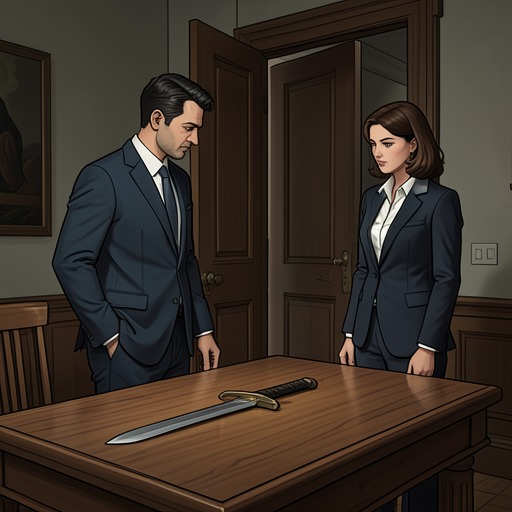
The strongroom also remains connected to the later attempt to open the door that trapped Pip and Arthur. Paul recognizes that the two keyholes imply two keys, and that Humphrey may have concealed them behind a test rather than leaving them as ordinary bits of brass. At a sword in the stone, Paul and Sophie pull out a blade whose blunt, crinkled tip resembles a key’s wards; Paul breaks off the key portion and keeps it. The strongroom’s earlier discovery of the Portable Door therefore leads into a search shaped by puzzles and disguised objects. Across these episodes, the archive’s clutter is not inert background: it is where evidence, magical machinery, and the means of both confinement and rescue enter the characters’ lives.