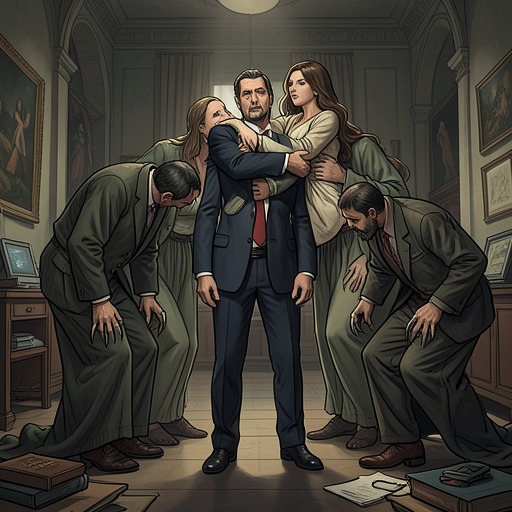
J.W. Wells–Goblin Night-Passage Agreement
The Portable DoorThe J.W. Wells–Goblin Night-Passage Agreement governs the unusual terms of J.W. Wells & Co.’s tenancy: the Goblins own the premises, and in return for a peppercorn rent they are allowed to emerge from their tunnels after the doors are locked and enjoy the building without interference. The arrangement makes the firm’s obligations to its landlords personal as well as practical: Dennis Tanner identifies the Goblins as family and insists that human occupants treat them with consideration.
Ownership and Terms
Dennis Tanner explains that the Goblins own the building and let it to J.W. Wells & Co. at a peppercorn rent. The tenancy rests on an explicit understanding about access: when the doors are locked, the Goblins can come out of the tunnels where they live, move around, and have what Tanner describes as harmless fun after a long day digging ore with their fingernails.
The agreement therefore reserves the locked building for the Goblins’ use at that time. Their passage is not presented as an intrusion to be prevented; it is a condition of the firm’s right to occupy premises that belong to them. The low rent is tied to the company’s acceptance of that condition, rather than being a payment that buys unrestricted control of the building.
Human Conduct and Enforcement
Tanner tells Sophie Pettingell that Goblins are not so different from people: frightening them may make them panic, while leaving them alone means they will not bother the humans. He warns her not to antagonize this particular colony and frames restraint as basic consideration for others, asking her to imagine large, ugly monsters barging into her parents’ lounge and shoving them around. His comparison turns the tenancy term into a reciprocal rule of conduct: human occupants should not treat the Goblins as threats simply because they are larger or unfamiliar.
He repeats the practical instruction to Paul Carpenter when Paul returns to 70 St Mary Axe on Saturday. With the building full of Goblins, Tanner advises him not to worry about getting to his office, provided he leaves them alone. The warning is concise, but it restates the agreement’s central limit on human behavior: access to the workplace does not give employees permission to disrupt the Goblins’ use of the premises.
The Agreement in Practice
By the time Paul climbs the stairs, the Goblins are no longer visible. Their recent presence is nevertheless unmistakable in the ripped carpet, claw-shredded wallpaper, axe-riven door panels, and dark stains on the floor. The damage gives the night passage a material consequence: allowing the Goblins to use the building does not mean the human occupants will find it untouched afterward.
Paul recognizes that the apparent scale of the cleanup would ordinarily require a large repair effort, but he knows magic could erase the signs with a few finger-clicks. This shows how the firm can accommodate the aftermath without changing the underlying bargain. The account does not depict the Goblins attacking Paul or establish that the damage was deliberate; instead, the contrast is between the visible disorder left behind and Tanner’s assurance that, if humans leave the colony alone, it will not bother them.
Significance
The arrangement makes a supernatural workplace depend on a landlord-tenant relationship with obligations running in an unexpected direction. The Goblins are not merely hidden inhabitants of the building: they are its owners, and J.W. Wells & Co. occupies it on terms that protect their after-hours freedom. Tanner’s reminder that they are family reinforces that this access is also a matter of loyalty and consideration, not only a convenient business exchange.