John Wellington Investigates the Firm's Partners
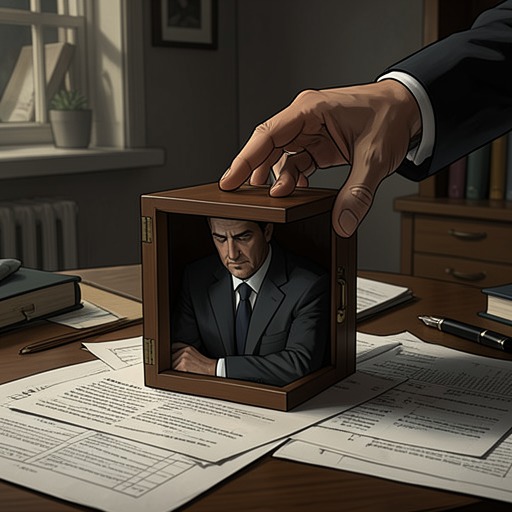
The Portable DoorJohn Wellington Wells’s investigation of the firm’s partners turns a return to the boardroom into an inquiry into concealed knowledge, competing loyalties, and the uses of magic. Rather than question the partners himself with a substance that might make his motives suspect, he asks Paul Carpenter and Sophie Pettingell to take Dragon-dropping beans and test what people mean beneath what they say. Their results expose Dennis Tanner’s knowledge of Humphrey Wells’s betrayal, but also establish why Tanner did not intervene: freeing John would have freed the father Tanner despised. John’s response is not simply to punish or dismiss him. He weighs the confession against Tanner’s part in bringing Paul and Sophie into the firm and ultimately asks them to preserve the partners’ ability to work together.
Return to the Boardroom
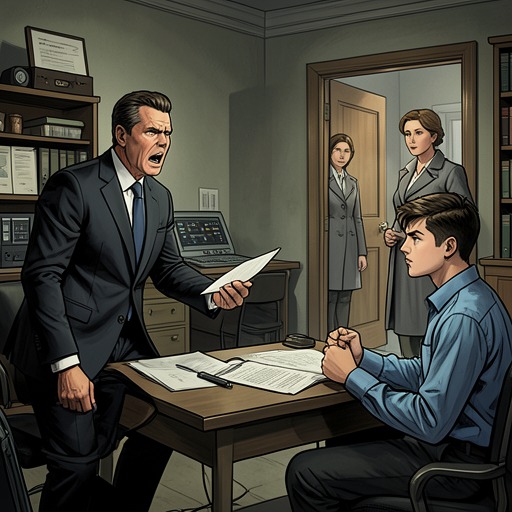
John convenes the inquiry after entering with Professor Van Spee, Casimir Suslowicz, the Contessa di Castel’Bianco, Dietrich Wurmtoter, Pip, and Tanner. Paul and Sophie have risen guiltily, but John tells them to sit with the others. From his pocket he takes a paper bag that Paul recognizes as containing Dragon-dropping beans, which make a listener hear what a speaker means rather than merely the words spoken. John says his own observations while transformed into a stapler, together with what he has learned since returning, point to a possibility beyond Humphrey’s individual wrongdoing: another partner may have joined the plot against him, or known what was happening and remained silent.
The distinction matters to the inquiry. John does not present suspicion as proof, and he acknowledges that if he swallowed the beans and questioned the partners himself, they might suspect he was using the result to remove people he disliked. Instead, he assigns the test to Paul and Sophie, who, in John’s account, have no reason to favor one partner over another. The others pause, then agree. John’s choice gives the procedure an appearance of impartiality, while making the returned employees responsible for interpreting what the partners disclose.
Testing What Is Meant
Before questioning anyone, John sets up a controlled demonstration. He writes different statements on two slips of paper, keeps them in his pocket, and speaks one statement while thinking the other. He then asks Paul and Sophie to report what they heard. The test is not an attempt to prove that ordinary speech is always truthful; it establishes, for this meeting, that the beans direct the pair to the speaker’s intended meaning rather than the surface wording. When Pip reads out the words Paul heard, Sophie’s account matches. John treats their agreement as sufficient demonstration and begins the partner-by-partner inquiry.
The order of questioning distinguishes opportunity from suspicion. John says Dietrich Wurmtoter can be excluded because he joined the firm long after John disappeared. Professor Van Spee, by contrast, admits intense hostility toward John but says he genuinely believed John dead. John then questions the Contessa, referring to his earlier impression of her ambition and character without establishing that she knew about Humphrey’s actions. The surviving evidence does not make these exchanges the inquiry’s decisive discovery; their function is to show John testing each person rather than treating dislike, rivalry, or a difficult reputation as proof of complicity.
Tanner’s Confession and Its Limits
John’s final direct question is to Dennis Tanner. Through the beans, Tanner acknowledges that he learned only years after joining the firm what Humphrey had done to John. He says he could not rescue John without also releasing Tanner’s father, the clerk who had made Tanner’s mother pregnant, and that he would have freed John if there had been a way to do so without freeing his father as well. His account therefore confirms prolonged silence, but describes its motive as hostility toward his father and a wish to protect his mother, not an alliance with Humphrey.
The distinction becomes especially charged when Tanner’s unspoken meaning turns to his mother’s renewed pursuit of John and the possibility of stopping her when John is no longer present. John cuts off the revelation before it develops further. The scene makes the beans’ operation consequential: Tanner’s ordinary spoken response does not contain the full extent of his thoughts, while Paul and Sophie hear the implication. John then decides that they have understood enough and no longer need to translate every thought for the table. Tanner announces that he is out and invokes his family’s ownership of the building, but John refuses to treat the disclosure as grounds for expulsion or to be intimidated by that claim.
Judgment and Aftermath
John’s judgment is shaped by information beyond the confession. He recalls that Tanner insisted on hiring Paul and Sophie when Humphrey opposed their appointment, sent them the swords in the stones, and arranged the staged encounter that brought them together on the evening Paul bought frozen pizza. John interprets these actions as evidence that Tanner recognized the pair could set matters right and had acted as a matchmaker. Tanner replies that his purpose was self-defence: he wanted Humphrey kept away from his mother. The exchange leaves his actions with more than one consequence—he protected a family interest, helped set the young employees’ story in motion, and withheld knowledge of John’s fate.
John does not declare Tanner innocent of silence; instead, he distinguishes that silence from active participation in Humphrey’s plot and says Tanner is not dismissed. He also expresses sympathy for the difficulty of having Tanner’s mother, while identifying Tanner himself as the person who brought Paul and Sophie into the firm. John then turns to the pair and asks for their discretion if the partners are to continue working together. Sophie kicks Paul under the table before he agrees. The investigation thus ends not with a public purge, but with a negotiated containment of what it has uncovered: the beans have exposed a partner’s knowledge and private motive, while John chooses continued cooperation over immediate rupture.