John Wellington Wells’s stapler transformation
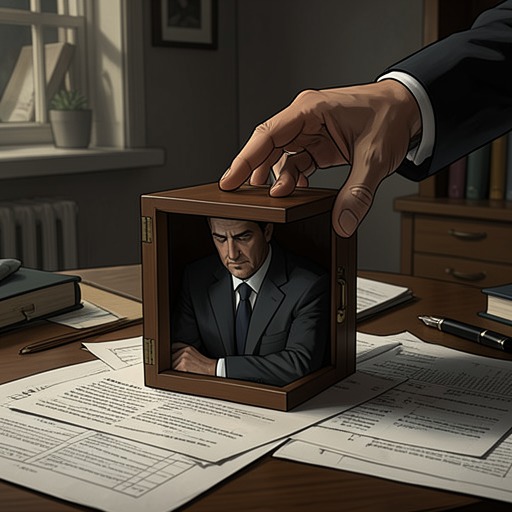
The Portable DoorJohn Wellington Wells’s stapler transformation makes an office implement the prison and disguise of a person who has been absent for 130 years. Its significance lies in the gap between what the room appears to contain and what its reflective table can disclose: Paul Carpenter first sees a familiar stapler, then discovers John hidden in its reflection, and helps release him with the golden chain.
The Stapler and Its Reflection
The Long stapler appears on a mirror-polished table in a room where Paul is restrained and unable to bear watching Humphrey Wells’s actions. Its arrival is itself unsettled: Paul wonders how it got there, since it had not been present a moment earlier, but its unexplained appearances and disappearances have become familiar enough that he initially gives it little attention. That habituation delays recognition. The tool is at once an ordinary object in the room and evidence that the room’s visible arrangement cannot be trusted.
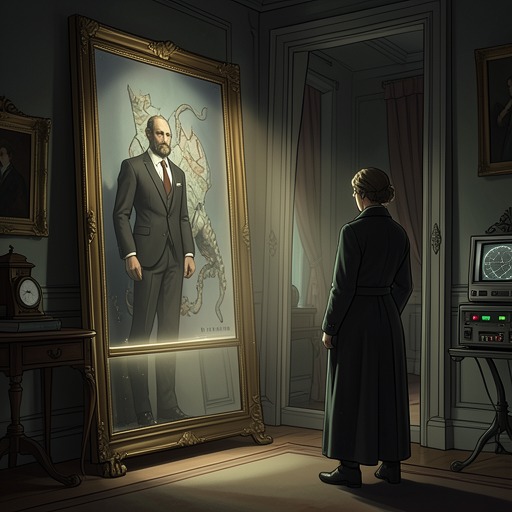
Paul recalls an earlier explanation from Ricky Wurmtoter about the table’s ability to reflect an object’s true form. The reflection is not simply an inverted image: it can show something additional to the visible object. On that previous occasion, the table disclosed Kurt Lundqvist’s mouse form. Looking at the stapler’s reflection now, Paul sees a tiny bald man in a black frock coat and grey striped trousers, crouched and waving frantically. The reflected figure is John Wellington Wells, while the stapler itself remains visibly just a stapler. The contrast turns the table from polished furniture into an instrument of recognition and makes the object’s unremarkable surface part of the concealment.
Paul’s Recognition and John’s Instruction
Paul identifies the reflected man as John Wellington Wells senior. John’s voice then reaches him faintly inside his head, telling him to lay the chain over the stapler when the spell is broken. The instruction gives Paul a precise action to perform, but not much time to prepare: the unseen ropes suddenly release him, and he pitches forward out of his chair as Humphrey turns with a sword raised.
As he falls, Paul reaches for the little gold chain on the table and flicks it toward the stapler. His action is hurried and uncertain rather than controlled. The chain clatters against the object and wraps around it, an outcome the narration presents as luck rather than skill. A blinding flash of blue light follows. Humphrey drops his sword and crashes against the wall, while John Wellington steps down from the table in human form. Paul’s chance movement has become the physical means by which John’s instruction takes effect.
Release and Its Immediate Effects
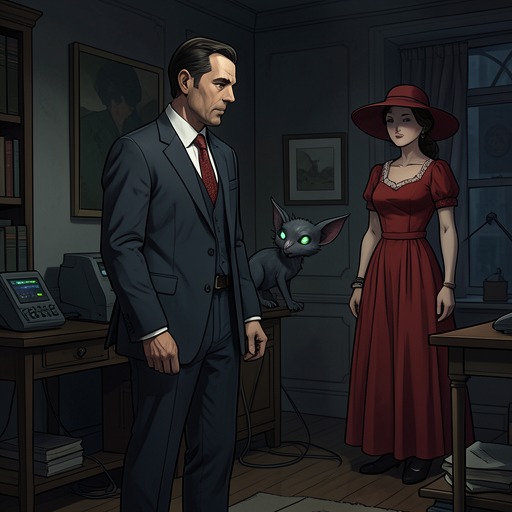
Once restored, John politely thanks Paul and clicks his fingers. His return is accompanied by several changes in the room: Mr Tanner’s mum acquires a long rose-madder silk dress with a zouave jacket and bustle; Arthur and Pip tumble from their chairs onto the floor; and a large snake coils around Humphrey until nearly all of him is concealed. Sophie’s head falls forward and she snores. John also spits out a mouthful of staples, while an empty plastic bottle rolls across the floor. The staples make the transformation’s material cost unmistakable: John has not merely been represented as an office tool but has been trapped in a form associated with its actual function and contents.
The release does not erase the duration of the imprisonment. Later, when Pip hesitates to read something aloud because it seems personal, John answers that it is no more personal than spending a hundred and thirty years as a stapler. The remark makes the length and indignity of his confinement explicit. Pip then reads the words, and Sophie’s version is identical; Countess Judy turns bright pink, while John laughs. He treats the episode as proof that speech is a frail instrument and turns from that demonstration to investigating the other partners. His return therefore restores not only a person but an active investigator, able to challenge those around him.
The Object as Concealment and Evidence
The transformation depends on a mismatch between physical appearance and identity. Seen directly, the stapler is a familiar object that Paul has learned not to question; seen in the table, it contains a human figure seeking help. The difference recalls the earlier revelation of Kurt Lundqvist as a mouse and establishes that the reflected image can overturn an initial reading of what is present. In this scene, Paul’s memory of that rule matters as much as the reflection itself: he recognizes the significance of the image because he remembers how the table works.
The stapler also links John’s long absence to the decisive action that ends it. It is where the chain must land, where the blue flash occurs, and where John stands before stepping back into the room. His transformation thus turns a mundane tool into a concealed body, a clue, and the site of his release. Once John is free, the stapler’s apparent ordinariness can no longer be taken at face value: it had held a person and kept his return from view for 130 years.