John Wells
The Portable DoorJohn Wells is the unseen senior partner of J.W. Wells & Co., identified in office protocol as JW. Though Paul Carpenter has never seen him, a dream gives John a striking imagined presence: his office is at once a seat of immense authority and a room where Paul finds himself unable to move.
Identity and Introduction
Dennis Tanner explains to Paul how employees are expected to address the firm’s senior figures. Humphrey Wells is to be called Mr Wells, while the senior partner, John Wells, is JW. The distinction places John at the top of the company’s hierarchy, but the brief instruction offers no account of his appearance or personality. Paul has not yet met him.
The Office in Paul’s Dream
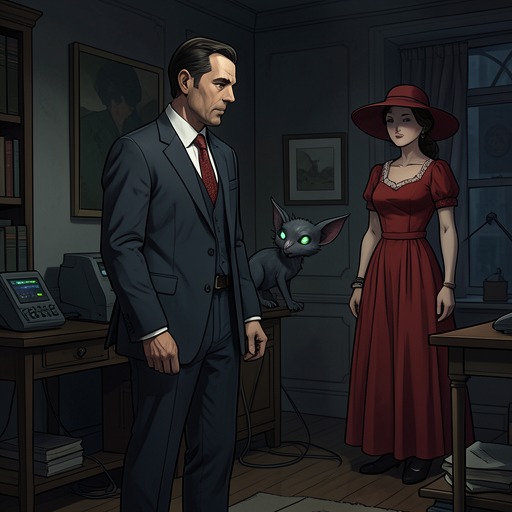
After a gloomy supper, Paul dreams that he is sitting in an office he somehow knows belongs to John. It overlooks London’s rooftops through a splendid bay window; its ornate ceiling, vast figured-walnut desk, and Persian rug make it seem extravagantly wealthy. The room’s collection mixes the historically precious with the startlingly odd: a Pappenheim rapier, a Gutenberg Bible, a candle in a thirteenth-century parcel-gilt candlestick, a Victorian handbell, and a plain gold ring sit in a glass case. Nearby are two paintings of radically different apparent value, seven telephones in different colours, a sepia photograph of a man in a top hat and frock coat, and a birdcage with its door open.
The dream does not simply show Paul visiting John’s office. Paul knows that the office has become his and has been his for some time, yet his shoes have been stapled to the floor. Across the desk, a goblin in a grey silk Italian suit waits with a notebook and pencil while Paul dictates a letter. These details belong to the dream, not to a confirmed account of John’s actual office or conduct: the scene turns the unseen senior partner’s room into the setting for an imagined future that is simultaneously grand and restrictive.
Narrative Significance
John’s characterization is mediated by absence. At work, a naming convention marks his seniority; in Paul’s dream, his office expands that authority into a lavish interior crowded with objects whose histories and values vary wildly. Yet the dream’s central position belongs to Paul, not John: Paul occupies the chair, holds the tea, and is already established in the office, while the stapled shoes make that imagined status feel confining. The episode therefore supplies an impression of John’s power and surroundings without presenting him directly or confirming that Paul’s dream predicts what will happen.