Love Potion
The Portable DoorThe Love Potion is a J.W. Wells & Co. preparation whose central promise is also its danger: after a dose, the drinker becomes permanently devoted to the first person of the opposite sex they encounter. The firm sells it as a product and arranges its secret administration for clients, making involuntary attachment both a business line and a recurring threat to personal choice.
Product and Effect
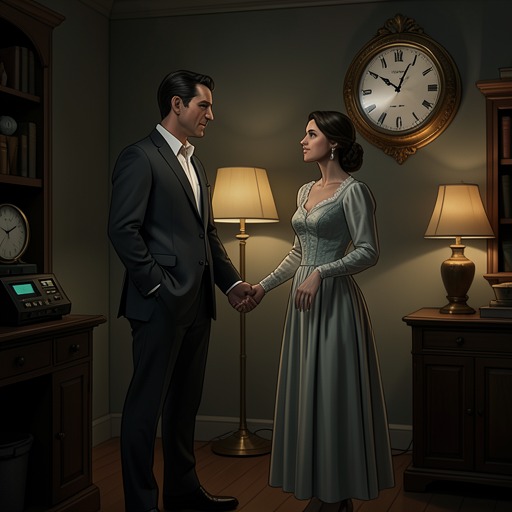
When Dietrich Wurmtoter introduces Paul Carpenter and Sophie Pettingell to the firm’s JWW Valentine Express Love Philtre, he describes it as one of the company’s best-selling lines. Although its popularity has declined since the era of arranged marriages, the business still moves about fifteen hundred gallons annually through wholesale and retail sales. Dietrich says that two tablespoons are enough to produce permanent love, lasting until the drinker’s death. Sophie’s sharp repetition of the word permanent marks the consequence that troubles her: this is not a passing infatuation but a lasting alteration of the drinker’s attachment.
The potion is presented as a commercially established product rather than an isolated magical curiosity. Dietrich says it once formed a mainstay of the firm’s business, and the brochure gives Paul and Sophie an introduction to a service that has persisted for more than a century. Its familiar product language and sales volume sit uneasily beside the scale of its effect: a measured quantity can determine whom someone loves for the rest of their life.
Commercial Use and Covert Administration
J.W. Wells & Co. does more than sell the liquid. Dietrich explains that the firm also handles specialist applications, including covert supply, and says there remains demand for secretly dosing someone. The arrangement treats a person’s future attachment as something a client can commission. Paul reacts with visible discomfort when Dietrich frames the service as fulfilling clients’ romantic daydreams, while Sophie listens without voicing the misgivings the proposal has stirred in her.
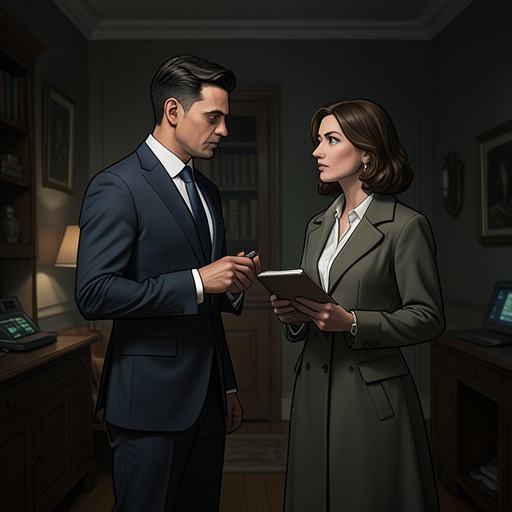
A goblin later briefs Paul and Sophie on a planned operation at a pub. The landlords are expected to fall asleep at a quarter to six; Sophie is to take the barmaid’s place, add the required dose to a customer’s beer, and leave immediately. The customer is expected to sleep for twenty minutes, while Paul takes over behind the bar and prevents any other woman from entering. The client is to arrive at a quarter past six, before the customer wakes. The plan’s tightly managed timing is designed to control who the potion’s drinker encounters, and therefore whom the potion makes its target. The scene presents administration not as consent between two people but as a concealed operation arranged around the drinker.
Coercion and the Attempted Spell on Sophie
The potion later becomes a weapon in Humphrey Wells’s attempt to break the connection between Paul and Sophie. After the pair have recognized their shared happy ending, Humphrey takes a partly full plastic bottle of golden liquid from Sophie’s handbag. He identifies it as his uncle’s recipe and gives Sophie the potion, intending that she wake and fall passionately in love with Pip. His scheme is calculated to create a painful mismatch: Sophie would remain aware that Pip was not the person she truly loved, while being made to feel an overpowering attachment to him. Humphrey expects this conflict to intensify because Sophie, Pip, and Paul would be confined together in a cramped bedsit.
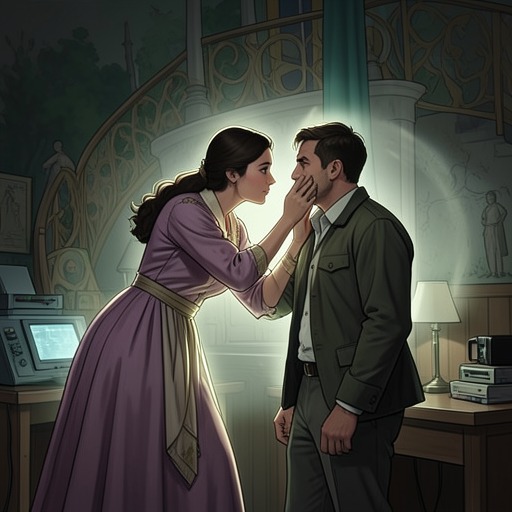
Sophie later recalls Humphrey making her drink the Love Potion and describes the intended target as the small clerk with the pointed nose. Paul confirms that she drank it, but says the planned effect did not occur. His account links the interruption to his discovery of John Wellington Wells in the form of the long stapler and his release of him; John then dealt with Humphrey. Sophie’s recollection makes clear that the threat was not merely a false alarm: Humphrey had physically administered the potion, and her feelings were the object of his plan. The rescue prevents the intended transformation from governing her relationship with Pip.
Other Doses, Remedies, and Uncertainty
The potion’s effects also entangle Paul. John Wellington Wells tells him that an antidote exists, but describes it as an oath rather than a counter-dose: Paul must swear to give up women and relationships, go away for a week or two, and wait for the potion to wear off. Paul understands that breaking the oath could mean disintegration and the forfeiture of his soul, though he reports that John was vague about the consequences. The proposed remedy therefore carries its own severe constraint; escaping the potion’s influence requires a binding commitment, not simply a change of mind.
Near the end of the account, Paul questions Sophie about an earlier possible exposure. He recalls putting Love Potion into one of two glasses of champagne at a pub as part of a scheme intended to make a woman fall in love with the film actor Ashford Clent. Sophie had said she needed a drink, and Paul cannot remember whether he warned her that one glass had been dosed. He asks whether she drank any before she put some in his tea on the train. The exchange establishes Paul’s uncertainty and his recollection of the potion’s passage into his tea, but does not resolve whether Sophie drank the champagne or explain the circumstances of the tea. This unresolved possibility underscores how easily a covert dose can travel beyond its intended target, while leaving the characters’ actual exposure distinct from what they can prove.