Mirror That Reveals True Forms
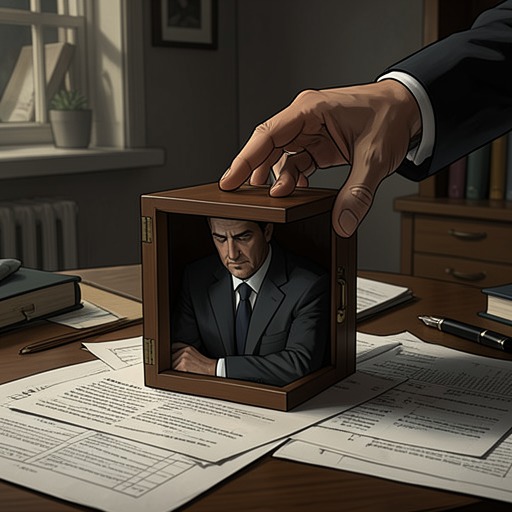
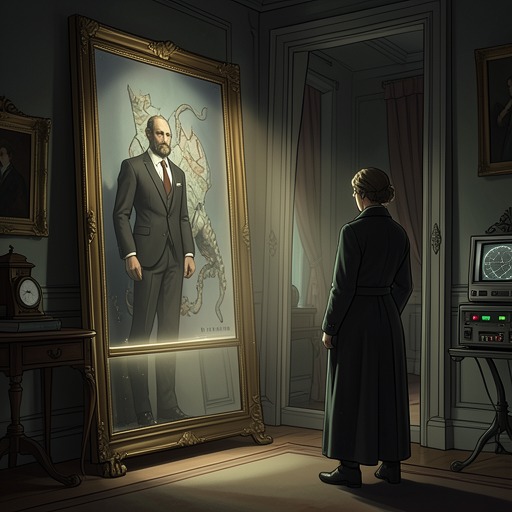
The Portable DoorThe Mirror That Reveals True Forms is a device that makes magically altered appearances legible: a transformed being appears in its reflection as what it really is. Introduced to Paul Carpenter by Dietrich Wurmtoter, the mirror turns a tabletop into a means of detecting deception and a prompt to question how much can be known from appearances alone.
Definition and Operation
Dietrich Wurmtoter explains that anything whose shape has been changed or transformed by magic appears in the mirror in its true form. He describes the devices as a Chinese invention and says they can be attached to almost anything. Their value lies in the difference between what a person seems to be and what the reflection discloses; the mirror does not undo a transformation, but makes its concealed reality visible.
The mirror’s demonstration is small in scale but striking in detail. Paul looks at a mouse and then at its reflection beneath its paws on the polished tabletop. There he sees a tiny man in combat fatigues and top-of-the-range Ray-Bans, with a minuscule one-thirty-second-scale Kalashnikov slung across his back, scrabbling against the wood. The mouse’s appearance has concealed Kurt Lundqvist’s human form; the reflection makes that disguise readable even while Kurt remains physically a mouse.
Uses and Limits
J.W. Wells & Co. keeps one of the mirrors on its boardroom table. As Dietrich explains it, the device gives the firm an advantage when negotiating face to face with an opposing team: seeing what the other side really is can matter in a business where supernatural transformations and deception are practical risks. The mirror is therefore not merely an object of private curiosity; installed in a place of negotiation, it functions as a precaution against hidden identities.
Its protection is not complete. Dietrich warns that some beings do not appear in the mirror at all and advises running from them. The distinction matters: the device can expose certain magical changes, but a missing reflection is not reassuring proof that nothing is present. Its usefulness depends on what kind of concealment it confronts, so it offers information rather than safety by itself.
Identity and Reflection
The mirror’s function reaches beyond identifying a transformed person. Later, Sophie Pettingell considers entering the boardroom to look at her own reflection in its tabletop, wondering what she might learn. Paul Carpenter believes he already knows what he would see in his own reflection, while Sophie suggests he may be mistaken. The exchange does not establish what either of them would see; instead, it turns the mirror’s power of disclosure into an open question about self-knowledge.
That contrast gives the device a double significance. In the encounter with Kurt, reflection supplies a definite answer to a hidden physical identity. In Sophie and Paul’s conversation, it becomes an imagined test of how accurately a person understands themselves. The same object that helps J.W. Wells & Co. look past an opponent’s disguise also unsettles confidence that anyone’s own identity is already fully known.