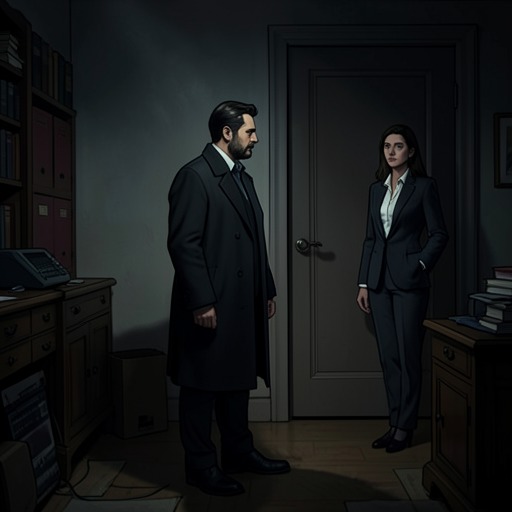
Paul Carpenter
The Portable DoorPaul Carpenter enters J.W. Wells & Co. convinced that he is the least likely candidate to be hired and that the job is one he scarcely wants. The position brings him into a world of Goblins, enchanted objects, and temporal dislocation, but his deeper change is personal: he moves from treating his own hopes as doomed to acting on his abilities, accepting his love for Sophie Pettingell, and helping free John Wellington Wells and defeat Humphrey Wells.
Identity and First Days at J.W. Wells & Co.
At the interview, Paul watches a confident candidate leave the room smiling and shaking hands with the grim-faced interviewer. He regards the other applicants as almost superhuman and himself as having no chance. Sophie Pettingell, the last candidate waiting beside him, seems no more likely to succeed in his estimation. His first impression of her is shaped by her small, dark appearance and an intimidating air of hostility; he thinks of the interview as a humiliation they might as well both avoid. The dismissive judgment is an early measure of his insecurity, not a reliable reading of the relationship that will develop between them.
The offer arrives by letter from 70 St Mary Axe, London W1. After briefly imagining the letter as a rejection, Paul reads that he has been offered the position of junior clerk, following his interview on the 21st, and is asked to make himself available from Monday the 26th. The formal language promises an ordinary office job. That expectation soon collides with the contents of the workplace: the company’s dusty strongroom, its unexplained records, and a business whose operations involve supernatural forces.
Paul and Sophie are assigned work together, including the collation of papers and an inventory of the strongroom. When they open an envelope during the inventory, they find a ragged brown sheet that Sophie identifies as a map to King Solomon’s mines. Another item, an old, cracked sepia photograph dated 1891, shows Professor Van Spee in a top hat and frock coat, holding a black lacquered walking stick and white cotton gloves. Paul recognizes him despite the photograph’s age. The strongroom is not merely a store of dusty curiosities: its objects connect the young clerks’ daily tasks to a history and a set of powers that the firm has not yet explained to them.
Work, Hidden Talent, and Disillusionment
Paul’s first responses to the company’s strangeness are reluctant and practical. After Professor Van Spee has told him something that unsettles him, Paul tries not to think about it as he heads to the basement. He throws away the extra-strong mints in his jacket pocket, a small, concrete gesture marking an effort to leave behind an earlier state of mind. The strongroom itself—a space combining the feel of an old library and a maximum-security prison—confirms that Mr Tanner’s warnings about the workplace were not a joke. Sophie’s blunt reaction to the room gives their work an everyday, comic counterpoint to its sinister atmosphere.
The firm’s explanation of Paul’s abilities gives a purpose to work that had seemed like arbitrary clerical busywork. Mr Tanner tells him that Goblins dig deep for minerals and that the company needs bauxite from New South Wales. Paul has been looking at photographs of Australian terrain and, without realizing what he was doing, identifying the deposits. Mr Tanner calls him a natural scryer and assesses his success rate at ninety per cent. Paul is stunned to learn that his employment was tied to this ability. Sophie, meanwhile, is told that Professor Van Spee believes she has the potential to be a seer. Their ordinary office assignments have been a practical test of unusual capacities.
The revelation does not immediately make Paul feel empowered. After a Goblin has gone, he sits looking at a photograph of Australian sand and describes an emptiness so complete that he feels as though his whole self has been poured away. His despair is bound up with the fragile hope he has invested in Sophie since seeing her at the interview. The contrast matters: Paul can possess a valuable supernatural talent and still feel powerless in the personal part of his life. For a period, he and Sophie barely speak except to borrow a pencil or apologize when their feet collide under the desk. Each recognizes, at least intermittently, that the mutual silence is childish and rude, yet neither breaks the pattern.
The Portable Door and Time
Paul’s discovery of the portable door introduces a new kind of agency, along with new uncertainty. When he returns to his office after using it, Sophie is still away at lunch, and his watch shows that only seconds have passed. The small instruction sheet remains on Sophie’s chair. When the door peels away from the wall and falls, Paul briefly wonders whether the experience was imaginary; the book of matches in his pocket, bearing a name, phone number, and website, provides physical evidence that it was not.
The door proves capable of sending Paul through time as well as space. He realizes this after finding himself back in the previous afternoon, and initially imagines using the ability to edit the mistakes of his life. One possible correction is clear to him: going back to avoid applying for the junior-clerk position at J.W. Wells & Co. The temptation to escape his predicament sits beside his growing recognition that the magical object could alter events. But the experience does not turn time into a controllable convenience. When Paul tries to repeat the previous day exactly, the exchanges he remembers fail to recur as expected: replies differ, and anticipated cues do not arrive. Even the portable door’s presence in his pocket contradicts what he remembers about the earlier sequence. Its power offers possibility without dependable command.
Sophie Pettingell and the Recognition of Love
Paul’s feelings for Sophie first appear as a hope he treats as likely to fail. Later, when she reflects that the two of them might have suffered the same romantic disaster as someone else, Paul is forced to consider the relationship that did not happen. He recognizes that he loves her—not simply in his habitual, anxious desire to have a girlfriend, but as a particular attachment to her. The realization changes the meaning of his earlier interview-room fixation: Sophie is no longer just the person around whom he built an unlikely private hope, but the person he understands he would choose.
That insight does not erase the awkwardness between them or resolve their history at once. Paul turns away rather than openly acting on his realization, and the thought of the Valentine Express bottle still apparently sitting on Sophie’s bedside table complicates the moment. His feelings emerge amid circumstances involving magic and possible manipulation, making the distinction between imposed enchantment and chosen love consequential. Paul’s recognition is inward at first; its importance lies in the clarity with which he now distinguishes love for Sophie from his old wish to be like everyone else.
Keys, Choice, and the Rescue
When Paul and Sophie need to open the portable door, Paul takes seriously the possibility that its two keyholes require two keys and that Humphrey Wells has concealed them behind tests. Tanner’s mother recalls Humphrey’s habit of enchanting ordinary equipment with arbitrary conditions, including a hot-drinks machine that would serve coffee, milk, and two sugars only to someone pure in heart, and a fax machine that required a seventh son of a seventh son to change its toner. Paul seizes on the fairy-tale logic of a test rather than the proposed brute-force solution.
At the first sword, Paul and Sophie pull together. The blade comes free smoothly, and its blunt, crinkled tip resembles the wards of a key. Paul bends the key-shaped portion until the brittle metal snaps, pockets it, and replaces the sword in the stone. They repeat the process with a second sword at Paul’s flat in Kentish Town; its key also breaks off cleanly. Both keys fit the portable door’s locks. Paul suspects that Humphrey did not place them there, but that someone else arranged for each of them to obtain one, keeping Humphrey from reaching them. He interprets the need for their joint effort as evidence that they were meant to find the keys and each other. Even as he blushes at saying so, he acts on his belief in Goblin prophecies and gives the door a gentle push.
Paul’s decisive action in the final confrontation is similarly practical and dependent on timing. When John Wellington Wells’s voice reaches him, Paul is told to lay the chain over the stapler as the spell breaks. The unseen restraints release him; falling forward, he reaches for the little gold chain on the table and flicks it toward the stapler as Humphrey turns with a sword raised. The chain catches around the stapler, a flash of blue light follows, and John steps down from the table. Paul has helped free the missing man at the moment Humphrey is poised to attack. In his later account to Sophie, he explains that he recognized John’s true form in a mirror, set him free, and that John used magic against Humphrey and changed him.
Character Arc and Narrative Role
Paul’s trajectory is not a simple conversion from skeptic to confident magician. His abilities are discovered before he understands them, and the news that he is useful to the firm initially coexists with loneliness, uncertainty, and a sense of inner emptiness. His development is visible instead in the way he begins to act on partial knowledge: he tests the portable door, attends to evidence that it is real, recognizes the pattern behind the keys, and follows the instruction that makes John’s release possible. His practical attention to objects becomes a form of courage.
The objects that shape Paul’s story also give it a comic fairy-tale structure embedded in office routine. A map turns an inventory into a treasure mystery; swords in stones conceal keys; a portable door disrupts both space and time; a stapler conceals a captive person. Paul does not master these wonders so much as learn how to respond to them. His growing belief that the keys were arranged to bring him and Sophie together links supernatural pattern to personal choice, without making either one a settled certainty. By the time he helps free John Wellington and defeat Humphrey, Paul has moved beyond the interview-room conviction that he has no chance: he is still fallible and surprised by events, but he has become an active participant in them.