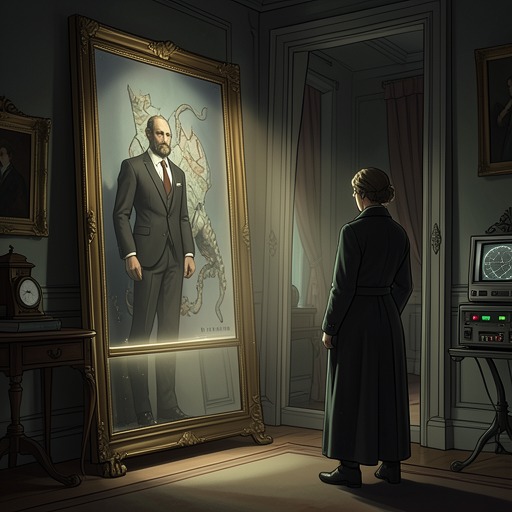
Paul Carpenter–Rosacrucia relationship
The Portable DoorPaul Carpenter’s relationship with Rosacrucia (Mrs Tanner) is defined by a struggle over who gets to decide what he wants. She alternates between teasing confidante and coercive influence: she needles him about Sophie Pettingell, offers warnings when he is vulnerable, and ultimately becomes the focus of an imposed declaration of love. Paul’s responses expose both his continuing attachment to Sophie and the danger of treating desire as something another person can arrange for him.
Identity and Uneasy Introduction
Rosacrucia first approaches Paul during a lunch break, explaining that she followed the same route he had taken and slipped through after him. Their meeting is not presented as an ordinary encounter: she already knows about the passage he used and treats her arrival as an opportunity to speak with him. Paul’s attention is divided between her presence and the question he is reluctant to ask, while she answers his uncertainty with a smile and makes him state what he means.
Her identity sharpens the imbalance between them. Rosacrucia openly identifies herself as a goblin and explains that her attractive human appearance is a chosen form, one she can maintain or change. She even offers to appear blonde instead; Paul declines. Her appearance also exerts an effect beyond their conversation: when she scowls, nearby men still respond to her as exceptionally attractive. The episode makes appearance part of her power, while Paul’s refusal of the offered alternative shows that he is not simply asking her to become more appealing to him.
Sophie as the Point of Tension
Rosacrucia reads Paul’s attention to Sophie as an opening for ridicule. She mocks his longing and characterizes his pursuit as shallow, immature, and desperate, while using disparaging language about Sophie. The teasing is pointed rather than neutral: Rosacrucia knows that Sophie is the person Paul wants, and she turns that knowledge into a way to unsettle him. Her own account of attraction is markedly different. She describes a goblin approach based on selecting a target and pursuing it, presenting decisive pursuit as preferable to Paul’s hesitation even as she acknowledges that her method has not brought her the result she wanted in her own life.
She also uses a small glass globe to show Paul Sophie in an Italian sandwich bar with a man. The image gives him access to Sophie’s present situation, but Rosacrucia controls when and how he sees it. Later, as she walks beside him, she tries to qualify what he has inferred from a kiss on the cheek, pointing out that such a gesture need not mean much. At the same time, she reminds him that the globe showed Sophie with her boyfriend. Her intervention therefore pulls in two directions: she offers a less painful interpretation of one sign while keeping the more troubling image in view. Paul does not answer her reassurance.
Warning and Claimed Help
Rosacrucia eventually tells Paul that she has not come merely to discuss Sophie. Referring to Humphrey Wells’s recent demonstration, she warns Paul to be careful of him and recognizes that Paul was frightened. This moment differs from her earlier teasing: she treats his fear as evidence of sound judgment and offers a warning about an actual danger. She also says that she is trying to help. The claim sits beside her earlier conduct, however, including the deliberate display of Sophie’s image and her dismissive treatment of Paul’s feelings. Her role as adviser is inseparable from her habit of controlling the terms of the conversation.
Her stated philosophy makes that control explicit. Rosacrucia says she knows what is best for Paul and frames bringing young people together as something she will do whether they agree or not. When Paul objects, she does not treat his reluctance as decisive. Instead, she presents his uncertainty as the problem she is entitled to solve. The difference between assistance and interference is central to their relationship: she may recognize his distress, but her notion of helping leaves little room for his consent.
Imposed Attachment and Resistance
The sharpest reversal occurs when Paul encounters Rosacrucia again and initially recognizes her as the older woman he remembers. Her face then appears to him as extraordinarily beautiful, and his response changes abruptly. Rosacrucia acknowledges that she has affected him; Sophie is beside her with a paper bag over her head, which Rosacrucia removes after explaining that she had struck Sophie only hard enough to keep her out of the way. Paul’s surroundings are otherwise occupied, but the central fact is intimate and direct: he knows what he intends to say and instead tells Rosacrucia that he loves her.
Rosacrucia welcomes the declaration and asks him to repeat it. Paul does, but the scene does not establish a freely chosen change of affection. When she insists that he cannot resist and that this is what he has always wanted, he answers that it is what he wanted before, but not anymore. His speech remains entangled with the influence acting on him, and his replies about Sophie become confused and contradictory. Still, the distinction he makes between an earlier desire and his present refusal matters. The episode presents his declaration not as a settled choice but as a moment in which his capacity to express one is compromised.
The Relationship’s Significance
The contrast between Rosacrucia’s language of matchmaking and Paul’s experience gives their relationship its defining tension. She treats attraction as something that can be targeted, displayed, and redirected; the J.W. Wells & Co. business around the JWW Valentine Express Love Philtre makes that treatment of love part of a wider magical commerce. Elsewhere, the philtre is described as producing permanent devotion, and its covert application is offered as a service. That context makes Rosacrucia’s assertion that she can decide what is best for Paul more than a comic provocation: the story repeatedly distinguishes affection from an attachment imposed through supernatural means.
Rosacrucia is not shown only as an antagonist. She recognizes Paul’s fear of Humphrey Wells and offers practical warning, and she can speak candidly about her own choices. But these moments do not cancel the pressure she applies to Paul or her willingness to act on Sophie without her agreement. Their relationship consequently remains unstable: Rosacrucia claims the role of helper and matchmaker, while Paul’s resistance insists that wanting Sophie, being made to declare love, and choosing freely are not the same thing.