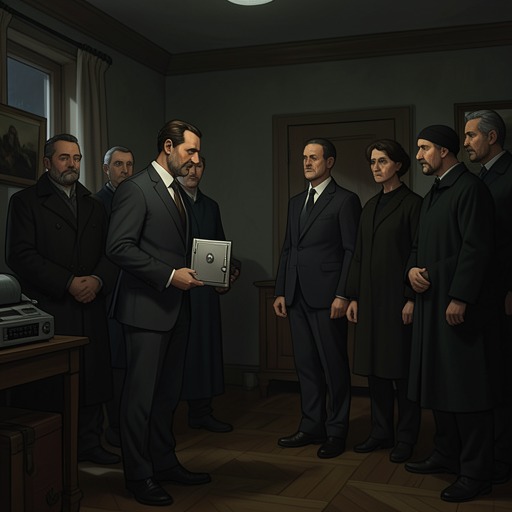
Paul Carpenter’s temporal displacement
The Portable DoorPaul Carpenter’s temporal displacement is an accidental journey into his own recent past, caused by a careless passage through the J.W. Wells portable door. Its importance lies not only in revealing that the door can move through time as well as space, but in making Paul confront the difference between revisiting events and being able to control them: the past becomes repeatable in outline, yet resists his efforts to reproduce or revise it.
Accidental Crossing and Temporal Mechanism
The displacement begins during a minibus journey, when Paul notices the portable door still in its cardboard tube in his jacket pocket. With Sophie Pettingell and the other passenger asleep, he decides that a short diversion might relieve the monotony of the ride. He considers destinations such as Florence or Acapulco, but crosses the threshold without firmly settling on one. That omission, which he later recognizes as carelessness, is the immediate cause of the unexpected result.
Instead of emerging somewhere distant, Paul finds himself back at his own office at 70 St Mary Axe. He initially means to return through the door, only to discover that it has vanished. He had failed to wedge it open before crossing; the movement of the bus had jarred it shut. The episode therefore combines two kinds of displacement: the door has carried him through time as well as space, while the vehicle’s movement has cut off the route by which he expected to return. The journey is not a planned experiment, and Paul does not yet know how to select its temporal destination.
Recognition and Repetition
Paul realizes that he has arrived on the previous day when Sophie refers to the Mortensen sheets. He understands that, at this point in the earlier afternoon, she has not yet attended the conference-room meeting or heard Dietrich Wurmtoter explain the Mortensen Counters. When he asks what day it is, Sophie says it is Wednesday. Her surprise at his odd behavior makes clear that, to her, this is an ordinary encounter; the temporal anomaly is Paul’s knowledge, not a shared experience.
He responds by trying to reproduce the day as he remembers it. Fearing that a deviation might alter events, he attempts to recall every word and action and repeat them in the same way. The effort proves impossible: exchanges do not reliably produce the replies he expects, and remembered cues fail to arrive. Even Dietrich Wurmtoter’s lecture differs. It is shorter, and instead of warning the employees about Xavier Distortions, he speaks about Ehrlichmann Paradoxes, including the possibility of meeting oneself at one’s own funeral. The altered lecture gives the repeated day a strange doubleness: Paul recognizes its broad shape, but cannot make its details conform to his recollection.
The portable door remains in Paul’s pocket, although he remembers having forgotten it at that point in the original sequence. That discrepancy sharpens his anxiety about changing events. He nearly breaks down, then works out that the door must have sent him not only to another place but to an earlier time. Recognition offers an explanation, not mastery: he can identify what happened, but the passage gives him no reliable method for controlling when or where the door will take him.
The Temptation to Revise the Past
Once the shock gives way to cautious excitement, Paul imagines using temporal travel to edit the humiliations and mistakes of his life. One possibility is to return to the time before he applied for a junior clerk’s post at J.W. Wells & Co. Another is to intervene before Sophie met the man Paul calls Pot Boy, hoping to prevent her heartbreak. He also entertains the wish to return to the day before his interview while losing his memory of having met her. These are fantasies of correction, but each depends on a degree of precision or control that the episode has not shown him how to achieve.
His speculation about Sophie also exposes the limits he senses in such a plan. Preventing one meeting would not determine whom she might meet instead; the person she would not fall in love with cannot be selected simply by changing the circumstances around her. Paul concludes that the door cannot settle the question of who he is, regardless of where or when he happens to be. In this way, the displacement makes time travel less a clean escape from regret than a pressure test of the desire to revise one’s life: changing the route does not necessarily change the person making the choice.
Return to the Journey
Paul’s response to the repeated day eventually becomes practical rather than speculative. On the bus, he remembers that he had missed his stop the previous day while daydreaming and had then walked home through driving rain. This time he gets off at the correct stop, accepting that the long walk will have to be repeated. The small correction contrasts with his grander fantasies of rewriting his past: he can alter a choice in the immediate sequence, but cannot erase the memory that tells him what happened before.
At six the next morning, Paul is again at 70 St Mary Axe, where Sophie is waiting. He has spent much of the night reconstructing their strained, awkward conversation and must endure it again with full knowledge of what is coming. On the following minibus journey, the difference is smaller but telling: Sophie reads Slipware Against Franco for twenty minutes, while Paul notices his fatigue and falls asleep. He has no apparent urge to use the door. When the vehicle arrives, Sophie wakes him with a gentle kick to the ankle, and he jumps up so quickly that he nearly hits his head on the roof. The account thus ends the episode not with a mastered power or a rewritten romance, but with Paul back inside the ordinary journey, carrying knowledge of the repetition without yet possessing control over it.