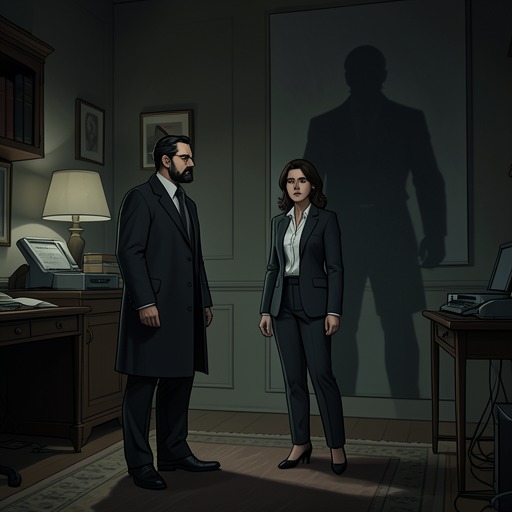
Paul and Sophie’s Destined Pairing
The Portable DoorPaul and Sophie’s Destined Pairing is the emerging idea that Paul Carpenter and Sophie Pettingell were meant to find not only the keys hidden in the swords, but each other. The story gives that apparent destiny a practical counterpart: Dennis Tanner admits to arranging their meeting and hiring, while John Wellington Wells credits him with sending the swords. Yet neither account confirms who concealed the keys or fully explains what makes the pair uniquely suited to the task. The result is a deliberate tension between fate and orchestration, with the couple’s connection both recognized by others and still partly mysterious to themselves.
The Pairing and the Keys
At the point when the idea becomes explicit, Paul and Sophie are trying to open a portable door with two keys recovered from swords. The second sword gives up its key as readily as the first had, and Paul checks that the keys fit the door’s two locks. Before turning them, he raises a possibility: Humphrey Wells did not put the keys in the swords; someone else did. His explanation is a theory, not a solved fact. He suspects that one person arranged for each of them to receive a key and hid them where Humphrey could not get them, so that the pair would have to retrieve them together.
The mechanism gives the romantic idea a concrete form. One key belongs to each person’s part in the discovery, and neither alone completes the task: the two keys fit separate locks, and Paul and Sophie have jointly recovered them. This does not prove that their relationship was designed in advance, but it makes cooperation part of the evidence from which Paul draws his conclusion. Their pairing is presented not simply as attraction, but as a connection bound up with a shared piece of work and an obstacle that required both participants.
Sophie points out the apparent difficulty in calling this destiny: they had only recognized their feelings earlier that day, although they had possessed the swords for a long time. Mr Tanner’s mum counters that their interest in one another had been obvious to her for weeks. Paul goes further than either of them, proposing that the connection reaches back beyond their recent realization and that they were somehow destined to find both the keys and one another. The differing time frames matter. Their conscious recognition is recent; their observable closeness, in Mr Tanner’s mum’s judgment, is not; and Paul’s larger claim remains an interpretation rather than a confirmed history.
Dennis Tanner’s Part in Bringing Them Together
John Wellington Wells later supplies a substantial human explanation for how Paul and Sophie came to share a workplace and a chain of unusual events. He recalls that Dennis Tanner insisted on hiring them when Humphrey Wells argued against it. Dennis pushed the other partners to change their minds and overrule Humphrey, and John suggests that Dennis already believed the two newcomers were the people who would set matters right. John also attributes the delivery of the swords to Dennis and says that Dennis stage-managed the encounter that brought Paul and Sophie together on the evening Paul bought a frozen pizza.
Those details give the idea of a destined pairing a history of deliberate intervention. Their meeting and employment were not merely coincidences in John’s account: Dennis acted to secure both, and the swords later gave them a shared route into the key-bearing mystery. John jokingly casts Dennis as a matchmaker, but his recollection also assigns him a practical purpose. He says Dennis wanted the two young employees in place because they could correct what had gone wrong. The romance and the work therefore converge in the same arrangements, without the evidence establishing that Dennis understood every consequence of what he set in motion.
Dennis offers his own explanation, which qualifies John’s. He says that insisting on their hiring was self-defence, because he wanted Humphrey to stay away from his mother. He also maintains that Paul and Sophie were right for the job: both were natural fits, a fact he believes the firm’s more powerful practitioners failed to see. His account does not erase the interventions John describes; it gives them a personal motive alongside a professional judgment. Dennis acknowledges his role in getting them hired while declining to explain fully what he recognized in them.
Evidence, Inference, and Unanswered Questions
The strongest confirmed strand is Dennis’s orchestration of the hiring and first meeting, together with John’s assertion that Dennis sent the swords. The claim about who placed the keys is less certain. Paul guesses that whoever arranged for each of them to receive a key also hid the keys from Humphrey, but the scene does not identify that person. Nor does John’s account, as presented here, state that Dennis concealed the keys. The two strands may belong to one design, as Paul suspects, but the text leaves that connection open.
The motive behind Dennis’s confidence is similarly withheld. When Sophie asks what was so obvious about the pair, Dennis refuses to spell it out, telling them instead that they can work it out for themselves. His refusal confirms that he sees a quality or connection in Paul and Sophie that others missed, but it does not name that quality. His description of them as naturals and John’s belief that they could set matters right support the sense that their suitability extends beyond ordinary office hiring; they do not provide a complete explanation of their abilities or of why the two belong together.
Narrative Significance
The pairing draws force from the overlap between a supernatural pattern and ordinary human choices. The keys appear to have been hidden so that two people would need to find them together, while the couple’s arrival at the firm depends, in John’s account, on Dennis’s interventions. The story does not settle whether destiny arranged the practical circumstances or whether a perceptive organizer made events look destined. Instead, it sets Paul’s intuition beside the evidence of Dennis’s actions and leaves the reader with a design that can be read in both ways.
That uncertainty also shapes how Paul and Sophie understand their relationship. Other people recognize their closeness before the pair fully acknowledges it: Mr Tanner’s mum says it had been apparent for weeks, and Dennis assumes they can recognize what he saw. Paul’s suggestion that they were destined to find each other gives those observations a larger meaning, but his embarrassment and brisk attempt to minimize the claim show that he is not presenting himself as certain. The pairing is thus both a plot arrangement and an unfinished recognition: their joint role is increasingly clear, while the reason for it remains for them—and the reader—to discern.