Paul’s home
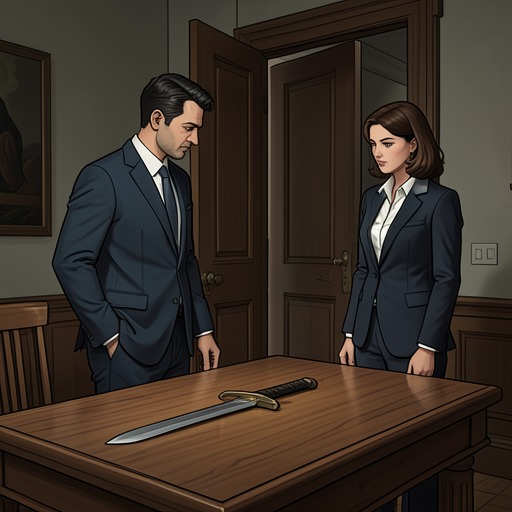
The Portable DoorPaul’s home is a bedsit in Kentish Town, recognisable through practical, unremarkable details: a bed, a table, a mantelpiece, a candle, and a keyring. Its decisive significance is the contrast between that ordinary domestic setting and the impossible things that gather there. The sword in the stone stands among the furniture like an intrusion from legend; later, the familiar room itself seems to have changed into a Victorian interior with no door. Home is both Paul’s refuge from the strangeness of J.W. Wells & Co. and one of the places where that strangeness becomes impossible to ignore.
The Bedsit and Its Ordinary Objects
When Paul comes home after a working day, the sword in the stone is still in his room. Its presence punctuates his attempt to make sense of the day’s concentrated weirdness: he considers Professor Van Spee’s uncanny observations, then tries to accept a mundane explanation rather than investigate further. The sword brings his attention back to the evidence he would rather set aside. Although his balance has come in and he is solvent, the familiar domestic scene does not settle the questions raised by work; the object remains there when his thoughts return to it.
The sword’s inscription gives it a deliberately grand promise: whoever draws it will be the rightful king of all England. Beneath that, a smaller instruction asks for the stone to be disposed of tidily after use. The gap between national destiny and housekeeping makes the object an emblem of the book’s comic collision between legendary matter and everyday life. At Paul’s home, a supposedly world-changing test occupies the same space as ordinary furniture, while its practical afterthought punctures the grandeur.
The room also serves as a private counterpoint to Paul’s workday. At night, he sees the sword’s blade reflect the light back at him and thinks that life at the magical firm, however strange, is less bewildering than being human. The thought places the home at a threshold: it is where he returns from the office, but it does not simply restore a stable division between an ordinary outside world and a safe private one. The sword carries the day’s unresolved weirdness across that threshold.
The Room Becomes Unfamiliar
On a rainy return, Paul finds the hallway dark because its bulb has gone. He is soaked, and his coat has been left at St Mary Axe. Inside the bedsit, he cannot find the light switch, though he remembers unlocking the door and still has his keys. Rather than assume immediately that the room has changed, he feels along the wall for the candle and matches on the mantelpiece. He remembers to sidestep where the sword should be, and finds the candle and matches exactly where he left them.
The candle reveals a room that is at once his and not his. Its bed, table, window, damp patch, candle, and sword correspond to his own possessions and surroundings, yet the room has the appearance of an earlier, Victorian-era version of itself. The uncanny change does not replace the home with an unrelated setting; it makes the familiar space look as though its history has surfaced over its present. Paul recognises the room through its objects even as their altered setting unsettles that recognition.
The most consequential alteration is architectural. When Paul turns to leave, the door is gone. The window will not open; its glass is frosted, and even a heavy bronze bust of Prince Albert cannot break it. The episode turns domestic furnishings into failed means of escape: the window resists, the bust bounces back, and the route Paul expects to use no longer exists. What had seemed a comfortable room becomes a closed space whose familiar appearance offers no practical security.
Return, Recurrence, and the Sword
The room’s Victorian version is described as comfortable and improved in several respects: a fire replaces the old gas fire, oil lamps replace the harsh bulb, and polished wood and fabric replace cheap flat-pack furniture. Yet these apparent comforts sharpen the problem rather than solve it. Warmth, attractive furnishings, and a homely character cannot compensate for the missing door. The contrast makes the room’s danger structural: the issue is not that the interior looks hostile, but that Paul cannot leave it by the ordinary means available to him.
A man in the strange room eventually takes Paul by the wrist, and Paul wakes in bed in his pyjamas. For a moment he thinks the man may still be standing over him, but the shape against the window is the sword in the stone. He says the word door, gets out of bed, and finds the door where it should be. He tests the latch and opens and closes it several times. The repeated check makes the restored doorway a concrete relief: the ordinary mechanism that had vanished is once again dependable.
The sword’s continuing presence links the home’s everyday reality to the room’s impossible transformation. It is there after Paul returns from work, and it is there in silhouette when he wakes from the doorless episode. Later, Paul and Sophie discover that a sword blade can conceal a key: when they draw one smoothly from the stone, its blunt, ridged tip resembles a key’s wards, and Paul breaks off the brittle key portion. This later discovery extends the sword’s role beyond a legendary challenge. The object associated with Paul’s home also belongs to the practical chain of magical locks and tests, where an apparently symbolic blade can prove to contain a usable key.
Domestic Space and the Wider Story
Paul’s bedsit matters because it makes supernatural disruption intimate and measurable. At the office, weirdness belongs to the strange routines and objects of J.W. Wells & Co.; at home, it touches the candle, the light switch, the window, and the door. The episode’s movement from misplaced switch to inaccessible exit makes the crisis unfold through ordinary expectations about how a room works. Familiar objects first help Paul orient himself, then fail to restore his control over the space.
The home also gives the novel’s legendary and folkloric material a distinctly domestic frame. The stone’s royal inscription and its tidy-disposal instruction coexist; later, a blade proves to contain a key. These reversals make the room more than a backdrop for Paul’s private life. It is a place where apparently separate categories—household furniture and magical apparatus, everyday routine and old legend—meet, and where an object’s significance can change as Paul learns how to read it. The home’s importance lies less in escape from the supernatural than in its recurring demonstration that the supernatural has already entered the ordinary.