Wellington and Wells boardroom
The Portable DoorThe Wellington and Wells boardroom is the setting for the novel’s final confrontation with Humphrey Wells and the inquiry that follows it. Its mirror-polished table is more than a marker of corporate authority: its reflective surface reveals John Wellington Wells concealed as a stapler, enabling Paul Carpenter to help free him. The room then changes from a trap into an investigative forum, where John questions the partners about possible complicity in his nephew’s plot.
The Boardroom as a Site of Confrontation
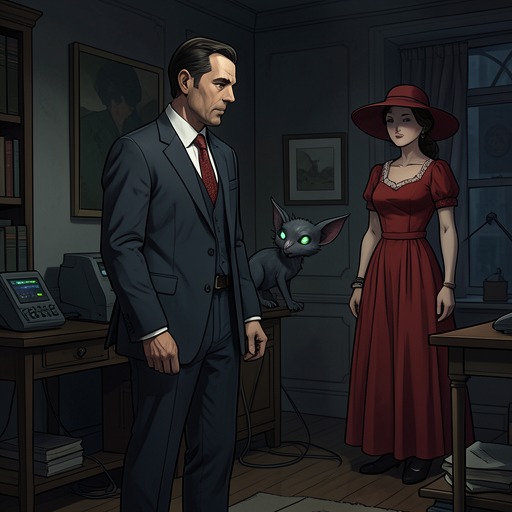
Paul, Sophie Pettingell, Arthur, Pip, and Mr Tanner’s mum do not simply walk into the boardroom. After a voice in the corner advises caution, the world spins around them; when the motion stops, they are standing beside the mirror-polished table as Humphrey advances in a conjuror’s cloak and hat, holding a saw. The abrupt displacement brings the group directly into danger and makes the boardroom a stage on which Humphrey can dictate the terms of the encounter.
Humphrey’s threat is personal as well as physical. He explains that the group interfered in matters beyond their business, and singles out Paul Carpenter and Sophie Pettingell after they have discovered what he describes as their shared happy ending. He takes the bottle of golden love potion from Sophie’s handbag and prepares to use it to make her fall in love with Pip. The room’s formal, polished character contrasts with this intimate magical coercion: the boardroom is not a neutral setting for business but a place where Humphrey turns the company’s authority and resources against those who have challenged him.
The Reflective Table and John’s Release
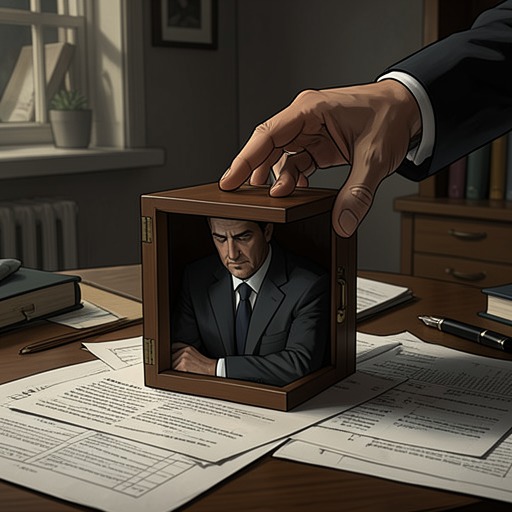
As Humphrey prepares the potion, Paul looks away, then notices the familiar long stapler on the table. He recognizes the significance of its reflection because Ricky Wurmtoter previously explained the table’s ability to reveal an imp’s true form. The reflected image is not merely an inverted stapler: it shows a small, bald man in a black frock coat and grey striped trousers, crouching and waving. Paul identifies the hidden figure as John Wellington Wells, whose apparent absence from the firm has concealed a much more literal imprisonment.
John gives Paul an instruction inside his mind: when the spell breaks, Paul is to lay the chain over the stapler. The ropes binding Paul abruptly give way, and he falls forward, reaching for the gold chain as Humphrey turns with a sword raised. Paul flicks the chain toward the table. It strikes the stapler and wraps around it; a flash of blue light follows. Humphrey drops his sword and crashes against the wall as John steps down from the tabletop. The table’s reflective surface has made the concealed prisoner visible, while the chain turns that recognition into action and reverses the balance of power in the room.
John’s return alters the boardroom’s atmosphere at once. He thanks Paul, then clicks his fingers. Mr Tanner’s mum acquires a rose-madder silk dress, Arthur and Pip fall from their chairs, and a large snake coils around Humphrey until almost all of him is hidden. Sophie, whose head falls forward, snores; John spits out staples, and the empty potion bottle rolls across the floor. The room holds the material aftermath of the spell as well as the change in authority: Humphrey is restrained, John is restored, and the potion’s intended effect has been interrupted.
From Showdown to Inquiry
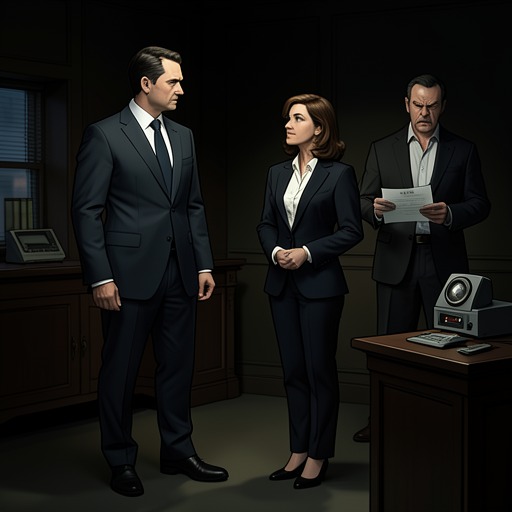
Later, the boardroom receives a wider gathering. John enters with Professor Van Spee, Casimir Suslowicz, the Contessa di Castel’Bianco, Ricky Wurmtoter, Pip, and Mr Tanner; Paul and Sophie, who have jumped up looking guilty, are also told to sit. John produces a paper bag taken from Paul’s desk. It contains dragon droppings, which enable a person to hear what others mean rather than merely what they say. The same room that hosted Humphrey’s deception now becomes the place where John seeks to establish what happened and who else may have been involved.
John says that, based on his observations while transformed into a stapler and what he has heard since returning, Humphrey may not have acted alone. Another partner, he suspects, either joined the plot or knew about it and failed to act. His proposal to have Paul and Sophie eat the dragon droppings rather than question the partners himself is presented as a way to avoid doubts about his own impartiality. Their unfamiliarity with the partners’ private interests, he argues, makes them more credible truth-finders. The uncomfortable silence that follows, as those assembled look at the floor or their folded hands, gives the suspicion a visible consequence before anyone answers it.
The investigation proceeds through the partners in turn. John says Ricky can be excluded because he joined the firm long after John disappeared. He then addresses Professor Van Spee, acknowledging their mutual dislike and asking whether Van Spee had plotted against him. Van Spee says he had genuinely believed John was dead, while also expressing, with grave irony, how much he would have enjoyed killing him. John next turns to Countess Judy, recalling her arrival in the chorus in the early 1870s and voicing distrust of her character. The conversation makes the boardroom an arena for old rivalries as well as evidence-gathering: the inquiry is shaped by personal histories, but John attempts to distinguish suspicion from proof.
The Room’s Narrative Function
The boardroom’s two principal uses are linked by its table. During the confrontation, the tabletop’s unusual reflection discloses a hidden identity and gives Paul the clue needed to act; during the later gathering, the table is the shared surface around which the partners face questioning. In both scenes, what appears on the surface is insufficient. A stapler reflects a man, and a company meeting becomes an inquiry into what its members know and conceal.
This change of function also marks the shift from Humphrey’s private control to John’s public attempt to restore order. The boardroom first contains an ambush, a threatened enchantment, and a rescue; afterward it holds the uncomfortable scrutiny of the partners. The room does not itself settle the firm’s internal suspicions, but it provides the setting in which concealed identities become visible and questions of responsibility can no longer be kept outside the company’s formal space.