Bronco Henry
The Power of the Dog (Thomas Savage Edition)Bronco Henry is a mostly offstage cowboy whose influence reaches far beyond his few appearances in the novel: he teaches Phil Burbank practical skills, supplies the standard by which Phil measures the Old West, and remains the central figure in Phil’s concealed emotional life. The account of him arrives piecemeal, through stories and memories, until the novel reveals that Phil’s devotion to his mentor was bound up with love, loss, and the pressure to conceal his sexuality.
Identity and Reputation
Bronco Henry is remembered as an exceptional rider and cowboy, but the novel does not give him a sustained physical portrait or an independent narrative voice. His character takes shape through what Phil remembers and tells other people. Phil presents him as the finest of cowboys, and his repeated return to Henry’s exploits gives the dead man an importance disproportionate to the few times he is directly mentioned. The reader encounters not simply a record of a skilled ranch hand but a memory polished into an ideal.
The reputation is not based on an image of effortless mastery. Phil says Henry came to the region knowing little about riding or roping and did not begin either practice until he was about Peter Gordon’s age. In Phil’s telling, Henry learned through courage and patience, qualities that could overcome an unpromising beginning. The contrast matters: the ideal cowboy is not born fully formed but becomes capable through sustained effort. Phil uses Henry’s example to encourage Peter, while presenting his own hard-won expertise as part of a tradition passed between men.
Skills and the Work of Teaching
Rawhide braiding is one of the clearest links between Henry and Phil. Henry taught Phil the craft, and Phil later braids in homage to Henry and another teacher, Joe. For Phil, the work carries more than practical value: it makes teaching visible in the object itself, as one person’s knowledge is taken up and continued by another. He thinks of human character as similarly woven from separate strands, sometimes well and sometimes badly. The comparison gives the braided rope a place in the novel’s account of inheritance, where skills and habits survive their teachers.
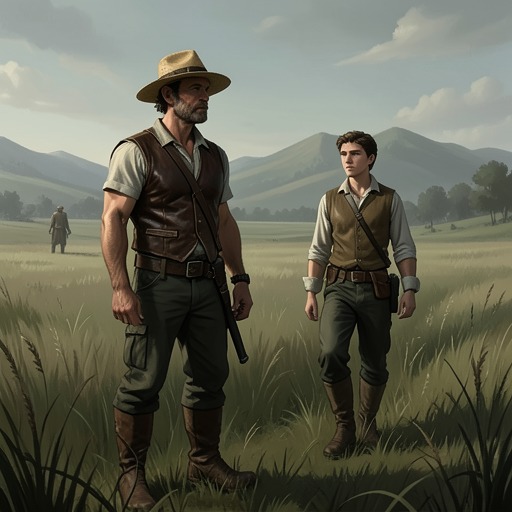
Riding and roping also anchor Henry’s remembered example in ranch work rather than legend alone. Phil recalls Henry’s delayed start as proof that training demands patience, and he draws on that lesson while helping Peter learn to ride. Phil gives Peter a gentle bay horse and rides with him through the fields; they build pole fences around haystacks, eat lunch together, and talk about Henry. In this everyday instruction, the absent cowboy serves as a third presence: Phil teaches Peter by repeating and adapting what Henry taught him.
Phil’s stories also enlarge Henry’s stature through exceptional episodes. He tells the ranch hands that Henry, sick with fever and forty-eight years old, once made what Phil considered one of the prettiest rides he had ever seen. On another occasion Phil remembers riding beside Henry twenty-five years earlier. Repeated in different settings, these recollections make Henry both an example of seasoned skill and a companion located in a past Phil cannot recover. Phil’s memory is admiring, but it is also selective: the stories keep Henry near while exposing how much of Phil’s life is organized around what has disappeared.
Phil Burbank’s Attachment and Loss
Henry’s importance to Phil is emotional as well as professional. A late revelation establishes that Henry died in an accident involving a horse while Phil, then twenty, watched from the rail of a corral. Phil’s anguish at the memory and his recurring stories show that the death did not become a settled episode in his past. His recollections return with particular force when the present disappoints him or when he fears that alcohol might loosen his control over what he says. He is reluctant to drink because he fears what he might disclose, suggesting that the memories are bound to feelings he habitually keeps unspoken.
The novel also makes clear that Phil’s attachment involved more than admiration. Its retrospective account indicates that he desired Henry and may have loved him; recognizing his own homosexuality placed Phil in conflict with the hostile masculine code of the cowboy world he inhabited. The narrative connects this pressure to Phil’s deliberate cultivation of a rough, conventionally masculine identity and to his hostility toward men perceived as insufficiently masculine. Henry’s death is a profound loss, but it is not offered as a complete explanation for Phil’s cruelty. His defense against exposure and judgment belongs to the social world that shapes him as well as to his private grief.
Memory, Mentorship, and Narrative Significance
Phil’s recollections do not establish every detail with equal certainty. While remembering the brass bands and fireworks of his youth, he wonders whether a celebration on U.S. Independence Day (July 4) was when he first saw Henry. Elsewhere, a story about initials and a date carved on a cliff leads Phil to speculate that a traveler from the Lewis and Clark expedition made them; he then recalls finding piles of stones that appeared to lead somewhere but says he never followed them to the end. These fragments show how Phil turns landscape and memory into stories, even when the connection remains conjectural. Henry is part of that process: the past is recovered through anecdotes, not presented as a complete biography.
The most consequential withheld fact is that Henry was the first to see the running dog shape in the landscape. This revelation, delivered near the end, makes Henry not only the source of Phil’s craft and cowboy ideals but also the original observer behind an image that has carried meaning through the book. Its late arrival changes the weight of the earlier memories: what first seemed like scattered praise now points to a deeper inheritance of perception. Henry remains largely absent, yet his skills, example, death, and way of seeing help explain both the identity Phil performs and the vulnerability he struggles to hide.