Burbank Ranch
The Power of the Dog (Thomas Savage Edition)Burbank Ranch is the largest ranch in its Montana valley, a working cattle operation whose household and labor system are organized around the partnership of brothers Phil Burbank and George Burbank. Located in southwestern Montana near the shipping town of Beech, the ranch joins an expansive working landscape to a large family home. Its routines reveal the brothers’ different forms of authority, the seasonal organization of hired labor, and the social boundaries of the valley in which the ranch stands.
Location and Ownership
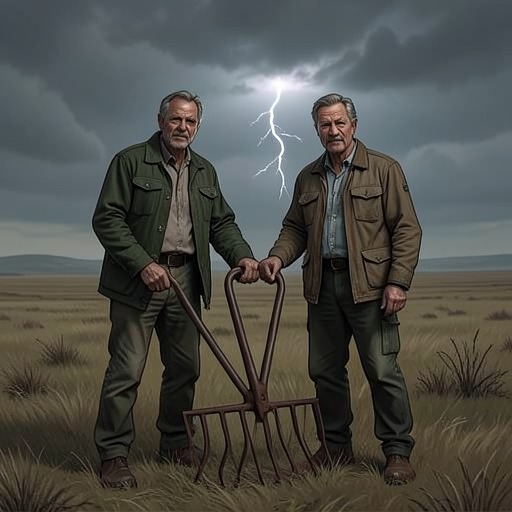
Burbank Ranch lies near Beech, where cattle can be shipped, and occupies a position of economic importance in the valley. Phil and George are not merely business partners: they are brothers and joint owners of the biggest ranch in the area. When the story opens in 1924, Phil is forty and George thirty-eight, and the two still share a bedroom, as they have since childhood. The arrangement joins adult business life to a family habit that has endured into the present.
The ranch had been operated for many years by their parents, the Old Gentleman Burbank and the Old Lady Burbank. Moneyed easterners, they maintained a relatively luxurious life there before retiring to a suite in a Salt Lake City hotel. The account notes an undescribed contretemps with Phil as the circumstance preceding their departure, leaving the sons to run the property. Their withdrawal marks a generational change in management, though the ranch remains the family’s central institution.
The House and Its Landscape
The ranch house is built of huge logs and appears, from a distance, like a small California bungalow enlarged beyond its apparent proportions. Its half-story contains a bathroom and six large bedrooms, with sloping-ceiling closets where the family’s accumulated belongings collect. A broad porch extends under the roof. The house is thus both imposing and crowded with the residue of long occupation, its spaces combining domestic comfort with the practical disorder of a ranch household.
The view from the house places that domestic world against the open country. From a dormer window, Peter Gordon looks across the roof toward Sagebrush Hill, where a bird or cottontail may be the only visible movement. The elevation also delays the sun’s arrival at the windows. These details make the ranch more than a backdrop: its scale, distances, and surrounding wildlife shape the ordinary limits of what its inhabitants see and do.
Rose Gordon Burbank’s first entrance into the house gives the domestic setting a different charge. She and George arrive from a winter afternoon; after George puts his Reo in the garage and returns with their suitcases, Rose enters ahead of him and finds Phil standing in the middle of the room. The scene establishes the house as a shared family space in which the new marriage must immediately meet Phil’s presence. Later, George arranges for a piano to be brought to the ranch. The delivery involves a hired trucking crew and local help, and George works alongside the men as they carry the instrument up the front steps and assemble it inside. Phil stays in his bedroom during the work, a contrast between George’s participation in the household’s new undertaking and his brother’s withdrawal from it.
Management and the Annual Work Cycle
The brothers’ responsibilities are divided rather than interchangeable. George keeps the books, communicates with buyers, writes letters, answers the telephone, and maintains the Reo. Phil oversees the physical organization of ranch work: he inspects equipment, directs haying, determines when irrigation water should be diverted from the main creeks, watches the crop’s growth, and sets the start of the haying season. Their arrangement gives George a visible administrative role while Phil’s authority is expressed through equipment, land, and the timing of labor.
The scale of Phil’s preparations is specific and extensive. Before haying, he inspects eight mowing machines—four John Deeres and four McCormack-Deerings—along with six buck rakes, six sulky rakes, two derricks, the cookshack, and the dining shack. He also has twelve large canvas tents taken from storage and checked for damage. These mobile facilities allow the workers’ camp to move with the job. Phil sets haying to begin as soon as possible after the Fourth of July, aligning the ranch’s central seasonal operation with the agricultural calendar.
Haying depends on skilled, temporary workers and carries practical risks. Eight men drive the mowing machines, two-wheeled rigs whose long cutter bars are lowered to cut the crop. Because the equipment is dangerous and the horses may be difficult to handle, the machine operators receive extra pay and a degree of deference: their tents are newer, their opinions receive attention, and they choose the finest steaks first. The hierarchy is not merely ceremonial; it recognizes the specialized skill and hazards of their work.
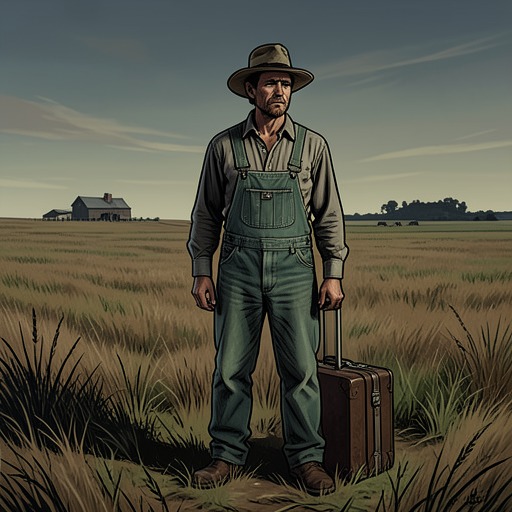
The ranch’s yearly rhythm also depends on the movement of itinerant hands. The Fourth of July provides a brief interval of celebration before the ninety-day haying season. Some workers arrive after being detained by the law as vagrants; others reach the ranch by stage, hitching rides, or walking from Beech. Their arrival carries them from town festivities into a demanding stretch of work. The transition shows how the ranch draws on mobile labor while organizing that labor into a disciplined seasonal operation.
Work, Skill, and Ranch Culture
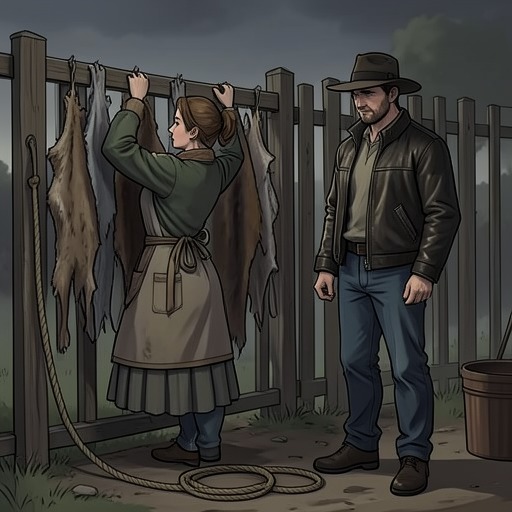
Ranch life values practical competence, but its standards are not uniform. The cowboys commonly wear horsehide gloves to protect their hands during tasks such as roping, fencing, branding, hay work, and riding. Phil refuses that protection and scorns the men who use it; his hands are described as lean and powerful. The contrast turns a small item of work clothing into a measure of competing ideas about toughness. The men’s gloves are also part of a wider material culture: they order them from mail-order catalogues, sometimes struggling with written forms and numbers and asking a more educated coworker to complete them.
The division of labor extends beyond the brothers’ formal duties. George is willing to undertake work that he believes should not be imposed on another man, including cleaning the cesspool. Rose watches him perform the task from the dining-room window, with the Rocky Mountains rising behind him. The episode sets the household’s ideals of responsibility against the physical maintenance that sustains it: the ranch depends not only on skilled management and seasonal crews but also on unpleasant work that someone must accept.
Phil and George’s connection to the land also takes the form of shared recreation. Each October, when creekside willows turn red and haze from distant forest fires hangs over the mountains, they ride toward the mountains with packhorses to hunt. They wager on who will spot and shoot the first elk, and Phil particularly relishes elk liver. The annual excursion offers a counterpart to their business partnership: away from buyers and ranch administration, the brothers travel together through the terrain their enterprise occupies.
Historical and Narrative Significance
The ranch stands within a valley whose history includes the forced removal of Indigenous people from their lands. The account describes the last residents being sent to a reservation and the government ceasing to honor treaties once land became valuable and officials feared white voters more than Indigenous resistance. Johnny Gordon witnesses the departing families from his Model-T. Reservation life is presented as constrained by rules against leaving without a permit and by the absence of places to go or people willing to shelter them. This history gives the ranch’s ownership of a large portion of the valley a broader context of dispossession; the evidence does not, however, describe the Burbank family as directing the removals.
Later, an Indigenous father and son attempting to return to ancestral land encounter the ranch’s boundary. Phil tells them to leave, and a gate that one of them does not remember becomes a concrete obstacle in the landscape. Rose later notices their cart again during a thunderstorm. These appearances place the ranch’s authority beside the continuing movement of people whose connection to the valley predates the ranch’s dominance, without resolving that conflict into a settled return.
As a setting, Burbank Ranch brings together a family business, a household, and a labor regime. Its size and wealth coexist with strict divisions of responsibility, the seasonal dependence on hired hands, and inherited patterns of family life. The house gives newcomers a place to live but also subjects them to the established household’s tensions; the working grounds make labor and authority visible; and the surrounding valley carries a history that the ranch’s prosperity cannot erase. The ranch is therefore not simply the brothers’ property but the novel’s central space for examining who belongs, who works, and who has power over the land.