Forced relocation of the valley's Indigenous people
The Power of the Dog (Thomas Savage Edition)The Forced relocation of the valley's Indigenous people is the historical dispossession behind Edward Nappo and his son’s attempt to revisit their ancestral land. The removal is presented not as a single departure but as a change in who could claim land, travel, and sustain a life there: Indigenous families were sent to a reservation, while the government’s observance of treaties gave way to the political and economic interests of white settlers. Its effects continue in the stories Edward tells his son, the rules governing reservation life, and the gate that blocks their return.
Removal and the interests behind it
The last Indigenous people in the valley were driven from their lands and sent away in worn buggies, riding old horses. The narration links this expulsion to a government that no longer felt obliged even to pretend that treaties mattered. Land had become too valuable to be secured through bargains, while officials had less reason to fear Indigenous resistance and more reason to fear white voters. The account thus places forced removal within a struggle over land and political power, rather than presenting it as a neutral administrative decision.
The journey from the valley had a witness in Johnny Gordon, who saw the departing families from the raised seat of his old Model-T. His attention followed them south in imagination to the reservation’s setting in southern Idaho: arid flats, few trees, poor soil, shallow wells whose water smelled of sulfur, and winters when the wind howled and the ground cracked with frost. The contrast between the land left behind and the place to which people were sent makes removal legible as a lasting material change, not simply a change of address.
Reservation rules and constrained life
The reservation’s rules narrowed the choices available to its residents. Liquor could not be sold or consumed, and leaving the reservation required a permit, granted only for a pressing reason. The account notes the isolation underlying that restriction: officials assumed Indigenous people had nowhere to go and no friends who would shelter them. A separate rule prohibited firearms, while meat was distributed through the government store. Taken together, the restrictions governed travel and access to food as well as conduct; the reservation was not represented as an equivalent replacement for the land from which people had been removed.
The Indian agent’s house was neat and white-painted, and he carefully raised and lowered the American flag at the proper times, with his children helping. He is described as not a bad man, but as someone who sometimes enforced reservation rules when officials from the Department of the Interior arrived. This detail places local administration inside a larger system: personal decency does not prevent the enforcement of policies that limit residents’ movement and choices.
Edward Nappo and ancestral memory
Edward Nappo carries the loss through family memory. His small .22 rifle, inherited from his father, is the last possession of his father’s that had not been burned after the older man’s death. Edward’s father had been a chief; Edward believes he would have been chief himself had his people not been sent to the reservation. In his dreams, and in the stories he tells his son, he holds on to a country the boy has never seen. The boy was still unborn when his parents traveled south in the buggy, so his knowledge of the homeland comes through what his father remembers and describes.
Edward’s wife Jennie, who tans deer hides left by white hunters and makes gloves and moccasins, sometimes resists those stories because she fears they will make the boy sad. Edward sees them as something the child needs: a means of imagining and understanding a land beyond the reservation. The narrative shows that memory is contested even within the family, between the pain of keeping the past present and the need to give the next generation a connection to it. In time, Jennie sometimes stays to listen rather than leaving them to talk alone.
When the boy is twelve, a hard winter and the illness of the family’s cow sharpen the stakes of those stories. While Edward and his son tend a fire beside the sick animal, Edward describes the northern land through its summer fields of purple lupine, the calls of killdeers at twilight, and storm clouds moving over the mountains. The boy rubs a ring his father made from a horseshoe nail and suggests running away. Edward knows that a sick cow makes escape difficult, and the homeland he describes is no longer theirs. Their longing is real, but it must contend with both immediate hardship and the political fact of dispossession.
The blocked return
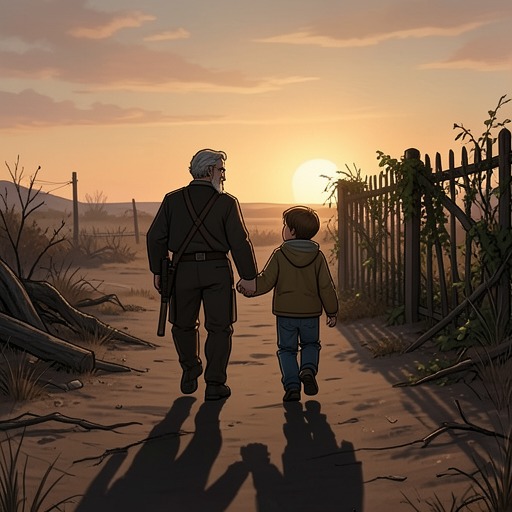
Later, Edward and the boy travel toward the mountains with their old horse. They reach a gate Edward cannot remember, a sign that the country they are trying to approach is now divided by boundaries he does not recognize. Phil Burbank stands between them and the gate. When Edward identifies his father as the chief, Phil says that the family must leave and rejects Edward’s request to stay for a couple of days so the horse can rest. The exchange turns historical removal into a present encounter: Edward’s inherited standing and memory carry no authority against Phil’s control of the ranch boundary.
Rose Burbank later notices the Indigenous cart on the road. She sees the travelers leading the horse, riding in the cart, and then getting out to lead it again near the rise. That brief observation confirms the journey’s physical difficulty without resolving it into a successful return. The gate and the cart frame the continuing consequences of relocation: a family can remember the land, travel toward it, and still be refused passage. The episode connects the broad dispossession of the valley’s Indigenous people to an intimate family history, showing how removal persists through restrictions, inherited memory, and the boundaries encountered by the next generation.